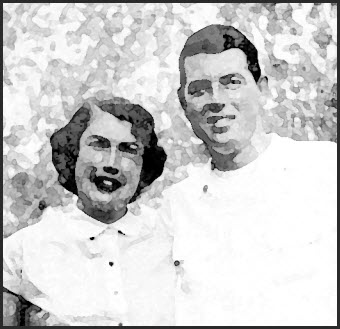

July 12, 2015. Stan arrived at my parents’ home at 9:00 A.M. from Houston, and Mom and I left for the CCH shortly after his arrival. Before Mom and I left the CCH for church, the respiratory therapist stopped by and replaced Dad’s speaking valve with a red cap. Oh my gosh! It was almost like having no trach tube. He breathed normally and he sounded more like his usual self. Dad’s ability to remove his own secretions with the Yaunker would determine when they could decannulate him. If Dad could not handle his secretions, the respiratory therapists would have to remove the red cap and suction him. While we were there, Dr. Smith stopped by and asked if Dad had been in the chair. I just hated knowing that our week with this doctor was about to end.
Stan visited with Dad at the CCH while Mom and I attended church, and then he stayed for another couple of hours while Dad sat in the chair. I was encouraged when Stan told me that Dad did most of the transfer from his bed to the chair, and once he was in the chair, his coughing stopped.
Later in that day, Cassie, the nurse, mentioned that Dr. Smith was considering switching Dad from intravenous to oral antibiotics. Among other things, the oral antibiotics were less harsh on the kidneys. Because Dad could not swallow pills, the oral antibiotics would be crushed and administered through his feeding tube.
 For the past few weeks, Mom and I had been unable to unlock the front door with the house key. Stan had sprayed graphite into the lock and that remedy had worked for a couple of weeks, but we were now back to square one. We didn’t have the time or inclination to fix it, so we just accessed the house from other doors. The front door lock was just an example of life’s little inconveniences that didn’t seem all that important at the time.
July 13. It was Monday, which meant that a new doctor started the week-long rotation, and Dad was scheduled for another 4-5 hours of dialysis. On the positive side, Dad was gaining less weight between dialysis sessions, which meant that they would remove less fluid from his blood. Today they removed only 1,497 ml, far less than the 4,000 ml or more removed only a week or so earlier. The nephrology personnel were cautiously optimistic that his kidneys might be perking up. What they actually said was that they “would watch him closely for a possible sign of recovery.” Dad’s labs that day were a little contradictory. Although his creatinine levels had improved slightly, his WBC count had inched up. It was still well within the normal range, but this was the first uptick that we’d seen in the WBC count in a couple of weeks. Dr. Ciceri, the new doctor, mentioned that Dad seemed to be in good spirits and that he was very conversant. Perhaps I worried too much.
My parents live down the street from Bob Probe, an orthopedic surgeon with Baylor Scott & White, who was now chief of staff for Scott & White Clinic. This morning, while Dad was in dialysis, Mom and I visited with Dr. Probe and expressed some of our concerns about recent events. In particular, we wanted to tell him about my mother’s experiences at the hospital—specifically, her admittance to Scott & White Hospital as Trauma Patient Ohio. We also told him about my difficulty calling 911. Although he had no authority over the 911 system, he had many contacts who he said he would contact. We also shared some of the challenges that we had had with Dad’s care. In our experience with the hospital, we had learned that it was the patients’ responsibility to understand what was happening. We had seen firsthand that the doctors didn’t ensure that the patient could hear or understand what was being said. You’d have to pity the poor person who was admitted without a support system or advocate. As someone who is concerned about new-user experiences, I told him that to navigate the system, new patients and their families needed more information about resources, and perhaps the case managers could come around more often. From what Mom and I could surmise, the hospital personnel who filled this void were the chaplains, and some did it better than others. If the chaplains were the designated go-to resources, it would have been nice to know that on May 6. Dr. Probe said that he appreciated the perspective and the feedback. He took a lot of notes during our meeting, and Mom and I left the meeting under the impression that we would hear back from the good doctor. Spoiler alert: It’s been almost 14 months and we still haven’t heard from him, but hope springs eternal. He might have bigger fish to fry. Since our meeting, Dr. Probe was promoted to Chief Medical Officer of the Baylor Scott & White system.
Following our visit with Dr. Probe, Mom and I went home for lunch. On my way back to Houston, I stopped by the hospital to say good-bye to Dad. He was dozing when I arrived, but woke easily and was pretty talkative. He looked pretty alert, and seemed to be feeling better than he had on most dialysis days. Mom arrived shortly before I left at 2:00 P.M. Soon after I left, Dad said that he was tired and had Mom leave for the day. When he was tired, he could fall asleep in midsentence. Later that evening, Mom tended to the garden and also gave it a good soaking. After all the rain just two months earlier, we were now suffering from a drought. Where rain was concerned, it was either feast or famine in central Texas.
July 14. Dad was alert and in good spirits when Dr. Ciceri visited him during morning rounds. Dad’s vitals were good, and it seemed like it was a perfect day to conduct the MBSS. The swallow study must be administered in the radiology department at Scott & White Memorial. Dad was ferried to the hospital in an ambulance and the test was administered by Holly, his speech therapist during his stay at Memorial. Unfortunately, the test that we had yearned for yielded some disappointing results. In short, he was diagnosed as a high risk for aspiration. They tested him with thin liquids, nectar and honey-thickened liquids, puree, and pudding. Even when swallowing with a chin tuck, he was not successfully swallowing anything but the pudding. Fortunately, Adan planned to continue working with him. The prospect of Dad not being able to eat again was unthinkable.
Dad was pretty tired by the time he returned from Memorial to his room at the CCH. Shortly after he arrived, Jennifer, the physical therapist, arrived for his session. He told her that he felt as though he had already been moving around all morning. Physical therapists tend to ignore such protests from patients, and she proceeded with therapy. Although Dad had some difficulty standing from a chair and the side of the bed, he was able to complete all the repetitions of his exercises and walked a few steps. He did much better when he “walked” in the wheelchair. When she was finished with their session, Jennifer left him in the chair, where he stayed for an hour. Mom was encouraged by all the therapy that he was receiving.
Mom stayed until 5:45 P.M. and was still there when our church friends, Kris and Sue, stopped by after work. They had stopped by once before, but didn’t know the password. I don’t remember ever being told about a password, and unless you visited after 8:00 P.M., the doors opened automatically. Sometimes this place was just weird.
Today seemed like a pretty good day for Dad. I would have felt better about it I hadn’t been so worried about his white blood cell count.
 July 15. During dialysis, Dad told the nephrologist that he wanted to go home. The doctor told him that to be declared dialysis dependent (with End Stage Renal Disease), he had to be hospitalized and on dialysis for a total of 12 weeks. Although Mom and I had heard this news a few days ago, it was new news for Dad and prompted him to start asking questions about billing. The doctor contacted Marty Edens, the social worker, who dropped by to answer his questions. Marty couldn’t answer his specific billing questions, but she was familiar with Medicare and some of Dad’s situation. Dad told Marty that he “can’t imagine being here for six more weeks.” He repeatedly told her that he “made a wrong decision two months ago that put him where he was now.” I was glad that I missed this heartbreaking conversation and the follow-up discussion that Marty had with my parents later that day. My mother then requested a plan for his discharge. Marty told them that she could not give them a time frame regarding recovery, other than that if he continued to need dialysis, he would remain at the CCH until at least August 26, or until the doctors said he didn’t need dialysis, or they declared him to be dialysis dependent.
My exasperated parents then asked her when Adan would be able to come by. They both found some comfort and sense of progress in therapy sessions, especially speech therapy sessions with Adan. Adan stop by, had Dad eat some ice chips, and said that he would stop by tomorrow with some thickened soup for Dad to try.
Jennifer then arrived for their physical therapy session, but Dad was too tired after dialysis to exercise. Before she left, Jennifer said that Dad was now ready for sessions with occupational therapy. They had withheld occupational therapy until he was a little stronger and no longer dependent on oxygen. The occupational therapist judged his prognosis to be fair, based on what he had read in Dad’s chart. His prognosis for just about everything was fair. I was getting tired of this “F” word.
Although Dad’s lab work and his vitals were holding tight, Dr. Ciceri thought that Dad might be somewhat confused, which can be a side-effect of prolonged hospitalization. On a more positive note, during Dad’s dialysis session, only 1,194 ml of fluid was removed, which was considerably less than earlier amounts and left him less fatigued. With Dad’s extra energy, he continually told nurses, doctors, and other providers that he “just wanted to go home.” Up until 71 days ago, my parents had been the poster adults for healthy seniors. They were active, engaged, and in control of their lives. Their current situation left them frustrated and just barely able to tolerate their current situation.
 July 9. Dr. Smith said that in terms of his respiratory status, Dad was doing well. Unfortunately, he still had too many secretions to have his trach tube red-capped. He also said that, although it was still elevated, Dad’s creatinine levels seemed to be dropping. He wasn’t going to make any predictions but thought that Dad might be having some recovery of his kidney function. Wouldn’t that be great!
 Before Mom and I left for the day, Dad told Mom to be sure to give the neighbors some of our cantaloupes. Mom said that she had planned to give them away and would start with our neighbors to the north after we got home.
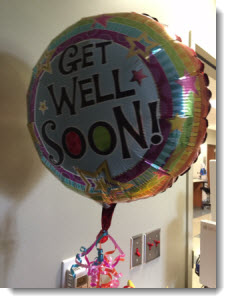
 One of our church friends, Sandra, stopped by and brought Dad a small flag for his room. One difference between this ICU-ish facility and the ICU at Memorial was the policy about flowers. Flowers were not allowed in ICU rooms, but they were allowed here. I had sent Dad an arrangement a few days earlier, and with the flag from Sandra in the center, it looked very festive.
 I was running late and didn’t arrive until 11:00 A.M., so I was surprised to see that Dad was in bed and sleeping, because I was expecting his transfer to be underway. Shortly thereafter, Laura, the case manager, called to say that Dad’s move was rescheduled for 1:00 P.M. I still needed to wrap up some things at work, so I left at noon, and Mom stayed behind.
 The primary rationale for transferring a patient from ICU to a continuing-care facility has to do with the environment—specifically, the light. We were told that that Dad needed exposure to more daylight and to a distinct daytime and nighttime. We hadn’t been at the CCH very long before I started wondering whether anyone from Memorial had ever set foot inside the CCH. Its odd-shaped rooms each had only one small window placed so awkwardly that I couldn’t see how the patient got any advantage from the much-vaunted changes in light.
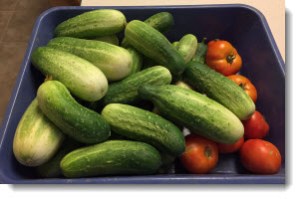
 That night after dinner, Mom and I headed to the garden. I picked the remaining cucumbers and then pulled up the cucumber plants—as directed by my father—to make room for the cantaloupe vines. Mom and I then picked about six dozen tomatoes. This was the summer of the tomato sandwich and the bread & butter pickles. We just hoped that Dad would come home in time to enjoy the bounty of his garden.
 When we arrived at the hospital on Monday, June 15, Dad was upset because the
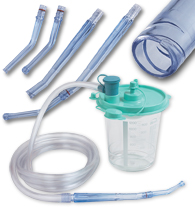
  During the afternoon, Svenja, the Trach Goddess of Scott & White, stopped by and downsized Dad’s tracheostomy tube. She discovered that the current tube was stuck, and she had a little difficulty removing it. Fortunately, removing the tube drew only a small amount of blood, and the new tube was inserted quickly and without any difficulty. The new tube had numerous benefits: it had a smaller outer diameter, a larger inner diameter, and could accommodate the
  As much as he was pleased to talk, he was equally disappointed when the nurse removed the speaking valve. Besides his not being able to sleep with the speaking valve in place, the valve also had to be removed whenever he received any sort of oxygen support.
 Tuesday, June 16, was another day of mixed news. Dad was talking and his WBC count was down to 8,300—a normal reading. The speech therapist, Holly, stopped by and administered a bedside swallow study—the first since he received the tracheotomy tube. Unfortunately, he failed it miserably. He coughed up pretty much all of the liquids. Holly gave us some very large, lemony Q-Tip-looking thingies to swab the back of his throat. Although just thinking about it makes you want to gag, it was supposed to stimulate swallowing. This therapy was to be repeated about five times daily.
 When we finally saw the doctor at 3:45 P.M., he
  That day I also accompanied Mom to see the neurologist. For the past month, our lives had revolved around my father, and it was easy to forget that
  Mom and Chris stayed home after lunch and tended to my parents’ vegetable garden, which seemed to be exploding with tomatoes and cucumbers. During the early afternoon, Dad had his CT scan, which showed that his right chest cavity still held excess fluid. The doctor said that he might need another chest tube to clear it. Later that afternoon, Dad and I watched “Jeopardy,” which was one of the few normal activities that we had shared in a long time. Today we were fortunate to have two separate visits from pastors Tom and Don. Dad always seemed to brighten up after visiting with them. As if to underscore the good feelings of the day, Michelle, another of our favorite nurses, stopped in for just a moment to tell Dad how good he looked. When we returned to see him after dinner, Dad was back on CPAP. His oxygen levels had dropped some and he would receive full oxygen support during the night.
 Thanks to his wonderful nurse, Dad also had a procedure of a different type. Michelle, who keeps her beautician license up-to-date, gave Dad a nice shave. He hadn’t shaved since he entered the hospital on May 6, and the change was dramatic. He looked almost like his usual self.
 Because it was Saturday, I slept in until 6:45 A.M. I usually slept with my phone on the nightstand, but I had inadvertently left it in the family room the previous night. I retrieved the phone and noticed that I had missed a call from Scott & White at 5:14 A.M. In a panic, I called the hospital and Kelli, the charge nurse answered. She told me that at 3:00 A.M., they had had to intubate my father. Evidently, he went into hypercapneic
  Susie’s appearance in the waiting room was just one example of the random acts of kindness that my mother and I received during my father’s ordeal. I still marvel at our good fortune to have been blessed with such wonderful selfless friends. The neighbors seemed to instinctively know when we needed a meal, some cookies, or a hug. My friend Rhoda gave up a week of her time in Wisconsin to help when Mom had her stoke, and in three days, my cousin Chris would be arriving from Phoenix to help out for a week.
 Dad was awake, alert, and was glad to see us. He had required BiPAP support while he slept, but they had stopped his medication for
 Tale of Two Parents