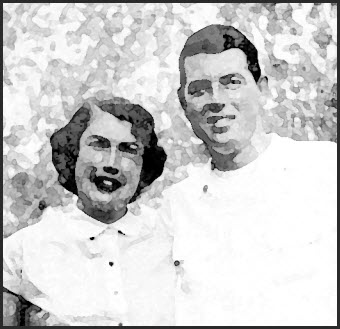

The battle lines were being drawn between caution and freedom

October 11, 2015. It was close to 12:30 A.M. and we had been asleep for less than an hour when Dad started coughing. After 90 minutes of his intermittent hard coughing, Dianne convinced him to use the Yankauer wand attached to the suction machine to remove some of his own secretions. Within a few minutes after using the wand, Dad was sleeping. Dianne also went back to sleep, but at 4:15 A.M., something woke her. To her horror, Dad was on his knees on the floor. He needed to use the bathroom and for some reason, he thought that he could get there by himself. In a panic, Dianne paged me through the baby monitor.  The anxiousness in her voice propelled me out of bed and down the stairs. The two of us tried for a few minutes, but we could not get him off of the floor and back into the bed. Fortunately, my husband was in town. I called for Stan through the baby monitor, and the three of us were able to get Dad off of the floor. At 4:50 A.M. we finally had him back in the bed. Once again, he was lucky that he hadn’t hurt himself. I could only suppose that when he woke up at night he couldn’t remember that he couldn’t walk or that he was hooked up to two devices. Depending on how he might fall, he could put a strain on his trach and decannulate himself or pull out his G-tube. Just the thought of such things happening gave me the heebie-jeebies.

I woke up again at 6:45 A.M. and woke Dianne and Dad. Dianne and I assisted Dad into his wheelchair and he wheeled himself into the master bathroom to wash his face, brush his teeth, and shave. Dianne gave him a sponge bath and helped him get dressed. He might have needed a few days to reacclimate himself to his house, but after 148 days in a hospital gown, he knew what he wanted to wear and told her where to find it. When he was all shiny and dressed, I stopped by his room and administered his trach care and morning meds. When I was finished, Dianne and I reattached his humidified oxygen and tube feed.

After breakfast, Mom shooed Dad out of the master bath and I went upstairs, and the two of us got ready for church. As we drove to church, I updated Mom on the activities of the previous night. We both enjoyed our respite at church and then returned home to an empty house, although there were two cars in the garage and three cars parked out back.

It was another beautiful day and shortly after Mom and I had left for church, Dad told Dianne that he wanted to go outside. She pushed him outside and she helped him navigate his wheelchair over the entire backyard. My parents’ house sits on an acre lot, so Dad had a lot to show her. After being out in the sun for 40 minutes, they moved to the patio and sat in the shade. Under the best of circumstances, spraying the trach bib provided only a modicum of moisture. Although Diane did her best to keep Dad’s trach bib wet with the spray bottle of sterilized water, the outside air was very dry, so he was breathing in a lot of dry air. After finding them on the patio, I became a little agitated that he had been off of the humidified air for a couple of hours. After a bit of foot-tapping from me, Dad agreed to come back inside.

Just a short time later, Dad said that he needed to go to the workshop in the garage to find a tool for Stan. It was 99 degrees outside and still dry. After he had spent 10 minutes in the workshop with Stan, I insisted that he go to his room for humidified air and nutrition. I kept pestering him to come inside, but he was uncooperative and became angry at my repeated attempts to get him back indoors. I was exasperated. I tried to explain that any time that he spent outdoors was time that he breathed dry air into his lungs and deprived his body of nutrition, yet I was the bad guy.

Finally, at 4:15 P.M. we finally got him back in bed and hooked up to his essential lines, and he quickly drifted off to sleep. Before Dad closed his eyes, Stan came to his room to say goodbye. Stan was returning to Houston but would come back next weekend.

Dad slept until 6:00 P.M., at which time we had happy hour. Sometimes he would sit and talk with us during happy hour, but today he spent most of the time wheeling himself around the house. I can’t begin to imagine how difficult it would be to not be able to sip a drink or eat my favorite foods, and sometimes it seemed that the denial of one of life’s pleasures depressed him. When Mom announced that dinner was ready, Dad wheeled himself back to his room. Dianne trailed after him and helped him back into bed and attached him to the tube feed and humidified air.

By 7:00 P.M., we had the dining room table cleared and the dishes in the dishwasher. We helped Dad back into his wheelchair and we played another cutthroat game of Oh Hell.

Tomorrow would be a work day for me, so I was glad when we started getting Dad ready for bed at 8:45 P.M. Truth be told, it was still past my bedtime. Dianne helped Dad get ready for bed and I administered the nighttime meds and trach care.  After I left the room, Dianne coached Dad through his exercises prescribed by the physical therapist.

He had had a full and busy day, and he fell asleep as soon as he finished his exercises. His coughing briefly woke him up at 11:00 P.M.

October 12. Dad slept pretty well until 1:00 A.M., at which time he started coughing again. Again, Dianne convinced him to use the Yankauer wand and suction machine to clear out some of his secretions. He didn’t sleep much afterward and was very restless. I could hear his coughing and gurgly breathing through the baby monitor, and at 3:00 A.M., I got up, donned my scrubs, and suctioned secretions from his trach. When I was finished, Dad assumed that it was time to get up. I explained to him that it was Monday and that he didn’t need to get up early for dialysis, and he agreed to go back to sleep.

After I cleaned up the trach-cleaning supplies, I went to my parents’ office and logged on to work. For about three hours, I was the only one who was awake. Although I was on Skype almost nonstop, my talking didn’t disturb Dianne or Dad. In addition to Dad being hard of hearing, the oxygen generator was noisy and blocked all sound outside of the master bedroom. My mother was sleeping in a room on the opposite side of the house. I could crash cymbals and not wake up anybody.

At 6:30 A.M., the residents of the master suite started stirring. Dianne unplugged Dad from the oxygen and the Kangaroo pump and helped him into his wheelchair. Once he was situated, he could wheel himself into the master bath and wash up and shave. Before helping him get dressed, Dianne checked his blood pressure and oxygen saturation. His blood pressure was good, but his oxygen saturation was still hovering in the low 90s. I administered his morning meds and trach care and went back to work.

While Dianne got ready for the day and ate breakfast, Dad sat in his room, received humidified air and nutrition, and read the newspaper. At 9:00 A.M., he was ready to go outside and have Dianne help him with some yard work. When he said he wanted her help, he meant that he would tell her what to do. I told him that our aides were not here to do his yard work. Dianne interrupted, insisting that she would love to go outside and do some light yard work. I shook my head and headed back to work while Dianne wheeled Dad outdoors.

Dad and Dianne stayed outside for about an hour, at which time I urged them to come back inside for air and nutrition. I couldn’t decide whether I was starting to feel like a broken record or a nag. Dad grudgingly came back indoors and let Dianne reattach him to his humidified air and tube feed. He fell asleep and slept until 11:30 A.M. We were expecting the nurse this afternoon and I wanted to be sure to administer his trach care and change his dressing before she arrived. When I reached to pull off the speaking valve, it wouldn’t budge. I. Could. Not. Believe. It. It was déjà vu all over again. My only consolation was that the nurse would be here soon. I decided to hold off on changing the trach until she arrived; perhaps she might have better luck removing it.

Like an answer my prayers, the nurse was able to remove the speaking valve, and without any muss or fuss. Before she left, she gave me some tips for handling the speaking valve. As the nurse was walking out to her car, the physical therapist aide entered the driveway. Dianne watched the physical therapy session so that she’d be able to assist Dad with his daily exercises. Shortly after the therapist left, Dianne and Dad went back outside. After about 15 minutes, I was pestering them to come back indoors. Dad agreed and Dianne hooked him back up to his air and tube feed.

At 5:10 P.M., I was finished working for the day and was ready for our happy hour. At that moment, Dad and Dianne went back outside for 10 minutes. I couldn’t believe how much time he was spending outdoors. Mom, Dianne, and I were ready for dinner by 6:30 P.M., which enabled Dad to spend some time on the humidified oxygen and tube feed.

After dinner, we played another rip-roaring game of Oh Hell. Although the game can be challenging, it’s even more challenging when you don’t deal the cards correctly—something that seemed to happen often with Dad’s impaired dexterity. Dianne and I started getting him ready for bed at 8:45 P.M. After Dianne helped him to get ready for bed, I administered his nighttime meds and trach care and sat with him while Dianne prepared herself for bed. At 9:15 P.M., I finally dragged myself upstairs to bed, called Stan, set my alarm for 3:30 A.M., and fell asleep.

October 13. With the exception of a little coughing around 12:30 A.M., Dad slept through the night until I woke him and Dianne at 4:20 A.M. As I returned to work, they resumed their morning routine in preparation for dialysis. When they were finished, Dianne dashed to the kitchen to grab a quick bite of breakfast and I returned to the master bedroom and administered Dad’s Midodrine and trach care. The Scott & White ambulance arrived about 15 minutes early, but Dad was ready. Dianne drove her car and followed the ambulance to the dialysis center. The good thing about being picked up at 6:00 A.M. is that, if you’re lucky, your dialysis session will start earlier, which is what happened today.

The aides at One on One Personal Care switched out on Tuesdays, which was a little difficult logistically with Dad’s dialysis. Gale arrived at the dialysis center at 10:30 A.M. and found Dianne and Dad just as Dad’s session was ending. Dianne drove back to the house, picked up her belongings and paycheck, and drove to her next assignment. The aides worked every other week and rest during the alternate weeks. To accommodate our dire predicament, she sacrificed three days of her week off. Gale stayed with Dad until he was picked up by the ambulance and then drove to our house.

aidesAndDad
Dianne, Dad, and Gale at the dialysis center

It was good to see Gale again. She looked refreshed but confessed that she had been dog tired when she left us a week earlier. During her first night home, when her husband got out of bed to use the bathroom, she bolted up in bed and said, “Where do you think you’re going?” It took her a couple of days home to wind down.

Gale marveled at the change in Dad and said that he seemed much stronger in just one week. A week earlier, it took considerable effort from the two of us to transfer him from the bed to his wheelchair or to the bedside commode. Now she could transfer him with only a little assistance from me.

Dad spent most of the day resting, which meant that he had a few uninterrupted hours of humidified air and nutrition. At 5:00 P.M., we got him up for happy hour and then he returned to his room while Mom, Gale, and I ate dinner. Although she hadn’t won a game yet, Gale was now a pro at Oh Hell. Dad still had a difficult time dealing cards and our cardinal rule was to always count our cards before starting to play a hand.

We breezed through our nighttime routine. After Gale helped Dad get ready for bed, I administered his meds and trach care while Gale got herself ready for bed. When she returned to the room at 8:45 P.M., I retired to my bedroom, set my alarm, called Stan, and hoped for another few hours of uninterrupted sleep.

We quickly drifted back into our routine. Dad and Gale were both kidders, and they resumed their friendly banter.

I couldn’t believe the difference in this day and Gale’s first day with us. I was still constantly on pins and needles and worried that something could go wrong at any minute, but at least we acted like we knew what we were doing.
 

Another new experience: premature aide loss

October 8, 2015. At 1:30 A.M., the Kangaroo pump alarm went off, indicating that the tube feed bag was empty. I got up and went downstairs to Dad’s room and woke Amanda so that she could change the bag. Dad was hard of hearing, so I could understand why he hadn’t heard the alarm, but it was about two feet from Amanda’s bed, loud, and annoying, and I didn’t understand how Amanda could sleep through it. The darn thing woke me through the baby monitor.

About 90 minutes later, Dad was awake and tried to get out of bed. It was dialysis day, so Amanda decided to help him get up and get ready for the day. By 4:00 A.M., they were ready for me to administer the trach care. Dad had plenty of time to read the paper, which usually arrived before 5:00 A.M., while Amanda took her morning shower.

dadGurneyHis dialysis session was happily uneventful, with no extra bleeding or trips to the hospital. To top it off, the ambulance was on time for the return trip, and Dad and Amanda arrived back home at 11:35 A.M., which was record time.

The dialysis sessions usually wore out Dad, and it wasn’t unusual for him to take an afternoon nap while we ate lunch. He slept off and on until 3:00 P.M., at which time he wanted to get up because he had company. Our neighbor, Barbara, who was married to Dr. Bob Probe, brought Dad a homemade chocolate cake and some flowers. She seemed surprised when she learned that he wasn’t swallowing yet. We told her that we’d give Dad the flowers and we’d be glad to eat the chocolate cake.

After Barbara left, Amanda convinced Dad to do the exercises that the physical therapist had prescribed.

Dad had been away from the house for 148 days. Fortunately, with the exception of writing an occasional check, Mom and I didn’t have to deal with any financial issues. He had set up their finances so that incoming money automatically went to certain accounts and almost every bill was automatically paid. Now, some of the hospital bills were arriving, and Mom thought that this was a good time to start reorienting Dad to the finances that he had so artfully set up. While they were busy with the finances, I was in the kitchen preparing dinner. While dinner was in the oven, I checked my email and was surprised to see the following message from Becky Crabtree, the owner of One on One Personal Homecare Services:

Good afternoon,

Amanda called me this afternoon asking that she be replaced. She didn’t think she was a good personality match for this position. I have Dianne scheduled to be there in the morning. She is a fill in and will stay until Gale returns on Tuesday. 

I’m sorry things didn’t work out with Amanda. Unfortunately, this happens occasionally. Again I apologize for this change.

princessCushionAlthough Dad seemed to like her, I wasn’t enamored with Amanda, and having a new aide would cause multiple interruptions in my work day to train another person. When the doorbell interrupted my pity party, my first thought was that I wasn’t in the mood for company, but I was relieved to see that we had just received a package from Amazon.com. Dad’s padded commode seat cushion had just arrived. The cushion was four inches thick and appeared as if it would have satisfied that princess who had all that trouble with that pea.

When Mom and Dad were finished reviewing their finances, Dad took another short nap while Mom, Amanda, and I ate dinner. Dinner conversation was a bit awkward as we avoided speaking about the elephant in the room.

When I started to administer Dad’s trach care, I encountered a problem with his speaking valve: it wouldn’t come off. When I tried again, Dad exclaimed that I hurt him. I tried one more time before resigning myself to the fact that I would have to change his trach so that I could remove his speaking valve. I couldn’t believe that I had to change out his trach just three days after the last time, but I couldn’t think of any alternative. Besides the fact that I hated changing the trach, I didn’t like changing it when I was so tired. I grabbed the extra TV tray and had Amanda assist me. It was the first time that she had seen a trach tube changed. As much as I hated to perform this little procedure, I felt a tiny bit more confident about doing it now that I had soloed twice.

By 10:15 P.M., Amanda had had her nighttime shower and we had Dad all medded up and in bed. I was exhausted and would need to get up in just a few hours for work. Within minutes of getting myself into bed, Dad was wide awake, telling Amanda that he needed to get up because he had work to do outside. He seemed confused and kept trying to get out of bed. He—and Amanda and I—finally fell asleep around midnight.

October 9. I slept until my iPhone alarm woke me at 3:30 A.M. I listened to the sounds coming through the baby alarm, but all I could hear was the sound of the oxygen concentrator. I dressed in my purple scrubs and headed downstairs to my parents’ office, where I had carved out a place for my computer so that I could work. On my way to the office, I looked into Dad’s room, which was next to the office, and noticed that he and Amanda were both sleeping.

At 5:00 A.M., I heard Dad stirring, so I took a short break from work and administered the trach care and morning meds. Sometimes I liked to go into his room just as he was waking up. He would open his eyes wide and say, “Hi, Mel!” and he always looked like he was glad to see me. When I was finished with Dad, Amanda and I transferred him to the wheelchair, and he wheeled himself into the bathroom to wash his face. Amanda helped him get dressed, and then she assisted him with his daily exercises and hooked him up to the feeding tube and humidified oxygen. About 15 minutes later he asked if he could leave the bedroom. Amanda disconnected his tube feed and oxygen concentrator and hooked him up to the oxygen tank. When he wheeled himself out to the family room, I told him that Amanda had to leave us and that Becky was replacing her with an aide named Dianne. He seemed genuinely sorry to hear that she was leaving. I didn’t tell him that it was Amanda’s idea to leave or that it wasn’t a terrible turn of events for Mom and me.

Shortly before 9:45 A.M., Dianne arrived and she was a bundle of energy. She had several years of experience and was closer in age to Gale than to Amanda. Amanda gave her a quick orientation and then she grabbed her bags and left the house so fast that one might have thought that her suitcase was full of our silver. Within 10 minutes after Amanda’s departure, Dad and Dianne had bonded and he gave her a tour of the house.

Shortly after the home tour, Dad wanted Dianne to take him outside. The weather in central Texas during October is usually very nice, and today we were experiencing Chamber of Commerce weather. Dad had been off of his humidified oxygen and tube feed for a couple of hours. Although I was unsuccessful in getting him to come indoors, he eventually had to come in when the nurse arrived at 11:35 A.M. Then, the nurse probably hadn’t even pulled out of the driveway before Dad was sound asleep. Not only did he sleep through his midday meds, we didn’t seem to disturb him when we changed the sheets on Dianne’s bed. He eventually woke up in time for happy hour. We didn’t play cards tonight, and we started preparing him for bed a little earlier than usual. Dianne was pretty sharp, but because it was her first night, preparing Dad for bed took a little longer than usual. I sat with Dad while Dianne prepared herself for bed.

October 10. I don’t know if he wanted to give the new aide a break or if he had worn himself out the previous day, but Dad did not wake up until 5:30 A.M. In addition, he had slept through the night. Perhaps he was trying to lull Dianne into a false sense of security.

It was Saturday, so I was thrilled to have had the extra sleep. My husband would be arriving soon to visit and to help out with the yard work. When I heard sounds through the baby monitor of Dad and Dianne stirring, I got up, dressed in my scrubs, and went downstairs to his room. I found him in the master bathroom, washing his face and brushing his teeth. When he was finished, I administered his morning meds and trach care. At 6:05 A.M., the phone rang. Back in the day, we might have wondered who in the world be calling us that that hour. Now, we correctly surmised that it was the EMT service from Scott & White, informing us that they would be late.

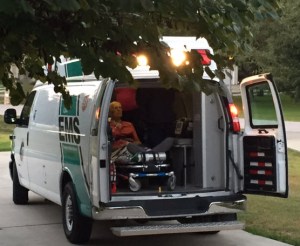
A few days earlier, the EMTs had asked us if we could wheel Dad outside where they would then transfer him from the wheelchair to the gurney. Our house had some twists and turns that were difficult for the EMTs to traverse with the gurney. Each time that they entered the house with the gurney, they had some close calls with walls and artwork. We weren’t sure if Dad could make the transfers, but we were willing to give their suggestion a try. The EMTs provided him with ample support (some could lift him) and he was able to make the transfers without too much trouble. Most dialysis patients are often weak after dialysis, so the return trip transfers from the gurney to the wheelchair were a bit difficult and required more assistance from the EMTs.

As it turned out, the EMTs were on time, and Dianne wheeled Dad outside and watched as the EMTs transferred him from the wheelchair to the gurney. Dad and Dianne arrived at the dialysis center at 6:45 A.M. and by 7:00 A.M., he was receiving dialysis treatment. Dad slept for the first 15 minutes, but after he woke up, he and Dianne chatted for the remainder of his four-hour session. During Dianne’s orientation, Amanda hadn’t mentioned how to secure an ambulance for the return trip at 11:00 A.M. Truth be told, Gale had never mentioned to me what she did, so I had no clue. About 10 minutes before the end of his session, Dianne asked the nurse who had to call for the ambulance. The nurse placed the call for her. I didn’t know if that was the normal procedure, but it worked for Dianne. The ambulance arrived at 11:15 A.M., and they were home by noon.

Dad was pretty weak, and the transfer from the gurney to the wheelchair was a bit more awkward than usual. He was tired and agreed to go to bed so that we could resume his humidified air and tube feed. Before Mom, Dianne, Stan, and I ate lunch, I administered his midday meds, during which time he fell asleep and didn’t wake until almost 4:30 P.M.

I decided that I liked wearing scrubs, but I didn’t like having only one set. Now that I understood the sizing, I accessed my favorite website and ordered three more sets in navy, black, and fuchsia, three of the colors that I saw nurses and therapists wear at Scott & White.

Before I had had the problem with the speaking valve a couple of days ago, I had changed out Dad’s trach on a Monday, which meant that I would need to change it on the following Monday. With work and my short and interrupted nights’ sleep, I was pretty tired during the work week. Although I now felt a bit more confident with the trach change, I’d prefer to have the change-out day fall on a weekend day. With that goal in mind, I changed Dad’s trach again. Because he had spent so much time away from the humidified air, his secretions built up and hardened in his trach, so changing out his trach more often was probably advisable; however, I didn’t want to stay on a two-day cadence for trach changes.

Similar to the two aides who preceded her, Dianne had never witnessed a trach change and was very interested in the process. She also proved to be a good assistant. Shortly after we finished the trach change, the five of us sat on the back patio for an hour to enjoy the beautiful weather. At 6:00 P.M., Dianne took Dad back to his room and we hooked up the humidified oxygen and tube feed. He took a short nap and woke up as Mom, Dianne, Stan, and I were finishing dinner.

After we cleared the table and finished cleaning up the dishes, Dad announced that it was time to play cards. He explained the rules of Oh Hell to Dianne, and it was game on. He tried to keep score, but the loss of manual dexterity prevented his being able to write to his satisfaction, so I took over the score-keeping. The five of us played a long version of the game and then sat around the table talking. At 10:15 P.M., we finally started to prepare Dad for bed. After Dianne helped him into his night clothes and into bed, I administered the trach care and meds. I sat with him until Dianne returned to the room around 11:30 P.M. and then I headed upstairs to bed.

Now that I had changed Dad’s trach three times, I noticed that he seemed to cough more for about 30 minutes afterward. I didn’t know if that was normal, or if perhaps I applied too much lubricant on the trach tube before inserting it into his trachea. I didn’t want to hurt him during the trach change, so I preferred erring on the side of too much lubricant. What amazed me was that he didn’t know what I was doing when I changed the trach, and he said that he didn’t feel anything. I was thankful that he didn’t approach the procedure with the same sense of dread and apprehension that I felt.


Caring for the man who would not sleep

October 2. It was 2:00 A.M., and Dad was wide awake and wanted to get up. After Gale, our caregiver, called me for assistance, she resituated Dad in bed and helped him roll over on his side, although she noticed he didn’t need her assistance. To keep him on his side and more or less stuck in bed, she wedged a pillow behind him. I don’t know if he slept, but at 4:00 A.M., Gale paged me again when Dad tried to get out of bed, so the pillow didn’t do much to control him.

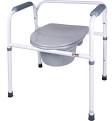
My parents’ bathroom was large, but the commode was located in a separate room, which was more like a closet. In his current condition, it was physically impossible for him to use the commode. American HomePatient (AHP) provided us with a bedside bedsideCommodecommode that we kept in the common area of the bathroom. Having it in a more open area enabled the aides to transport him to and from the commode, a contraption that he loathed. After helping him into the bathroom to use the dreaded bedside commode, Gale and I were able to convince him to go back to bed. Thankfully, he remained in bed until 8:30 A.M., at which time I administered his trach care and morning meds. I was still a rookie with the trach care and the process took about 45 minutes.
I received a call from Kathleen Devine (I loved her name.), who introduced herself as the home care physical therapist. She wanted to stop by to assess Dad’s strength to determine a plan for his occupational and physical therapies. Our schedule was wide open and she said that she would stop by before noon.

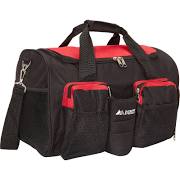
After a couple of trips to dialysis, we had realized that in addition to his extra trach, Dad gymBagalso needed to bring a blanket, a box of tissues, and various other items. Gale told Stan that instead of Mom’s Elizabeth Arden tote bag that we were using to transport his dialysis accessories, Dad needed something larger and more masculine, like a duffle bag. Stan wasn’t sure what she had in mind, but he eventually found a gym bag that she deemed perfect for the task.

Gale checked out Dad’s bureau and closet. She marveled at how well his clothes were folded and organized, although I don’t know if the credit goes to Dad or Mom. With a little guidance from Dad, Gale picked out some clothes for him and dressed him for the day. Gale also made a slight design adjustment to Dad’s undershirt. Because his PEG tube extended out from his midsection, wearing an undershirt over the tube bent the tube, which, in addition to being uncomfortable, was not good for the PEG tube. With Dad’s permission and the precision of Edward Scissorhands, Gale cut a hole in his undershirt and fished the tube through the opening. When Dad wore a button-down shirt, the tube extended through the placket. The PEG tube wardrobe problem was solved.

By 9:30 A.M., Gale and I had transferred Dad to the wheelchair and Gale wheeled him outside on the porch. Dad could navigate the wheelchair pretty well by himself in the house, but he needed some assistance going through the thresholds to the outside. By 10:00 A.M., I insisted that he come back inside so that we could hook him up to the moist air. He wasn’t enamored with the thought of being tethered to the concentrator and nebulizer, but after Mom brought him the paper he seemed pretty satisfied to sit in his room to read it. He hadn’t read a newspaper since July.

At 11:45 A.M., Kathleen arrived. She was a no-nonsense transplant from New York and I liked her immediately. She watched as Gale and I transferred Dad from the wheelchair to the bed and back again. She told us that a physical therapist aide would stop by twice a week to help him stand and walk, and the occupational therapist would visit him once a week and work on his upper body and core strength. We agreed that Dad would have physical therapy on Monday and Wednesday and occupational therapy on Friday. When I asked about speech therapy to address his swallowing problems, she said that I would have to speak with Adan about swallow therapy.

A few minutes after Kathleen left, the doorbell rang again, and this time it was Paula, the home care nurse. According to the plan that we had established during Dad’s admission to home care, the home care nurse would visit us three times a week. Although I was glad to have the nurses stop by, I was also nervous that they would find fault with something that we were or were not doing. Paula told us that Dad’s bed sore, which started when he fell in May, was serious, and she suggested that we get some Mepilex border patches. She had a couple of extras in her bag but told us that they were expensive and that we should ask AHP to supply them for us.

When Paula left, I called AHP but was told that without a doctor’s order, Medicare would not reimburse them. To obtain doctor’s orders would require that I contact Dad’s primary care physician and schedule an appointment, and this activity was not high on my list of priorities, so I decided to buy a package myself. Also, when Gale and I snagged supplies from Dad’s room at the CCH, I grabbed a box of gloves, size small, which were fine for me but were too small for Gale. I logged on to Amazon.com and ordered the Mepilex patches and a case of medium gloves. Was there anything that this company didn’t sell?

After his busy day of visitors, and a tremendous lack of sleep, Dad finally let us put him back in bed and he slept for two glorious hours.

Shortly before 5:00 P.M., Dad wanted to get out of bed and visit with us while we partook of some alcoholic beverages. Happy hour at the Locke house had been a nightly ritual that he could now only watch. Before the surgery last May, my Dad’s Manhattans had been a highlight of the overnight visit to my parents’ house that my girlfriends looked forward to every year.

At 7:30 P.M., we began what was becoming our nightly ritual. I administered the trach care and the meds, and Gale changed out the tube feed bag and filled the new one with Nepro. Gale was quickly becoming a pro at winding the tubing through the Kangaroo pump, and I knew that I needed to start paying more attention to what she was doing. It was unfortunate that the bag did not hold enough Nepro to make it through the night. Fortunately, I guess, Dad didn’t sleep through the night anyway.

October 3. At 2:20 A.M., Gale woke to find that Dad was halfway out of the bed, which prompted her to use the baby monitor to page me. Gale and I maneuvered him back into bed, but he insisted that he was going to get up. I told him that if he didn’t stay in bed, I would get into the bed next to him so that he couldn’t escape. He said, “OK,” and scooted over. Two hours later, we were up and I had a dandy kink in my neck from sleeping halfway off of the pillow. Gale and I transferred Dad to the wheelchair and he wheeled himself to the sink in the bathroom, where he washed his face and brushed his teeth. As he held his hands and washcloth under the faucet, he said that this was the first time in five months that he had felt running water on his hands. Gale and I exchanged glances, too overcome to say anything in response. He neglected to mention that it had also been five months since he had brushed his teeth and washed his face. These milestones helped to put Dad in a great mood.

I administered his morning meds and trach care and Gale dressed him for dialysis. He was ready for the ambulance transport at 6:10 A.M., 10 minutes before his scheduled pickup time. Dad’s great mood diminished somewhat when the transport arrived at 7:20 A.M., 20 minutes after his session was supposed to start.  He was eventually hooked up at 8:00 A.M.

trachBib2During dialysis, Dad used oxygen tanks from the dialysis center, but this service did not include the moisture that he needed to keep his trach moist. In an attempt to compensate for the lack of moisture, Timothy from American HomePatient had provided us with several bibs composed of a porous non-woven material. The bib was placed between the trach and the oxygen source. The bib wouldn’t stay moist for more than 30 minutes, so we kept a small spray bottle in his dialysis bag, and Gale was vigilant about keeping the bib wet.

Dad stayed alert during the entire dialysis session, and he and Gale talked the entire time. I imagine that Gale would have appreciated his taking a little nap so that she could close her eyes. Dad’s blood pressure had dropped somewhat during dialysis, so the dialysis nurse stopped the session before the goal of 1500 ml was reached. Gale called the EMT service for a ride, and once again they waited for more than an hour for a ride home. We were starting to set some pretty low expectations for the EMT transport service.

After they returned home, Dad was tired and wanted to take a nap. During the two hours that he slept, Gale also slept. At 4:00 P.M., Dad was awake and ready to get up. Gale and I transferred him to his wheelchair and we went outside and sat on the patio for 90 minutes. He had been away from the nebulizer for almost six hours today, so I strongly suggested that he go back to his room. My husband, Stan, was still in town, and he visited with Dad until 7:00 P.M., when Mom served dinner. In addition to the baby monitor station in my bedroom, we also kept one of the stations in the dining room. Just a few minutes into dinner, we heard an unusual sound from the monitor. Gale practically leapt from her chair and ran to the bedroom and found my father on the floor on the right side of his bed. In addition to the oxygen, he was also receiving nutrition from the tube feed. All of this equipment was located on the left side of the bed, which meant that he was putting a strain on a couple of vital supplies by being on the floor. It astonished me that he couldn’t figure out that in addition to being too weak to stand, he was also tethered. Fortunately, Stan was there and he, Gale, and I got Dad up off the floor and into the wheelchair. Gale checked his PEG and looked for skin tears and I checked his trach. He hadn’t hurt himself, but he gave the rest of us a scare.

Gale stayed with Dad while Mom, Stan, and I finished dinner. I then sat with him while Gale ate. When she was finished, Gale started getting Dad ready for bed. After he was dressed for bed, Gale and I ran through our nightly routine of meds, trach care, and tube feed.

Starting at 10:00 P.M., he started trying to get out of bed. He might have been too weak to stand, but Gale thought that for a weak guy, he was pretty strong. He could really put up a battle when he wanted to get out of bed.

October 4. The baby monitor alarm woke me at 4:00 A.M. Gale thought that Dad sounded gurgly and thought that he might need to be suctioned. I agreed and after I finished suctioning him, he insisted that he wanted to use the house toilet. Gale and I tried to explain that he couldn’t use it but that we would take him to the bedside commode in the bathroom. To say the least, he became very upset. He complained that the commode seat was very uncomfortable, which was true. He finally relented, but then he didn’t want to go back to bed, so Gale got him up and prepared for the day. I promised Dad that I would order a seat cushion for him, which I did later in the day.

By 6:00 A.M., he was sitting in the wheelchair, attached to the moist oxygen, and reading the paper, and we were all happy.

After breakfast, I returned to Dad’s room and administered his morning meds and trach care and then excused myself to shower and get ready for church. At 10:20 A.M., my mother and I escaped to church. Our friends at church were anxious to hear about Dad. Sue, our friend who was the nurse practitioner at the dialysis center, said that Dad was a real chatterbox. She had been amazed by how much he talked during dialysis. The pastors and everyone else we told about Dad were thrilled that he was at home.

Shortly before we returned home from church around 12:30 P.M., Dad felt a little tired and wanted to go back to bed to rest. Gale mentioned to me that she had heard some noise coming from his stomach and told me that she was going to ask the nurse to listen more closely tomorrow.

My husband had been staying with us for the past week, but after lunch, he went back home to Houston. I don’t know how we would have managed without him and I hoped that we wouldn’t need his brawn while he was gone. For both of us, our vacation had now come to an end. I had set up my work computer in my parents’ office and planned to start back to work tomorrow at 4:30 A.M.

Tonight was another frustrating night of Dad trying to get out of bed. We had him ready for bed at 8:30 P.M., but he slept until 11:00 P.M., after which time he tried repeatedly to get out of bed. At 2:00 A.M., Gale used the baby monitor alarm to call me. Dad had scooted to the end of the bed and she needed help to raise him. He insisted that he wanted to get up. I explained to him that I had to go back to work in a couple of hours and that I wanted him to sleep until 4:00 A.M., which was when I would get up. He agreed to that plan, and the three of us slept for two more hours. I fantasized about six consecutive hours of sleep.

Day 148: Transitioning to Home Care

September 29. Dad was visited by his nurses and respiratory therapists before 8:00 A.M. so that he’d be ready to leave by 8:30 A.M. to have the PICC line removed and the dialysis catheter changed. The ambulance arrived a little early and he was transferred to Interventional Radiology (IR) at S&W Memorial at 8:20 A.M.

Shortly after Dad arrived at the IR department, he tried to scoot himself off the end of the bed. When confronted by the OR nurse, Dad became combative and took a swing at him. In my whole life, I had never seen my father take a swing at anything bigger than a tree roach, yet it seemed to be a common occurrence during his hospitalization. He must have been impossibly frustrated, and I’m sure the cocktails of meds didn’t help his view of the world. As often happened at the CCH, Dad wanted to get up and use the bathroom, which was a physical impossibility. As the OR nurse and an aide helped him with the bedpan, Dad got a skin tear on his calf. During his 147 days of hospitalization, his skin had become very fragile and these skin tears were an all-too-common and disturbing occurrence. Dad finally settled down and his procedure was performed by Dr. Bradley Dollar without further incident. Dad was ready to return to the CCH by 11:00 A.M.

While Dad was having his plumbing changed out, I stayed at home so that I could meet our assistant from One On One and take care of a few things at WalMart with Stan. Among other things, we needed to stock up on washcloths, towels, and sheets. While we were at WalMart, I saw Sheila Rogers from Interim Hospice. After I had called her a couple of days ago about our change of plans from hospice to home care, she resumed her plans to move and was now picking up a few necessities for her new place. She was very gracious and supportive about the turn of events. I really liked Sheila. She was one of those people who seemed to exude compassion and kindness through her pores.

When Gale arrived, I showed her around the house and told her about our plans to have her stay in the back bedroom. Mom would sleep in the twin bed in the master bedroom, and I would stay in the guest room upstairs. Stan had purchased a baby monitor and we had placed the main station in the master bedroom and one monitor station in my bedroom and the other in Gale’s room. Gale immediately disagreed with the plan and said that her room was too far from the master bedroom to be able to attend to Dad at night. Instead, she suggested that she stay in the master bedroom with Dad and that Mom should stay in the back bedroom. It was a good call. We still kept the back bedroom as her home base, where she could keep her personal effects and use the shower. We set up an inflatable bed for Mom in a large room that was adjacent to the guest room. This wasn’t Gale’s first rodeo and she offered many good suggestions.

After getting Gale settled in, she and I headed to the CCH and arrived shortly before Dad returned from his procedure at Memorial. When he returned, I introduced Gale to Dad.


weThree
Gale, Dad, and me

Maybe it was the 100+ questions that I asked her, but I think that Angela sensed that I was still a little unsure about changing out the trach. I was less confident than a baby Wallenda who was preparing to move from the safety of a net to a high-wire act across the Grand Canyon. She said that we could change the trach now. Although it could be a problem if you waited too long to change it, changing it more frequently than seven days was not a problem. Angela assured me that it usually took three trach changes to become comfortable with the process. This would be my third time. I had a camera with me and had Gale record the entire process starting with wrestling with the gloves through cleaning and repacking the trach. This time I had sufficient disk space. I was also glad that Gale was here to witness the trach-changing process.

Angela also showed us how to use and maintain the suction machine that we’d have at home. It was a loud contraption—much louder than the system at the hospital, and I hated it. She also gave me a care package of sorts that contained supplies to help us get started, including a couple of trach care kits.

While we were bonding with the suction machine, we noticed that Dad’s new dialysis dressing was seeping a lot of blood. The nurses tried applying pressure dressings to stop the bleeding but to no avail. The nurses eventually called on Dr. Anderson. To stem the bleeding, he had to cauterize the wound.

During the hubbub of activity around Dad, Marty stopped by and I stepped out of Dad’s room to talk with her. When I asked her about Dad’s prescriptions, she said that we were responsible for filling them and asked if I wanted her to fax them to our pharmacy. At the glacial rate at which things were progressing, I didn’t think that I’d have time to get to the pharmacy before they closed. I gladly accepted her offer to transmit the prescriptions.

Whenever the room was empty of CCH providers, Gale gleefully slipped into scavenger mode, gathering anything that wasn’t furniture or nailed down. It made perfect sense because most of the supplies would be tossed after Dad’s discharge. The collection of goodies probably didn’t require covert activities; Angela had provided us with everything we requested, and more. Fortunately, we had come armed with several empty bags.

I called the house and Mom and Stan were still waiting for the morning delivery of the hospital bed, respiratory equipment, and medical supplies. It was now after 3:30 P.M. and I was becoming concerned that Dad would be discharged and arrive home before his bed.

Marty had faxed Dad’s prescriptions to a Scott & White pharmacy near my parent’s house. Unlike CVS and Walgreens pharmacies, the Scott & White pharmacies were not open late, and I had to make sure that I picked up Dad’s prescriptions before they closed. At 4:30 P.M., I left Gale with Dad and went to the pharmacy. Dad’s prescriptions were ready, but I was a little unprepared for the $239.22 sticker shock. The culprit turned out to be Renvela, which retailed for $1250 for 45 packets. Before I could leave, the pharmacist wanted to meet with me to discuss the bag full of prescriptions that included meds to raise blood pressure, an antifungal, a statin, nausea, pain medicine, meds for delirium and sleep, and Renvela, the phosphorous binder. I’d have to make a spreadsheet to keep track of his meds, dosages, and times.

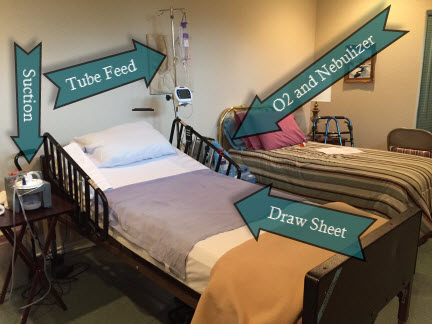
homeHospitalBedI returned home from the pharmacy just after 5:00 P.M. and the guys from American HomePatient had arrived a few minutes earlier and were transforming the master bedroom into our hospital room. Because transportation services are a low priority for ambulances, Dad and Gale had had to wait more than an hour for the ambulance ride home from the CCH. The wait time enabled us to sorta prepare the room. In addition to our special flooring and the shelving, we had also spent a pretty penny on everything that Medicare didn’t cover, like blood pressure equipment and an oximeter, bed pads, and all those linens. Just to set up the room cost us close to $700. We were lucky that we could afford it.

Dad and Gale arrived, via ambulance, at 7:15 P.M. Dad was glad to be home, but he seemed a little anxious. He hadn’t been home for several months, and his memories of home were jumbled.

Timothy and Jared from American HomePatient were still here and they showed Gale and me how to use all of the equipment. Jared demonstrated how to set up the oxygen and the nebulizer that injected moisture into the oxygen tube. Because Dad wasn’t breathing through his nose, he needed the added moisture to keep his air supply moist. Timothy then showed us how to set up the Kangaroo enteral feeding pump and tube feed. My head was spinning and I hoped that between the two of us, we could remember how to use everything.

After Jared and Timothy left, Gale and I studied all of the containers of meds, trying to determine what to give Dad tonight. Right off the bat, I pulled out the Haldol, Hycet, and Risperidone, and put them in another room. It probably wasn’t a good idea, but on my watch, he was going cold turkey and would never receive these drugs again. As it was, I still gave him five different drugs through his PEG tube. Gale unpacked the tube feed bags and set up his tube feed.

Because Dad didn’t get home until after 5:00 P.M., he had to be admitted by the S&W Home Health night nurse. Leo finally arrived at 10:00 P.M., and Mom went to bed after she led him to the bedroom. He was a trip, and Gale and I were pretty sure he had had a couple of cups of coffee. According to him, he was the expert because of the two letters after his name. The admitting process seemed to take forever and included an inspection of the house and a check of Dad’s vitals. Leo finally left shortly after midnight.

Gale and I prayed that Dad would stay in bed. Unlike the hospital beds, this one did not have rails at the foot of the bed. Fortunately, he slept all night—that is, if you call sleeping until 4:00 AM. all night.

Caregiver in training

September 26, 2015. I saw Angela, the respiratory therapist, a few minutes after I arrived at the CCH at 7:35 A.M. She said that after she set up a couple of more patients, she would return to Dad’s room to continue my training. Jennifer, the charge nurse, was also tasked with training me this weekend. Her instruction started with having me administer Dad’s morning meds. We started with the pills, which I was to crush and mix with water. I then drew up the liquid mixture into a syringe and emptied it into the PEG tube. The other two meds were powders: the Renvela was for his kidneys and the Beneprotein was a nutritional supplement. According to Jennifer, I had to mix the Renvela with water and then squirt out 1/3 of the mixture into the sink. The entire sachet of Beneprotein was injected into the PEG tube. After injecting all of the meds and supplements, I flushed the tube with lukewarm water to ensure that nothing remained. So far, so good.

mapAfter Jennifer left the room, Dad asked me about “all of the buildings that he was going to travel through.” I explained to him that to get home, he wouldn’t travel through buildings, but that his ambulance would take him home via the Loop and 31st Street. I drew him a bad, oversimplified map of the area and explained where everything was and the distances between them. He had been hospitalized so long that he was confused, thinking that there was a difference between our house and our home. He then told me that it would be prudent to get him a bedpan, so I called the nurse and left his room.

While waiting in the hallway, I encountered Dr. Smith and conferred with him for a few minutes. While we were chatting, he told me that I was pretty lucky because Jennifer was one of Scott & White’s top 25 nurses of the year. I had just met her this morning and had already concluded that she was very friendly, supportive, and professional. I also didn’t pick up any vibes that she was judging me for moving Dad to home care.

2015_sepeclipse_028At 11:00 A.M., Angela returned, and my respiratory therapy training ratcheted up a notch. In addition to suctioning Dad today, she said that I would change out his tracheostomy tube. I had hoped to record the process with my camera, but I ran out of disk space before I was finished. Regardless of whether you were suctioning or changing out the trach, the process required a sterile environment. There was a specific way in which to open the kit and put on the gloves, which I thought would be my undoing. Putting on a pair of gloves so that you don’t touch and contaminate them was not as easy as you might think, and I felt like a complete doofus.

I had a tiny problem getting the trach tube into his throat, but I think it was because I didn’t insert it at the correct angle. I panicked a little; Angela took over, and it slid right in. She also showed me how to clean the trach that I had just removed and how store it for the next changeout. As if all those steps weren’t important enough, it seemed like the biggest lesson was that you had to ensure that you tightened the collar enough so that it wouldn’t come out, yet not so tight that you choked the patient. Being able to place two of my fingers between the trach collar and Dad’s neck seemed to ensure the correct fit. I was a little stressed out and I couldn’t believe that I would have to perform this procedure every seven days. Was it that long ago that I thought to myself that I couldn’t imagine having to change out a trach? Sheesh.

2015_sepeclipse_047While I was sitting with Dad, Angela returned to the room with printed instructions about how to suction and change out a trach. Dad was sleeping, so I decided to read the entire document. I write technical documentation for a living, and although I’m not diligent about always reading it, this seemed like a good time to read the manual. I was glad that I did. When Angela stopped by again, I told her that the two other respiratory therapists had had me insert the tubing much further into Dad’s trach than the instructions advised. She told me that she had noticed that I had performed deep suctioning on Dad, but that it wasn’t necessary. When I changed my suctioning technique, I found that suctioning didn’t hurt Dad the way it did with some of the respiratory therapists. I was glad that Angela was now my trainer. I recalled how Dad had told her that she was different from the other respiratory therapists and how he didn’t like others, like Victor. Angela had me suction Dad the rest of the day, and by the end of the day, I was somewhat comfortable with the procedure, although I still had to psych myself up for it.

I was glad when it was time to go home for lunch.

After I returned to the CCH from lunch, Jennifer and I got Dad into the wheelchair. The next time that Angela came in to suction Dad, she noticed that he was slouched in the wheelchair. She said that he was too bent for suctioning and she would wait until he was back in bed and at a better angle. I made a mental note to myself that the angle of his neck was important when suctioning the trach.

I was by myself at the CCH for most of the day. Mom was at home preparing the house, especially the master bedroom, for Dad’s homecoming. Stan split his time between performing chores at the house and running endless errands.

floor_matIf you spend any time at a hospital, you quickly learn that healthcare is a dirty business and the floor is difficult to keep clean. My parents’ house, including their bedroom, was carpeted with a beautiful sea green carpet. We were pretty certain that the carpeting would not survive Dad’s home care. One of Stan’s assignments was to figure out how to save the carpet. He eventually decided on chair mats. He bought out the supply of rectangular mats at Staples and Office Max and then worked out the arrangement of the mats in the bedroom. In addition to protecting the floor, the mats provided a relatively hard surface and protected the carpet from some of the heavy equipment and the wheelchair that would be brought into the room. He also purchased some shelving and boxes that we would need for storing medical supplies. Thank goodness my parents’ bedroom was large enough to accommodate everything.

By the time that the three of us met at home at the end of the day, we all felt like we had put in a full day’s work and were ready to make use of my parents’ bar.

September 27. I woke up at 5:30 A.M. and wandered into the kitchen to make coffee. I was surprised to find that my mother was already up and about. She told me that she had been awakened at 3:15 A.M. by a phone call from some college. The crank calls persisted until about 5:00 A.M. Before the annoying calls stopped, she had reached the point where she would answer the phone and immediately hang up. By the time that I woke up, she had done a lot of housework and was exhausted.

Mom and I arrived at the CCH at 9:00 A.M. Dad was awake and promptly told Mom that he had been trying to call her since 3:15 A.M. What Mom had heard was the audio caller ID announce wireless caller. The audio wasn’t all that clear, so you might imagine that it sounded something like Warless College, especially at 3:15 A.M. Mom might have appreciated the humor of the situation more if she had had 2-1/2 hours more sleep. My father could be a real pill with a phone. I don’t know if we ever knew why he was calling.

2015_sepeclipse_056Shortly after we arrived, I went to the nurses’ station to see Jennifer. She said that she had been waiting for me to arrive so that I could administer Dad’s morning meds. At practically the same time, Dr. Smith arrived and we discussed Dad’s feeding tube and his invasive lines. I agreed with the doctor that because of its upkeep and the potential for infection, we wanted the PICC line removed. It was used to administer IV medication and he had already changed Dad’s prescriptions so that he was no longer receiving any IV drugs. Dr. Smith said that if we had an emergency, we could use the dialysis catheter while trying to start another IV or insert a new central line. He said that nephrology wouldn’t like this option, but in a pinch the dialysis catheter would work. During our discussion I learned that Dad had been tested for the Candida fungus five times and had tested positive only the first time. It sure would have been nice to know this sooner. If I had had more time to think about it, I would have resented being manipulated by Dr. Ciceri. I still shudder when I thought about how close we came to withdrawing care because of misleading information.

I put on a hospital gown over my Sunday clothes and administered Dad’s morning meds. Mom and I left for church at 10:20 A.M. and once again, Stan stayed and visited with Dad.

When Mom and I had attended church last week, we had a very sobering and tearful meeting with our good friends, who I referred to as the church ladies. Our friends at church had prayed their hearts out for Dad, and they were heartbroken about his prognosis. As upset as they had been last week, they were thrilled today. They and Pastor Tom praised God about the miracle that had occurred.

Stan had a good visit with Dad and left the CCH when I called him at 12:25 P.M.

2015_sepeclipse_063I returned to the hospital at 2:00 P.M. to find that Jennifer and the aide were giving Dad a bath. When they were finished, Jennifer and I maneuvered Dad into the wheelchair. Jennifer thought that he was a bit weaker than yesterday and said that she wanted him back in bed in about an hour. It was a nice day, so after I had Dad cough up some secretions, we headed outside in the wheelchair. We strolled on all of the available sidewalks, which still wasn’t much of an outing, and then settled under the covered hospital entrance. While we were sitting out front, Stan and Mom drove up and visited. Stan could stay for only a couple of minutes because they had been grocery shopping and he had to get the perishables home. Mom and I visited outside with Dad until 3:25 P.M. Shortly after the three of us returned to Dad’s room, Jennifer, Hector, and I put him back in bed. Mom and I visited with Dad until about 4:30 P.M.

It had been another long day and Stan, Mom, and I were pooped. I had downloaded the Domino’s app to my iPad, so we ordered a pizza the 21st century way. We had ordered three pizzas since I had been staying there, which is more than I had ordered in the last 25 years. I loved to make homemade pizza, but desperate times called for takeout.

2015_sepeclipse_097Stan and I stayed up late to watch the total lunar eclipse (blood moon). While watching the moon, my dear friend Rhoda texted me to see how I was doing. I quickly called her to let her know about the miracle and our change in plans.

She was just over the moon!


Wait. What? You’re kidding!

September 24, 2015. I contacted One On One Personal Homecare Services and provided Rebecca Crabtree, the owner, with a brief story about my father. In inquiring about her services, I wanted her to understand a little about the circumstances that put us in this terrible situation. Her company provided aides who worked seven on and seven off. Ideally, a couple of aides would be assigned to you and they would trade off on Tuesdays. This 24×7 service was provided at the bargain-basement price of $1,106/week. Based on my research, the going rate for aides was about $30/hour. If you could get someone to spend nights with you, you’d likely pay more than $5,000/week. Following a couple of email exchanges, I signed a contract for her services to begin on September 29.

After contracting One On One, I contacted Sheila Rogers at Interim Hospice and told her that we had arranged for aides to assist us with Dad’s care. The aides would provide personal care services, but I would provide the trach care.

Dad’s day started off a little rough when he insisted that he would get out of bed. He was very agitated and combative when his nurse, Alyssa, told him that he had to stay in bed. She finally administered some medication to calm him.

Susan, the physical therapist, arrived at 9:00 A.M. for Dad’s therapy session. She was not in favor of our desire to have Dad transfer into a wheelchair when he was at home, and she provided a demonstration of the Hoyer sling. At the end of his therapy session, Dad was able to use the walker to stand up from the bed and back up into a traditional wheelchair. He piloted the wheelchair as he and Mom went outdoors and visited for almost 45 minutes. Alyssa caught sight of them a couple of times during their meandering visit through the CCH facility and noticed that they seemed to be having a pleasant visit.

Shortly after lunch, Mom had another confrontation with Marty — this time she was insisting that Mom needed to learn how to take care of Dad. Considering how Marty had told me earlier that the nurses didn’t think that Mom could take care of Dad, I found it interesting that she was now pressuring Mom to learn. I was just a little miffed about this confrontation. I thought that we had agreed that I would be trained. I couldn’t help but think that the confrontation had more to do with trying to dissuade us from taking Dad home than training Mom.

Marty called me after this confrontation with Mom and told me that my mother was being very defensive. Mom had already told me about their encounter, so Marty’s call wasn’t a big surprise. I told her that my parents had been married for more than 65 years and that my mother was going through the worst time in her life. I thought that the least that she could do was give my mother a little slack as she tried to prepare herself to be a widow. I had once asked the nurses if they had any humanity and it seemed like a lacking commodity at this place. The thing that my mother needed most was a hug, not the endless grief that she seemed to receive from some of the providers at this facility.

According to my mother, Marty took my comments to heart and she and my mother shared a tearful moment back in Dad’s room.

Shortly before 3:00 P.M., to prepare for his haircut, Alyssa and another nurse helped Dad get back into his wheelchair. Mom’s stylist, Gina, arrived at the appointed time and gave Dad his much-needed haircut. When she was finished, Mom thought that Dad looked a lot more like his old self. Dad thought that the haircut was “OK,” and said that he looked forward to getting a better haircut from his barber. The haircut was timely, as Pastor Don, Jack, and Sandra, all from the church, stopped by to visit with Dad.

Mom left for the day around 5:00 P.M., thinking that Dad had had a pretty good day, all things considered.

At 11:30 P.M., Andrea, Dad’s night nurse, offered Dad the opportunity to administer his own oral care. Unfortunately, he was very confused and tried to use the mouth swab to suction himself. Andrea finally offered to assist him, and he sorta graciously accepted.

Dad and Andrea had another confrontation four hours later when he insisted that he had to get out of bed to use the bathroom. They argued about the bed pan and she left to retrieve Haldol to calm him. By the time that she returned, Dad had calmed down, so she didn’t administer the med.

September 25. I left Houston at 6:10 A.M. and arrived at my parents’ house in Temple at 10:30 A.M. Shortly after I arrived, GoodWill arrived and picked up my parents’ king size bed.

Mom and I arrived at the CCH at 12:45 P.M. Dad was still in dialysis, which allowed Mom and me a few minutes to visit with Dr. Smith. He told us that Dad would not need the dialysis lines when he went home. He didn’t know if the hospice care nurses would need the central line to administer morphine or other drugs, and asked me to contact them. I texted Sheila at Interim, and she said that they wouldn’t need the central line. Dr. Smith said that he would write orders to have the dialysis catheter and PICC lines removed before we took him home.

Dad returned from dialysis around 1:15 P.M. While he and I were talking, he mentioned how much he hated dialysis. When I told him that he would need to endure it just one more time, he said, “No! Without dialysis, you’re dead.” Something about the intensity of his response made me get up and look for Dr. Smith, and I found him in the hall outside of the administration offices. I told him that Dad just didn’t seem like someone who was dying, not that I possessed any real insight. I didn’t really have any goals and I didn’t know where I was going with this comment, but Dr. Smith and I discussed Dad’s state of mind, and he agreed that Dad seemed pretty lucid and that we shouldn’t withdraw care. He went on to say that the fungus had not been noticeable in Dad’s lab results for the last three tests. He thought that we might have to deal with a fungus at some time down the road, but that he would tell Marty to change Dad’s discharge plan from Hospice Care to Home Care if that’s what we wanted. I wasn’t familiar with Home Care and its implications, but it sounded a darn sight better than Hospice Care, and I quickly agreed.

blog01I practically ran back to Dad’s room to tell Mom the good news. Marty stopped by a few minutes later at 2:00 P.M. and asked if we wanted to review some brochures for Home Care providers. We knew that Adan worked for Scott & White Home Care and worked with the physical and occupational therapists that would care for Dad. Ironically, our decision to go with Scott & White Home Care was practically instantaneous. I had been critical of Marty over the past month, but she really earned her pay today. She quickly shifted gears and told us about all of the equipment that we would need and everything that we’d have to do, but we told her that we had made up our mind to take Dad home. She explained that she would do everything possible for a Tuesday discharge, but we were at the mercy of American Home Patient and their providers to deliver everything we needed.
When Mom and I had interviewed Shiela at Interim, we were touched at how willing she was to accommodate us. She had planned to move that weekend and changed her plans. I now needed to contact her to give her the good news that we would not need her services. She was very gracious and was thrilled for us.

At 3:15 P.M., Dana showed me how to administer Dad’s meds in the PEG tube. She reiterated that I would need to spend the weekend learning how to administer meds and how to handle all of Dad’s trach care. I assured her that I would arrive early tomorrow to begin my training in earnest.

Mom and I were asked to leave Dad’s room for a few minutes, so we walked to the CCH lobby and helped ourselves to a cup of coffee. I didn’t usually drink caffeinated coffee after noon, and Mom didn’t drink caffeinated coffee at all, but we didn’t care. We were practically walking on air and felt like celebrating with a cup of nasty coffee.

When we returned to Dad’s room, I saw Jennifer, the physical therapy assistant, outside of the room next to Dad’s, and introduced myself to her. In the 36 days that Dad had been at the CCH, I had not met her. I told her that I had heard great things about her and that I was glad that I had finally had the opportunity to meet her. She was very pleased and gave me a hug.

Mom_ERDad was a little tired after dialysis and didn’t feel up to much physical therapy. He didn’t get out of bed but did agree to some exercises in bed. Shortly after Jennifer left Dad’s room, Mom started feeling very lightheaded and faint. I got her a glass of water and I had Dana, the nurse, check her pulse. It was 82, which was fine, but Mom’s lightheadedness didn’t go away. While I watched this unbelievable mini-drama play out, I noticed Dad’s razor sharp focus on Mom that never wavered. I felt like an intruder on an intimate moment. I then asked Dana to take Mom’s blood pressure. Her blood pressure was very high, and the nurses strongly suggested that I take her to the emergency room at Memorial. I couldn’t believe it, and myriad emotions washed over me. Just minutes earlier we had been so elated about Dad, and now I was very worried about my mother. What was it with my parents and their dueling maladies? The nurse fetched a wheelchair while I pulled the car to the front entrance and we drove five miles to Memorial.


We arrived at the hospital at 4:15 P.M. and didn’t have to wait long before they triaged Mom. We were ushered into an examination room about 30 minutes later, and time seemed to stop. After the nurse repeated the same questions that we were asked 30 minutes earlier, she hooked up Mom to the monitors and we waited for the resident, who asked many of the same questions that we had now answered twice. A while later, we met Dr. Jones, who ordered some blood work, and then we waited an hour for the lab results.

There must have been a shift change, because a little over an hour later, a different resident entered the room and proceeded to tell us what was wrong with Mom. Evidently, Mom was dehydrated and needed an IV, which they would administer after they admitted her. Mom’s blood pressure had dropped and stabilized during the two hours that we had cooled our heels in the ER, but that announcement made her blood boil. Mom had big plans for the next couple of days and had no intention of being admitted. At Mom’s refusal to be admitted, I asked the resident if Mom could receive the IV in the ER and then go home. The resident agreed to that plan, and it seemed like my plan was a go until Mom learned that it would take more than an hour to administer the IV. It was 8:00 P.M. and we had now been here for more than four hours. Still searching for a solution, I asked if we could stop by HEB, the local grocery store, on the way home and pick up some Gatorade instead. The resident thought for a moment and said that this might be a viable solution, but she wanted to check first with Dr. Jones.

When the resident and the doctor returned a few minutes later, they explained that the original diagnosis had been incorrect. Instead of being dehydrated, Mom had the opposite problem and needed to restrict fluids. I’m not sure what they had in mind, but the two of them were pretty insistent that they must admit Mom for observation. Mom would have none of it and insisted that she was leaving. Frankly, we weren’t feeling too confident that these guys knew what they were doing. Had we not balked about the treatment, would they have administered the IV? The two doctors finally realized that they had more than met their match, and Mom signed an Against Medical Advice (AMA) waiver, stating that she was declining the recommended medical treatment. We waited for our paperwork and finally left the ER shortly after 9:00 P.M. In hindsight, a caffeinated cup of coffee on top of the shocking turn of events was probably a bad idea.

We drove home as fast as we could and celebrated the events of the day with a dinner of leftover Sloppy Joes. Mom poured herself a scotch and I poured myself a glass of wine—as far as we were concerned, this was just what the doctor ordered.

As we looked back on the day, we wondered when the heck the doctors were going to tell us that Dad didn’t have the Candidiasis fungus. We had spoken with Dr. Ciceri several times a day for several days and he looked us in the eye and told us that Dad had this fungus and never wavered in his prognosis that Dad would die in one-to-two months, even with care. And to top it off, we told this guy that he was one of the two doctors that we trusted. Because Drs. Smith and Ciceri were partners, I had assumed that Dr. Smith knew about Dr. Ciceri’s dire predictions, but now we weren’t so sure. We also wondered if Dr. Smith thought that we knew about Dad’s negative test results. The events of the day had unfolded so rapidly that we hadn’t had the opportunity to process everything we heard, let alone ask questions.

The list of doctors that we trusted with my father’s life was now down to one: Dr. Smith.

I don’t know what prompted me to approach Dr. Smith about Dad, but I do know that God works in mysterious ways. Thank God.

I just wished that God could make Dad stay in bed.

Oh, Candidiasis!

September 18, 2015. Dad started his day in dialysis after having spent an uneventful night asleep. According to his early morning lab results, his WBC count was 12.1, up from 11.1 If only the WBC count was the worst of the lab results. Dad’s blood culture came back positive for Candida parapsilosis. When he saw the lab results, Dr. David Ciceri called Mom to tell her about the findings of the blood culture.

It being Friday, I was working in my home office in Houston. I was going to Temple the next day. This was an important weekend for me to be in Temple because I wouldn’t be returning for a couple of weeks. The stress of the past few months was taking its toll, and I was looking forward to this coming Wednesday, five days from now, when my husband and I would join my best friends in Wisconsin for the belated celebration of my birthday. The trip itself was a birthday gift, and we had been planning it since June.

Around noon, my phone rang, and the caller ID told me that it was my mother. We spoke every day, but I always initiated the calls. During the past 136 days, a phone call from her had indicated bad news. Today’s call was no exception. According to Mom, Dr. Ciceri told her that Dad tested positive for some fungus in his blood that was fatal, and could I come to Temple now?

After Mom’s phone call, I dashed off a quick email to my manager, telling her that I was leaving. I was somewhat packed for the weekend trip, so I grabbed what I could and left the house within 30 minutes of her call. The all-too-familiar drive to Temple seemed more like an eternity than three hours.

Dad returned to his room around 1:15 P.M. He had been a little confused earlier in the day but seemed to be in good spirits. His dialysis session had been pretty easy on him. He had no edema when he arrived at dialysis, so his blood was cleaned and only 342 ml of fluid was removed, which was about 15 percent of normal. Jennifer stopped by for Dad’s physical therapy session but was told by the nurse that Dad was having blood drawn.

imagesWhen I arrived, I met Dr. Ciceri and he explained to me that Dad had something that sounded like “the Canada fungus.” He said that they planned to replace his dialysis catheter and his PIC line. The doctor had also started Dad on an antifungal. He said that he requested a TTE (transthoracic echocardiogram) for later today. I didn’t understand the significance of most of what he said, but I clearly understood what he said next. He said that Dad’s prognosis was extremely poor, that he probably had one to two months to live, and would most likely die in a nursing home.

The doctor went on to say that given Dad’s prolonged illness and advanced age, as well as his current condition, it was extremely unlikely that Dad would ever improve to the point that he could go home. As we discussed options with him, Mom was adamant that Dad would not want to go to a nursing home. With so few choices, we finally ended this terrible conversation with a plan to bring him home on hospice care. The doctor said that having Dad at home on hospice care would be difficult and would require that Mom and I be able to care for him. After assuring him that home was the only option for us, the doctor said that he would instruct the nurses to start training me tomorrow. In retrospect, I can’t believe how fast we made this decision to abruptly shorten my father’s life.

I don’t know how we did it, but we visited with Dad for a couple of hours before heading home for the evening. Mom and I were shell-shocked and there were more than a few tears shed over our drinks that evening.

September 19. Dad seemed to be in good spirits when Mom and I arrived this morning and announced that he was retiring from this place, adding that he figured that he had another 10 years left in him. His voice also sounded good and he seemed to be handling his secretions with little difficulty.

Mom and I had been adamant that we could not move Dad to a nursing home, but I thought that I should give our knee-jerk decision a second thought. When we spoke with Dr. Ciceri this morning, I asked him whether a nursing home might prolong Dad’s life by months or years. He said that a nursing home might extend Dad’s life by a couple of months. He explained that dialysis was tough on patients in their 80s and 90s. When I asked him if it would be possible to extend Dad’s time at the CCH so that I could take my trip, he said that they should be able to accommodate that request. Looking back, that request was probably one of the more selfish and embarrassing moments of my life.

We concluded our conversation with Dr. Ciceri by telling him that he was one of only a couple of doctors at the CCH that we trusted, the other doctor being Dr. Smith. Coincidentally, he and Dr. Smith were partners. He explained that he and Dr. Smith were very similar, but that Dr. Smith was much more of an optimist. He liked to think of himself as a realist.

After Dad and I exchanged morning pleasantries, he initiated a couple of very strange conversations. He spoke at length about a dialysis tech by the name of Penny Nickel. When I challenged him, he insisted that such a person really did exist. I wished that we had spent more time talking about the phantom Penny, because the following conversation was somewhat shocking and very disturbing. Dad told Mom that he needed to know the names of her other children. My parents started dating shortly after high school, were married in their early 20s, and I’m their only child. At first, my mother thought that he was kidding, but he was very serious. He assumed that he would have some financial responsibility for these other offspring and so he needed to know what he was dealing with. No matter how Mom protested, he insisted that she was lying. We finally diverted his attention to another subject.

Shortly before noon, Andrea, the respiratory therapist, stopped by Dad’s room to demonstrate how to suction Dad and perform routine trach care. She told me that she would have me perform the trach care when I returned this afternoon.

When Mom and I returned home for the day, Mom was very upset that Dad believed that she had had other children. She said that she couldn’t bear the thought of him dying thinking that she had lied to him about other children.

Mom and I were having a difficult time living with our decision, and we tried to think of alternatives to our dreadful plan. We found a website that addressed home dialysis. We thought that perhaps we could have Dad at home and extend his life with dialysis. When I searched the website, I learned that Scott & White provided home-based dialysis. Mom and I decided to talk with the nephrologist and Dr. Ciceri tomorrow to see if we could explore other alternatives.

September 20. Mom and I arrived at the CCH shortly after 9:00 A.M. I located the doctor and told him that Mom and I wanted to discuss some other options, such as home-based dialysis. Without skipping a beat, he said that this was a bad idea. Among other things, he said that this option would be expensive because Medicare would not pay for dialysis for a hospice patient. He said that he would speak with Dr. Concepcion, the nephrologist, for his recommendation. Regardless of their recommendations, our plan was for Dad to continue dialysis treatment and physical therapy until he was discharged to hospice.

Dad was sleeping when we entered his room, but it was obvious to us that he had been awake earlier in the morning. Everyone we encountered mentioned some earlier conversation with him and that he seemed to be in a good mood. He finally woke up just before Mom and I left for church. Before we left his room he reminded Mom that he still wanted the list of her other children.

After church, we spoke with our friend, Sue, about at-home dialysis, and she agreed with the doctor that this was a bad idea. She said that the training would take four to six weeks and that the patient also has to come to the dialysis center each day during the training. She recommended that we stop Dad’s tube feed when he returned home. Her suggestion seemed a little cruel, but she explained that continuing to administer nutrition would only cause swelling and discomfort and would ultimately shorten his life. She thought that we might prolong his life by one to two weeks without the nutritional support.

After church and lunch, we returned to the hospital around 2:30 P.M. We were in Dad’s room for only a few minutes before he initiated another lively discussion about Mom’s other children. It took me some time, but I finally convinced him that there weren’t any other children.

With the help of the nurses, we got Dad into the Stryker cardiac chair around 3:30 P.M. The weather was unseasonably nice, so I took him outside. The warm weather and breezes lulled him to sleep in about two minutes. I wheeled him all over the hospital, but he never woke up. Around 5:00 P.M., Pam, today’s respiratory therapist, stopped by to teach me how to clean and suction the trach. It was a little nerve-wracking, but I accomplished the task without waking him. Forgetting that Dad had been able to sleep through all sorts of torturous procedures, I considered my first attempt at trach care to be a phenomenal success. Mom and I finally left the CCH around 5:40 P.M., and Dad never woke up.

After we returned home, I had a come-to-Jesus meeting with myself and reached an obvious decision: I couldn’t travel to Wisconsin with my friends and leave my mother to deal with Dad’s situation. I wrote the painful email message to my friends, telling them that my father was going to die in hospice care and that we’d need to change our plans. They knew my parents and were distressed when they read the terrible news. One of my friends had been my wing woman when Mom had her stroke. It was hard to believe that this ordeal was going to end like this.

My phone calls to my husband were a blur of changed and new plans. He and I had both planned to travel to Wisconsin, and he helped cancel our travel plans. Because we had already planned vacation time for September 25 through October 1, we’d spend that time in Temple with my parents.

phoneAt 9:40 P.M., I was awakened by the house phone, and  I ran to answer it before it woke Mom. As far as we were concerned, there was nothing worse than a nighttime phone call. My parents’ phone system had an audio caller ID. My heart practically stopped when I heard it announce that the call was from Scott & White. The call was from Jeliza, Dad’s nurse. According to her, Dad insisted that he wanted to go home and that he had seen Mom in the hall. He kept calling out for her, and the nurse couldn’t calm him. She hoped that my mother or I might be more successful. Jeliza held up the phone to Dad’s ear while I explained to him that we had been in his room until 6:00 P.M., but that he had been asleep. He asked me when we would return to see him again, and when I said, “tomorrow,” he asked if we’d come by early. When I told him that we’d see him after dialysis, he said that he wasn’t going to dialysis anymore and that he would go someplace else. I explained that going someplace else would require advance planning and that we couldn’t make alternative plans on a Sunday night. I promised him that Mom and I would be there and that I’d visit with him before I left for Houston. He agreed to that plan and we said good night. The nurse took back the phone and thanked me for talking with him.
 

One step forward, two steps back


September 5, 2015. When we opened the Temple Daily Telegram, we were greeted with the unfortunate news of another Scott & White doctor dying, this time in a climbing accident. Scott & White had now lost two doctors during Dad’s hospitalization.

I arrived at Dad’s room at 9:45 A.M. The window shades were open, but the lights were off and he was still asleep. The first thing that I noticed was that he was restrained with his wrists bound to the side rails, which prevented him from being able to call for assistance or suction himself. I used the call button to call the nurse, but she cut me off while I was speaking. I was pretty annoyed when I called her, but being cut off mid-sentence really irked me. I stormed out of Dad’s  room to the nurses’ station and told the nurse that if she was going to leave him in a helpless state, I expected her to stop by his room every 15 minutes to tend him, or loosen the restraints to the point that he could suction himself. The nurse and respiratory therapist accompanied me back into Dad’s room. The three of us were followed by the charge nurse, who gave me a dressing down for yelling at her nurses at the nurses’ station. I wasn’t yelling, but there was no doubt that I sounded very annoyed. As I walked back to Dad’s room, I asked them if they possessed any humanity at all.

As Dad woke up, he started becoming agitated about his restraints. He also kept saying that he was done here and wanted to leave. Who could blame him?

At 10:20 A.M., Alyssa, his nurse, stopped by to tend to a wound on his right foot.  She also tended to his oral care for the morning. Dad wasn’t wild about having his teeth cleaned, but he finally let her do it.  I tried my best to explain how important oral care was to his situation, but he didn’t believe that we were helping him.

At 10:40 A.M., a couple of nurses stopped by to reposition him. I had to remind them to give him enough slack in his restraints so that he could suction himself.

lumen60I left the CCH at 11:40 A.M. to have lunch at the house with Mom and Stan. They had stayed at the house to do some yard work.  Mom had found a couple of snake skins, which I took to use with some of my lumen printing. I thought that they might add a nice touch to my fig leaf prints.

Mom and I returned to the hospital at 2:00 P.M. Dad kept wanting to get out of bed, and I kept trying to get him to understand that he had to follow the rules and stay in bed or else they would restrain him. Alyssa then told me that Dr. Anderson wanted Dad restrained 24/7.

At 2:45 P.M., his feeding tube became clogged. Alyssa couldn’t clear it, so she went to enlist some help from Melissa, another nurse. While she was out of the room, Victor, the respiratory therapist, came in to clean Dad’s trach dressing and to suction him. Dad had mentioned to me that he didn’t like this respiratory therapist. He would insert the suction tube down the trach to the point that Dad would gag, then he’d sort of giggle and push it deeper until Dad’s legs would shake. It was a disturbing spectacle to watch and wasn’t typical of all of the respiratory therapists.

While he was in the room, Victor told us that Dad was still be being suctioned a few times a day. Until Dad could remove his secretions better, they couldn’t contemplate red-capping him.

After Victor left, I gave Dad a bunch of pep talks about coughing and suctioning to the point that he asked me if I was his cheerleader. Sometimes I could be a little over the top, but I felt like I was practically willing him to improve.

At 4:10 P.M., the nurses came back to Dad’s room to try to clear out his clogged feeding tube. They tried moving him around in the bed to see if the movement would help clear up the clog. They then loosened up the tie on his right hand so that he could use it to hold the Yankauer, his suctioning wand. After they had given him some slack in the restraints he said that he usually used his left hand for the Yankauer, which made the nurses laugh. They changed the restraints again so that he could suction himself with his left hand.

Mom and I left for home around 4:30 P.M. Dad looked so lonely. I hated to leave him. On the way out, one of the nurses told us that he had asked her for scissors. When she told him that she couldn’t do that, he told her that she wouldn’t have to tell anyone about it. Everything about Dad’s behavior seemed so surreal. He was delirious to the point that he was like a different person, but occasionally his sense of humor surfaced. Even the nurse thought his request was funny.

Stan treated Mom and me to a dinner at J&B’s. After dinner, we stopped back by the hospital to say goodnight to Dad, but he was asleep. The only person who saw us was Victor.

I was so worried about Dad and his restraints. I just couldn’t envision the doctor ever having them removed. Of course, it would have been nice to see Dr. Anderson so that we could discuss it. When we did catch sight of him, he just walked by without acknowledging our presence.

Although Dad’s hands were restrained, his feet weren’t. Three times during the night, Connie, his nurse, found him with both of his legs dangling out of the side of the bed. Before putting his legs back in the bed, she tried to convince him that he needed to keep his legs in the bed.

September 6. Before we went to the CCH, I emailed three of my best friends about an upcoming trip to Wisconsin that was scheduled for late September. The trip was a birthday gift from my girlfriends and I was looking forward to the break. My Dad’s condition had been a little touch-and-go recently, but I was still hopefully optimistic that he would be well enough for me to feel comfortable leaving him for five days.

img_1190Mom and I arrived at Dad’s room around 9:15 A.M. Dad was getting an IV for a heart flutter. I asked the doctor about his restraints and about his plan for removing them. Because the Seroquel didn’t seem to be addressing his delirium, the doctor told me that he was switching him to Risperidone. He said that Dad pulled out his feeding tube three times overnight. I believed him at the time, but there was nothing in Dad’s chart that supported such a statement. When I asked about what was keeping him at the CCH, he said that they needed to check to see whether the dialysis center would take him.
In the last day or so, it seemed that Dad had lost his manual dexterity, which affected his ability to suction himself. It was hard to watch him fumble with the Yankauer and not be able to hold it up to his mouth. Mom and I agreed that we should ask the doctor to see if Dad could have some occupational therapy to help regain his ability to suction himself.

Mom and I left for church shortly after 10:00 A.M. and Stan stayed with Dad during our absence. At church, the sermon was about waiting. Sometimes it seemed like the pastor wrote his sermons specifically for us.

After lunch, Mom and I returned to the hospital around 2:00 P.M. Dad announced that he was ready for a ride in the chair.

Michelle got him in the Stryker chair, showed me how to use it, and we took off. It’s a wild chair with wheels that move independently of each other, so you can move sideways. With Mom in charge of the portable oxygen tank and me in charge of driving the chair, we went up and down the halls, out the front door and back in. I also took him towards the back of the hospital and out the delivery doors, which was where he entered this place via ambulance. The doors opened easily enough to let us out, but they did not reopen when we tried to return. As long as we were outside, I tried to give Dad the lay of the land. When my parents first moved to Temple, they lived just a short distance from this facility. He really had no concept of where he was, and I think that he enjoyed the time outside and the mini geography lesson.

silksuns_thumbWhen we were ready to return to the air conditioning, I tried the back door buzzer, which notified the nurses’ station that someone was at the receiving entrance. The nurses kindly told me that it wasn’t safe to go out that door. I took Dad out for one more spin, but through the front door. When we returned to his room, he said that he wanted to go back to his room. I told him that he was in his room. To orient him to his surroundings, I backed him out of his room and pushed him back in. I also showed him his sunflowers and told him that as long as he saw those flowers, he was in his room. He then fell fast asleep. We called Michelle, his nurse, to tell her that we were leaving. She fastened a gait belt around him so that he wouldn’t slide out of the chair and said that they would move him back to bed before the shift change. Mom and I then left at 4:30. We stopped off at HEB and picked up a pizza for our dinner.
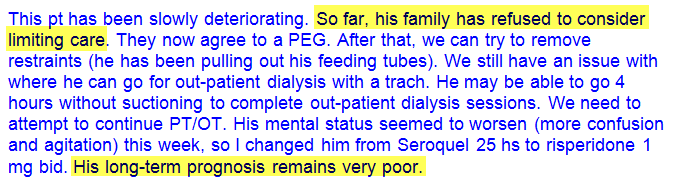

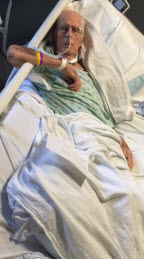
Labor Day, September 7. Mom and I arrived at the CCH at 1:00 P.M. Dad usually returned to his room from dialysis between 1:00 P.M. and 1:30 P.M., so we were surprised to see him and Michelle, his nurse, in the room. The lights were off, with the only light coming from the small windows. Michelle was at his bedside with a couple of vials of blood in her hands. She said that he had had a bad morning and that his blood pressure had dropped and his MAP had dipped into the 50s. Because of his low blood pressure, they ended his session an hour early. They removed only 64 ml of fluid, a tiny amount, and had just cleaned his blood during the session. She said that the normal dose of Midodrine that he usually took for his blood pressure didn’t help so they started him on some vasopressors, which finally increased his MAP to 65. The doctor ordered a blood workup to see if Dad was developing a sepsis condition. The nurse said that he was rousable, but he seemed pretty knocked out to us.

Michelle said that he had been more responsive before dialysis, but he was becoming less responsive. When the nurse tried to get a response from him, he scowled in pain, but wouldn’t open his eyes. The nurse said that they would check his venous blood gases and that they also ordered some blood cultures, but they wouldn’t get those results for a couple of days. The doctor came back and said that Dad was like just this before he got sick last time, which didn’t make sense to me because his condition had been improving before he aspirated in July. He added that Dad might be in septic shock again, but he didn’t know why yet. In the meantime, he ordered an additional broad-based antibiotic—in addition to the one that he was already taking.

Stan and I had traveled to Temple in one car and I hadn’t brought my computer with me, so I couldn’t stay in Temple. We had planned to leave at 2:00 P.M., but I asked Stan if we could wait an hour longer. I hated to leave my parents with my father in this condition. I left Dad’s room and called Mom’s friend, Marilyn, to see if she could stop by to stay with Mom for a while. Like a true friend in time of need, she said that she would arrive by 3:00 P.M. When I returned to his room, he started to wake up. He quickly got annoyed with the pneumatic compression devices (PCD) on his legs, and he asked why this keeps happening to him.

The doctor also suspected that Dad had acquired CDiff. Until they received the results of that lab work, they had to assume that he had it. While we were in Dad’s room, the nurse taped an isolation sign on the door. I stayed and visited with him a little longer, and then  I told him goodbye, and he kissed me goodbye.

Mom was very concerned that the doctor caused Dad’s worsening problems. While she was probably wrong, we sensed some attitude from this doctor, and found the following note from him in Dad’s chart:

words_sept7

Stan picked me up at the CCH shortly after 3:00 P.M. and I said goodbye to Mom and Marilyn.

Stan and I encountered heavy traffic during our drive back into Houston. It seemed as if everyone was returning to Houston at the same time. When we got to Buc-ee’s, about 40 miles from home, Stan stopped for a beverage. While he was inside, I called Mom to check on Dad. She said that he was doing better and that Michelle had rolled him onto his side, and he fell asleep. What was interesting about this news was that Dad had always slept on his side, and this was probably the first time during his hospitalization that he was rolled onto his side. His myriad devices and restraints had been forcing him to sleep on his back.


It’s pointless; he’ll never learn how to swallow

September 1, 2015. Dad was awake at 3:40 A.M. and was convinced that there were animals in his room. Regardless of what Michelle, his nurse, said, he insisted that they were there and he wanted her to move his bed so that he could get a better view of them. Michelle tried her best to reorient him to his surroundings by asking him some questions, but he would answer only a few of them. After he became somewhat oriented, she gave Dad his call light and left his room. A few additional hours of sleep didn’t seem to help Dad, as he still seemed somewhat confused when he woke up later.

When Jennifer arrived for Dad’s physical therapy session, Dad said that he wasn’t feeling very well, but would try to participate. She got him to do some bed exercises and eventually got him to sit on the edge of the bed. From that point on, he refused to participate and said that he wanted to lie down. She was able to assist him into the Stryker cardiac chair and then left him with Mom. Mom took him outside, and he was amazed by it; he had not been outside in almost four months, and he thoroughly enjoyed the different sensory experience.

I was in Houston, but right about that time, I received a text message from Pastor Don, who asked for Mom’s mobile phone number. He must have been near the CCH because he texted me right back that Mom and Dad were outside the building but were heading indoors. Mom had never seen Don’s car before and didn’t realize that he was in the parking lot.

After my parents returned to Dad’s room, Dad wanted to know if he and Mom were going shopping. Given his current circumstances, it was an odd question but was typical of a question he might have asked some five months earlier. While three nurses moved Dad from the Stryker chair back into bed, Pastor Don came inside and the three of them had a nice visit. There was something about visits from male friends that seemed to make Dad more lucid and engaged. We had had a similar experience when our neighbor, Tom, visited.

Dad had been receiving fentanyl for his shoulder pain, and he was sleeping when Mom returned from lunch. Mom had been told that they were reducing his dosage, but he sure seemed sleepy. After he woke up, he and Mom had a nice afternoon. She told him about the rehab facility that she and I had visited and she also told him about rehab therapy that he could receive at home.

September 2. Shortly after midnight, Dad was wide awake and very confused. Konnie, his nurse, tried to reorient him, but Dad could not recall his birth date, the time, the date, or the president. Konnie spent quite a while reorienting Dad, and then Dad slept until he was awakened shortly before 7:00 A.M. for dialysis. However, according to Suzanne, the dialysis nurse, Dad was still pretty disoriented when he arrived for his session.

When Mom arrived, Dad immediately started talking about going home, and he kept on topic for the entire day. He just could not understand why he couldn’t leave and eventually got mad at Mom for not taking him out of this place. The nurses tried to help by giving him some medication to calm his agitation.

dad08-2015Addison, one of the speech pathologists that we knew from Memorial, arrived to administer another bedside swallow study. The last one, which was administered by Holly, was a total bust. Dr. White had ordered this evaluation at my request a couple of days ago. Unfortunately, Dad responded about as well to Addison as he had to Holly a few days earlier on August 31. He refused to participate and Mom had to read him the riot act to get him to work with Addison. His swallows were delayed for a few seconds and he coughed each time he swallowed. When Addison instructed him to use his Yankauer to suction himself, he flatly refused. She tried to explain the consequences to him, but the effort was wasted breath on her part. A few minutes after Addison completed the evaluation, the respiratory therapist suctioned out the brown and purple fluid that he had aspirated during the test. Because of another failed bedside evaluation, Addison could not recommend him for the modified barium swallow study (MBSS), which would further assess his readiness to have his trach red-capped. Dad’s delirium seemed to be getting worse, and I couldn’t help but wonder what they had given Dad earlier in the day to calm him.

Shortly after 3:30 P.M., Susan stopped by for Dad’s physical therapy session. Dad had been asking all day to get out of bed. That he kept trying to get out of bed to walk to the bathroom was ironic, because he could not stand without some assistance, let alone walk. When Susan finished his session with him, she moved him to the Stryker chair with the air mattress. She admitted that Dad was making progress, albeit, very slowly.

Mom had been a little disappointed about the day. Dad had made little or no progress toward the goals laid out for him by the doctor, and Dad’s time with hospitalization coverage was quickly slipping away.

September 3. If only Dad could sleep through the night. Once again, he was awake in the middle of the night, and he set off the bed alarm when he attempted to get out of bed. He told the nurse that he needed to get out of bed so that he could go to his office and work on his finances. Konnie, the nurse, tried to reorient Dad to the fact that he was at the CCH and not at home. Dad became verbally aggressive with him and started hitting and kicking Konnie and the nurses who came to the room to assist him. Konnie finally administered Haldol, although Dad still remained pretty combative for a while afterward. His lungs were full of secretions and he needed to be suctioned, but Dad refused to let the respiratory therapist suction him. Finally, the nurse contacted the doctor, who ordered the nurses to restrain him.

When Dr. Anderson arrived later than morning, he decided to address Dad’s delirium by doubling Dad’s bedtime dosage of Seroquel. I had to assume that the increased dosage would decrease his need for restraints. The doctor had ordered that they remain in place because Dad was pulling at his devices earlier in the morning.

Dad had a much better physical therapy session today with Susan. In addition to executing the exercises, she had him use the walker to navigate from the bed to the chair. When she had finished her session with him, she left him in the Stryker chair. After Dad was situated in the chair, Esther put on his restraints.

Mom arrived as Dad was getting into the chair at the end of his physical therapy session with Susan. After the past few days, during which Dad was too weak to complete some of his exercises, Mom was thrilled to see his progress this morning.

Mom approached Dr. Anderson about letting Dad have some ice. Dad had been allowed to have some ice chips a few times each day when he was at Memorial. Holly and Addison, the speech therapists at Memorial, had told us that even if he aspirated a little of the water from the ice, it would be absorbed by his lungs. Mom thought that if he had some ice chips a few times each day, he would get some practice swallowing. The doctor said that there wasn’t any point in letting Dad have any ice because he would never learn how to swallow. Dr. Anderson added that it was “pointless [to give him ice] because Dad had aspirated so many times” since he left Memorial. Before he left the room, Mom told the doctor that she was going to check out the local dialysis center. In his typical encouraging manner, Dr. Anderson said that she’d “have to go a long way to find a dialysis center that would accept him.”

Mom had made an appointment with the director of the Scott & White dialysis center. Mom later told me that the meeting went well and that she left the meeting with the impression that the trach would not prevent Dad from receiving dialysis there.

Shortly after Mom left for her appointment with the director of the dialysis center, Dad asked Esther, his nurse, why he was restrained. She reminded him about his aggressive behavior during the night. When Dad asked to have the restraints removed, Esther told him about the requirements for removing them. He said that he understood and indicated that he would be more cooperative.

A few minutes after his restraints were removed, Dr. Sangeetha Ranganath, the infectious diseases specialist, stopped by for another assessment. Dr. Ranganath was a sweet Indian woman, but she spoke rapidly with a soft voice and an accent that Mom couldn’t understand. Mom later learned that Dr. Ranganath said that they were keeping him on the same antibiotic for another few weeks.

Dad spent about six hours in the chair and Mom felt like he had had a pretty good day and had made some progress. For her, the day was a mixture of potentially good and discouraging news. Her encounter with Dr. Anderson further hardened her negative feelings toward this doctor. However, she had come away from her meeting with the director of the dialysis center with the impression that they would be able to accommodate Dad.

Konnie was Dad’s night nurse again, and once again, he had difficulty getting Dad to understand that he had to remain in bed. Konnie was only partially successful in reorienting Dad to his situation and had to apply the restraints. He checked on Dad a few times during the night and it seemed like Dad stayed asleep.

September 4. For Dad, one day sort of morphed into the next. For him, today was dialysis day, but for the rest of us, it was the start of the Labor Day weekend. When Dad was wheeled into the dialysis center, he was still wearing his bed restraints. Dad kept attempting to get out of his bed, and Leon, the dialysis nurse, thought that Dad was very confused and disoriented.

While Dad was in dialysis, Mom met with Adan, formerly a speech pathologist at the CCH. She and I had been told by several physicians that Dad should have his feeding tube replaced with the PEG. Unfortunately, we had come to the point where we really didn’t trust some of the attending physicians. She trusted Adan and felt like she could go to him for advice. At the conclusion of their meeting, Mom was ready to tell Dr. Anderson that we wanted to proceed with the PEG procedure.

When she eventually saw the doctor, she told him of her decision. He said that he would order the procedure, but Dad might not get the PEG until Tuesday, the day after Labor Day.

One of Mom’s good friends, Sally, had admitted herself into a SNiF after hip surgery. Mom called her to get a first-hand account of her experience and what we might expect with Dad. With the exception of the food, she said that her experience was positive. She also mentioned that SNiF residents could get a pass to go home on the weekend. This was a benefit that we hadn’t considered.

During the afternoon, Jennifer stopped by for Dad’s physical therapy session. He was very uncooperative and was fixated on scissors and a hair appointment that he supposedly was late for. Jennifer was able to get him to perform only a few range-of-motion exercises during their session.

After work, Stan and I drove to Temple for the long weekend. After dinner, Mom, Stan, and I visited Dad at the CCH. We had the nurse move Dad into the Stryker chair, and then we wheeled him outside and visited with him for about 45 minutes. At 7:45 P.M., we returned Dad to his room, and the three of us returned to the house.

After we left, Dad was moved back into the bed, where the nurse reapplied his restraints.

rescuedslipperWhen the three of us arrived at the house, Mom told us that last night she had washed her slippers and had left them on the bench in the courtyard.When she woke up today, only one slipper remained. The neighbors share stories of the wildlife in the area. I decided to try my luck slipper hunting in the backyard. Sure enough, I found it under a tree, none the worse for wear. Something that seemed like a tasty treat must have left its predator with a little dry mouth. Dad would love this story.
 

Talk about your obstacle courses!

August 29, 2015. Dad’s day started around 5:00 A.M. when he was visited by Mary, a wound care nurse. The CCH wound care nurses not only tended to wounds, which you might expect, they also trimmed nails and would give Dad a shave. Neither Dad nor Mom was a fan of facial hair, so they both felt better after he received a spruce up from wound-care nurses.

img_0978When Mom and I arrived at the CCH at 7:45 A.M., Dad was sleeping. A few minutes later, the respiratory therapist woke him, finished his breathing treatment, and administered his oral care. While she was finishing her session with Dad, Dr. White arrived. He and I stepped out of the room and discussed a treatment plan for Dad that would enable him to transfer from the CCH to a skilled nursing facility (SNiF) before his hospitalization benefits expired. If we could get him into a SNiF, he could receive up to 100 days for rehabilitation therapies. When I met with Marty yesterday, she and I agreed that we would like to see him leave the CCH within a couple weeks so that he wouldn’t use up all of his lifetime reserve days of Medicare coverage.

Dr. White thought that Dad had some challenges that could prevent him from transferring to a SNiF. The doctor thought that the feeding tube would be a problem, along with Dad’s mentation and diminished strength. He also suspected that the trach tube might be another obstacle, but he wasn’t sure. He did say that based on the CT scan from yesterday afternoon, Dad’s lung condition was improving.

The doctor said that he could start the process of removing Dad’s trach tube, but he’d been moving cautiously in that regard in case they needed to intubate Dad again. I asked if Dad could start receiving swallow therapy and he said that he’d request a swallow evaluation on Monday. Dr. White said that he’d have Marty give us a list of SNiFs so that we could contact some of them to get an idea about the goals we needed to meet to transfer Dad by Oct. 1st. I told him that I’d like to aim a little higher and get him transferred sooner. He also said that Dad’s nights had been uneventful since he got out of bed a few days earlier. He also said that he would meet with Rachel, the nurse practitioner, to see if she could offer any insight into conditions that could prevent him from being admitted to a SNiF.

When I returned to his room, Dad asked to see his list of exercises. When I couldn’t lay my hands on it, he became somewhat annoyed and agitated that it was lost. I finally got him to calm down when I assured him that I’d help him redo the list.

He grimaced a lot during the morning and finally told us that his shoulder was hurting him a lot. We called for Christine, the nurse, and requested some pain medicine. A few minutes after she gave him the meds, he started complaining about sharp pains in his head. After conferring with the nurse, we suspected that the pain in his shoulder was radiating to his head. After the pain medicine took effect, he stopped complaining about pain.

Kevin from x-ray stopped by around 10:00 A.M to x-ray Dad’s shoulder. While Mom and I sat in the waiting room, I told her about my conversation with Dr. White. She didn’t want Dad to go to a SNiF, and said that she and Dad had promised each other that they would not institutionalize each other. I hadn’t expected this response. A good friend of hers had checked herself into a SNiF during her convalescence from hip surgery. I had no intention of institutionalizing Dad, but we were running out of hospitalization benefits and had to find a place where he could complete his recovery. I told her that not using a SNiF would mean that she would have to hire caregivers to come to the house. She probably would not be able to leave him alone if he was at the house. I was also pretty sure that Medicare would not cover this expense. She said that she didn’t care and would be willing to do what was necessary to keep him out of a nursing home. We dropped the subject for the time being when we returned to Dad’s room.

Dad was a lot more comfortable when the bed extension was on his bed. Unfortunately, when the extension was on the bed, the bed wouldn’t fit into the elevator, so most of the time, the extension sat in the corner of the room. Because the weekend afforded him a couple days without elevators, Christine attached the bed extension.

Dad fell asleep pretty fast when the pain meds kicked in, which seemed like a good time for Mom and me to slip out for lunch.

When we returned after lunch, Dad was lying diagonally in the bed. After Christine got him resituated, Dad and I spent much of the afternoon redoing his exercise routine. I had to talk him down from some of the exercises that he used to do in boot camp some 65 years ago. I hoped that he would be as gung-ho at execution as he was during planning. So far, the physical therapist could barely get him to stand up on the side of the bed.

The three of us watched some of the golf tournament in the afternoon, but Dad had received more pain medicine and he kept drifting off to sleep during our conversations. After one such dozing off at 4:45 P.M., Mom and I went home.

Mom and I continued our tense discussions about moving Dad from the CCH to Marlandwood West, which was a SNiF in the neighbor that, on paper, seemed like a great option for him. Mom still wasn’t convinced, and she was also very concerned about the upcoming week because Dr. Anderson would be returning as the attending physician. It was probably just a freakish coincidence, but nothing seemed to go well for Dad when Dr. Anderson was there. With all that we had going on, I decided to stay in Temple a little longer. Instead of going home on Sunday, I agreed to stay through 4:00 P.M. on Monday. In addition to seeing Dr. Anderson, I would try to stop by Marlandwood with Mom and check out the facility. At this point, we had been arguing about what we envisioned the environment to be like. We needed to see it first-hand.

While Mom and I were at home discussing rehab options, back at the CCH, Dad was attempting to get out of bed so that he could use the bathroom. Luckily, Andrea, the night nurse, intercepted his escape and convinced him to remain in bed. Fortunately, Dad stayed in bed for the remainder of the night.

August 30.  Every morning that he was in the hospital, Dad received a briefing of sorts from the nurse about the importance of staying in bed and using the call light when he needed assistance. From what I had witnessed so far, Dad had not taken these daily briefings to heart. Truth be told, between his delirium and some of his meds, I doubted that he could remember these chats with the nurses for more than a few minutes.

Mom and I arrived at the CCH at 9:05 A.M. to find that Dad was still sleeping. We learned that Dr. White was making his rounds, but he had already been to Dad’s room. We woke Dad and eventually convinced him to wear his hearing aids and wear glasses. Glasses and hearing aids might not seem like a big deal, but wearing them wasn’t always a given with him. Stan arrived at 10:00 A.M. to spell me and Mom while we attended church.

The church service lasted 15 minutes longer than usual, so we didn’t arrive home until 12:30 P.M. We were surprised that Stan wasn’t already there, but he arrived shortly after we arrived. Dad had been asking about the finances, but they were on his computer, which I had disconnected so that I could work from his desk. When we finished lunch, Stan hooked up Dad’s computer again in case he asked me to look up some financial information for him.

After saying goodbye to Stan, Mom and I returned to the CCH at 2:00 P.M. When we entered Dad’s room, we found that Angela was in his room and Dad was partway out of the bed. I tried again to see if we could raise the fourth rail but to no avail.

We had not been able to speak with the doctor today. When we asked Carrie if she could find him for us, she said that Dr. White had left the building. We had seen him walk by several times, so either she was misinformed or he had left and had subsequently returned. Regardless, we never saw him again.

For most of the afternoon, Dad slept while Mom and I watched the Barclay’s golf tournament. I hated that he slept so much, but at least we weren’t arguing about the importance of staying in bed or why he couldn’t go home. Mom and I finally left for home shortly after 4:30 P.M.

August 31. Mom had a doctor’s appointment this morning, and when she returned, she and I drove to Marlandwood, the SNiF that was located less than three miles from my parents’ house. Like many nursing facilities, it housed rehab patients who were building back their strength so that they could safely return home. Half of the facility was devoted to permanent residents.

While at the Marlandwood facility, Mom and I visited with Stacy and Colleen, representative of the facility, about moving Dad. We weren’t wild about the semi-private rooms, but we were impressed with the respiratory therapist and the PT and OT personnel. They seemed devoted to building up their rehab patients for their safe return home and they had no qualms about any of Dad’s conditions that we raised. Mom and I were very optimistic about Dad’s situation until we returned to the CCH and talked with Rachel, the nurse practitioner. According to her, Dad could not receive offsite dialysis with a trach unless he could remove his own secretions. She also said that he would need to be able to change out his trach, should a problem arise during dialysis. She reminded me that having the four rails up on the bed was considered restraint, and a SNiF would not accept him if he had been restrained. It was a terrible conversation. I know that everyone loved Rachel, but she had never offered up anything but obstacles. We never heard a single suggestion from her to help us in our plight.

dohAt 2:55 P.M., Holly stopped by for a bedside swallow assessment. She came armed with ice, grape juice, and pudding, but Dad totally refused to participate. I couldn’t take it for another minute. After trying unsuccessfully to get him to exert any effort, I yelled at him and left the building. By 3:05 P.M. I was in my car and on my way home. Between the numerous obstacles and his inability to overcome them, I was frustrated to the breaking point and I felt like I was about to explode. I stopped by the house to pick up my computer and drove home–fuming all the way. Once again, it seemed like Dad’s biggest obstacle was Dad.