Caregiver in training

September 26, 2015. I saw Angela, the respiratory therapist, a few minutes after I arrived at the CCH at 7:35 A.M. She said that after she set up a couple of more patients, she would return to Dad’s room to continue my training. Jennifer, the charge nurse, was also tasked with training me this weekend. Her instruction started with having me administer Dad’s morning meds. We started with the pills, which I was to crush and mix with water. I then drew up the liquid mixture into a syringe and emptied it into the PEG tube. The other two meds were powders: the Renvela was for his kidneys and the Beneprotein was a nutritional supplement. According to Jennifer, I had to mix the Renvela with water and then squirt out 1/3 of the mixture into the sink. The entire sachet of Beneprotein was injected into the PEG tube. After injecting all of the meds and supplements, I flushed the tube with lukewarm water to ensure that nothing remained. So far, so good.

mapAfter Jennifer left the room, Dad asked me about “all of the buildings that he was going to travel through.” I explained to him that to get home, he wouldn’t travel through buildings, but that his ambulance would take him home via the Loop and 31st Street. I drew him a bad, oversimplified map of the area and explained where everything was and the distances between them. He had been hospitalized so long that he was confused, thinking that there was a difference between our house and our home. He then told me that it would be prudent to get him a bedpan, so I called the nurse and left his room.

While waiting in the hallway, I encountered Dr. Smith and conferred with him for a few minutes. While we were chatting, he told me that I was pretty lucky because Jennifer was one of Scott & White’s top 25 nurses of the year. I had just met her this morning and had already concluded that she was very friendly, supportive, and professional. I also didn’t pick up any vibes that she was judging me for moving Dad to home care.

2015_sepeclipse_028At 11:00 A.M., Angela returned, and my respiratory therapy training ratcheted up a notch. In addition to suctioning Dad today, she said that I would change out his tracheostomy tube. I had hoped to record the process with my camera, but I ran out of disk space before I was finished. Regardless of whether you were suctioning or changing out the trach, the process required a sterile environment. There was a specific way in which to open the kit and put on the gloves, which I thought would be my undoing. Putting on a pair of gloves so that you don’t touch and contaminate them was not as easy as you might think, and I felt like a complete doofus.

I had a tiny problem getting the trach tube into his throat, but I think it was because I didn’t insert it at the correct angle. I panicked a little; Angela took over, and it slid right in. She also showed me how to clean the trach that I had just removed and how store it for the next changeout. As if all those steps weren’t important enough, it seemed like the biggest lesson was that you had to ensure that you tightened the collar enough so that it wouldn’t come out, yet not so tight that you choked the patient. Being able to place two of my fingers between the trach collar and Dad’s neck seemed to ensure the correct fit. I was a little stressed out and I couldn’t believe that I would have to perform this procedure every seven days. Was it that long ago that I thought to myself that I couldn’t imagine having to change out a trach? Sheesh.

2015_sepeclipse_047While I was sitting with Dad, Angela returned to the room with printed instructions about how to suction and change out a trach. Dad was sleeping, so I decided to read the entire document. I write technical documentation for a living, and although I’m not diligent about always reading it, this seemed like a good time to read the manual. I was glad that I did. When Angela stopped by again, I told her that the two other respiratory therapists had had me insert the tubing much further into Dad’s trach than the instructions advised. She told me that she had noticed that I had performed deep suctioning on Dad, but that it wasn’t necessary. When I changed my suctioning technique, I found that suctioning didn’t hurt Dad the way it did with some of the respiratory therapists. I was glad that Angela was now my trainer. I recalled how Dad had told her that she was different from the other respiratory therapists and how he didn’t like others, like Victor. Angela had me suction Dad the rest of the day, and by the end of the day, I was somewhat comfortable with the procedure, although I still had to psych myself up for it.

I was glad when it was time to go home for lunch.

After I returned to the CCH from lunch, Jennifer and I got Dad into the wheelchair. The next time that Angela came in to suction Dad, she noticed that he was slouched in the wheelchair. She said that he was too bent for suctioning and she would wait until he was back in bed and at a better angle. I made a mental note to myself that the angle of his neck was important when suctioning the trach.

I was by myself at the CCH for most of the day. Mom was at home preparing the house, especially the master bedroom, for Dad’s homecoming. Stan split his time between performing chores at the house and running endless errands.
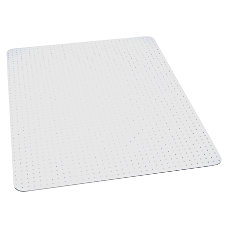
floor_matIf you spend any time at a hospital, you quickly learn that healthcare is a dirty business and the floor is difficult to keep clean. My parents’ house, including their bedroom, was carpeted with a beautiful sea green carpet. We were pretty certain that the carpeting would not survive Dad’s home care. One of Stan’s assignments was to figure out how to save the carpet. He eventually decided on chair mats. He bought out the supply of rectangular mats at Staples and Office Max and then worked out the arrangement of the mats in the bedroom. In addition to protecting the floor, the mats provided a relatively hard surface and protected the carpet from some of the heavy equipment and the wheelchair that would be brought into the room. He also purchased some shelving and boxes that we would need for storing medical supplies. Thank goodness my parents’ bedroom was large enough to accommodate everything.

By the time that the three of us met at home at the end of the day, we all felt like we had put in a full day’s work and were ready to make use of my parents’ bar.

September 27. I woke up at 5:30 A.M. and wandered into the kitchen to make coffee. I was surprised to find that my mother was already up and about. She told me that she had been awakened at 3:15 A.M. by a phone call from some college. The crank calls persisted until about 5:00 A.M. Before the annoying calls stopped, she had reached the point where she would answer the phone and immediately hang up. By the time that I woke up, she had done a lot of housework and was exhausted.

Mom and I arrived at the CCH at 9:00 A.M. Dad was awake and promptly told Mom that he had been trying to call her since 3:15 A.M. What Mom had heard was the audio caller ID announce wireless caller. The audio wasn’t all that clear, so you might imagine that it sounded something like Warless College, especially at 3:15 A.M. Mom might have appreciated the humor of the situation more if she had had 2-1/2 hours more sleep. My father could be a real pill with a phone. I don’t know if we ever knew why he was calling.

2015_sepeclipse_056Shortly after we arrived, I went to the nurses’ station to see Jennifer. She said that she had been waiting for me to arrive so that I could administer Dad’s morning meds. At practically the same time, Dr. Smith arrived and we discussed Dad’s feeding tube and his invasive lines. I agreed with the doctor that because of its upkeep and the potential for infection, we wanted the PICC line removed. It was used to administer IV medication and he had already changed Dad’s prescriptions so that he was no longer receiving any IV drugs. Dr. Smith said that if we had an emergency, we could use the dialysis catheter while trying to start another IV or insert a new central line. He said that nephrology wouldn’t like this option, but in a pinch the dialysis catheter would work. During our discussion I learned that Dad had been tested for the Candida fungus five times and had tested positive only the first time. It sure would have been nice to know this sooner. If I had had more time to think about it, I would have resented being manipulated by Dr. Ciceri. I still shudder when I thought about how close we came to withdrawing care because of misleading information.

I put on a hospital gown over my Sunday clothes and administered Dad’s morning meds. Mom and I left for church at 10:20 A.M. and once again, Stan stayed and visited with Dad.

When Mom and I had attended church last week, we had a very sobering and tearful meeting with our good friends, who I referred to as the church ladies. Our friends at church had prayed their hearts out for Dad, and they were heartbroken about his prognosis. As upset as they had been last week, they were thrilled today. They and Pastor Tom praised God about the miracle that had occurred.

Stan had a good visit with Dad and left the CCH when I called him at 12:25 P.M.

2015_sepeclipse_063I returned to the hospital at 2:00 P.M. to find that Jennifer and the aide were giving Dad a bath. When they were finished, Jennifer and I maneuvered Dad into the wheelchair. Jennifer thought that he was a bit weaker than yesterday and said that she wanted him back in bed in about an hour. It was a nice day, so after I had Dad cough up some secretions, we headed outside in the wheelchair. We strolled on all of the available sidewalks, which still wasn’t much of an outing, and then settled under the covered hospital entrance. While we were sitting out front, Stan and Mom drove up and visited. Stan could stay for only a couple of minutes because they had been grocery shopping and he had to get the perishables home. Mom and I visited outside with Dad until 3:25 P.M. Shortly after the three of us returned to Dad’s room, Jennifer, Hector, and I put him back in bed. Mom and I visited with Dad until about 4:30 P.M.

It had been another long day and Stan, Mom, and I were pooped. I had downloaded the Domino’s app to my iPad, so we ordered a pizza the 21st century way. We had ordered three pizzas since I had been staying there, which is more than I had ordered in the last 25 years. I loved to make homemade pizza, but desperate times called for takeout.

2015_sepeclipse_097Stan and I stayed up late to watch the total lunar eclipse (blood moon). While watching the moon, my dear friend Rhoda texted me to see how I was doing. I quickly called her to let her know about the miracle and our change in plans.

She was just over the moon!

 

Oh, Candidiasis!

September 18, 2015. Dad started his day in dialysis after having spent an uneventful night asleep. According to his early morning lab results, his WBC count was 12.1, up from 11.1 If only the WBC count was the worst of the lab results. Dad’s blood culture came back positive for Candida parapsilosis. When he saw the lab results, Dr. David Ciceri called Mom to tell her about the findings of the blood culture.

It being Friday, I was working in my home office in Houston. I was going to Temple the next day. This was an important weekend for me to be in Temple because I wouldn’t be returning for a couple of weeks. The stress of the past few months was taking its toll, and I was looking forward to this coming Wednesday, five days from now, when my husband and I would join my best friends in Wisconsin for the belated celebration of my birthday. The trip itself was a birthday gift, and we had been planning it since June.

Around noon, my phone rang, and the caller ID told me that it was my mother. We spoke every day, but I always initiated the calls. During the past 136 days, a phone call from her had indicated bad news. Today’s call was no exception. According to Mom, Dr. Ciceri told her that Dad tested positive for some fungus in his blood that was fatal, and could I come to Temple now?

After Mom’s phone call, I dashed off a quick email to my manager, telling her that I was leaving. I was somewhat packed for the weekend trip, so I grabbed what I could and left the house within 30 minutes of her call. The all-too-familiar drive to Temple seemed more like an eternity than three hours.

Dad returned to his room around 1:15 P.M. He had been a little confused earlier in the day but seemed to be in good spirits. His dialysis session had been pretty easy on him. He had no edema when he arrived at dialysis, so his blood was cleaned and only 342 ml of fluid was removed, which was about 15 percent of normal. Jennifer stopped by for Dad’s physical therapy session but was told by the nurse that Dad was having blood drawn.

imagesWhen I arrived, I met Dr. Ciceri and he explained to me that Dad had something that sounded like “the Canada fungus.” He said that they planned to replace his dialysis catheter and his PIC line. The doctor had also started Dad on an antifungal. He said that he requested a TTE (transthoracic echocardiogram) for later today. I didn’t understand the significance of most of what he said, but I clearly understood what he said next. He said that Dad’s prognosis was extremely poor, that he probably had one to two months to live, and would most likely die in a nursing home.

The doctor went on to say that given Dad’s prolonged illness and advanced age, as well as his current condition, it was extremely unlikely that Dad would ever improve to the point that he could go home. As we discussed options with him, Mom was adamant that Dad would not want to go to a nursing home. With so few choices, we finally ended this terrible conversation with a plan to bring him home on hospice care. The doctor said that having Dad at home on hospice care would be difficult and would require that Mom and I be able to care for him. After assuring him that home was the only option for us, the doctor said that he would instruct the nurses to start training me tomorrow. In retrospect, I can’t believe how fast we made this decision to abruptly shorten my father’s life.

I don’t know how we did it, but we visited with Dad for a couple of hours before heading home for the evening. Mom and I were shell-shocked and there were more than a few tears shed over our drinks that evening.

September 19. Dad seemed to be in good spirits when Mom and I arrived this morning and announced that he was retiring from this place, adding that he figured that he had another 10 years left in him. His voice also sounded good and he seemed to be handling his secretions with little difficulty.

Mom and I had been adamant that we could not move Dad to a nursing home, but I thought that I should give our knee-jerk decision a second thought. When we spoke with Dr. Ciceri this morning, I asked him whether a nursing home might prolong Dad’s life by months or years. He said that a nursing home might extend Dad’s life by a couple of months. He explained that dialysis was tough on patients in their 80s and 90s. When I asked him if it would be possible to extend Dad’s time at the CCH so that I could take my trip, he said that they should be able to accommodate that request. Looking back, that request was probably one of the more selfish and embarrassing moments of my life.

We concluded our conversation with Dr. Ciceri by telling him that he was one of only a couple of doctors at the CCH that we trusted, the other doctor being Dr. Smith. Coincidentally, he and Dr. Smith were partners. He explained that he and Dr. Smith were very similar, but that Dr. Smith was much more of an optimist. He liked to think of himself as a realist.

After Dad and I exchanged morning pleasantries, he initiated a couple of very strange conversations. He spoke at length about a dialysis tech by the name of Penny Nickel. When I challenged him, he insisted that such a person really did exist. I wished that we had spent more time talking about the phantom Penny, because the following conversation was somewhat shocking and very disturbing. Dad told Mom that he needed to know the names of her other children. My parents started dating shortly after high school, were married in their early 20s, and I’m their only child. At first, my mother thought that he was kidding, but he was very serious. He assumed that he would have some financial responsibility for these other offspring and so he needed to know what he was dealing with. No matter how Mom protested, he insisted that she was lying. We finally diverted his attention to another subject.

Shortly before noon, Andrea, the respiratory therapist, stopped by Dad’s room to demonstrate how to suction Dad and perform routine trach care. She told me that she would have me perform the trach care when I returned this afternoon.

When Mom and I returned home for the day, Mom was very upset that Dad believed that she had had other children. She said that she couldn’t bear the thought of him dying thinking that she had lied to him about other children.

Mom and I were having a difficult time living with our decision, and we tried to think of alternatives to our dreadful plan. We found a website that addressed home dialysis. We thought that perhaps we could have Dad at home and extend his life with dialysis. When I searched the website, I learned that Scott & White provided home-based dialysis. Mom and I decided to talk with the nephrologist and Dr. Ciceri tomorrow to see if we could explore other alternatives.

September 20. Mom and I arrived at the CCH shortly after 9:00 A.M. I located the doctor and told him that Mom and I wanted to discuss some other options, such as home-based dialysis. Without skipping a beat, he said that this was a bad idea. Among other things, he said that this option would be expensive because Medicare would not pay for dialysis for a hospice patient. He said that he would speak with Dr. Concepcion, the nephrologist, for his recommendation. Regardless of their recommendations, our plan was for Dad to continue dialysis treatment and physical therapy until he was discharged to hospice.

Dad was sleeping when we entered his room, but it was obvious to us that he had been awake earlier in the morning. Everyone we encountered mentioned some earlier conversation with him and that he seemed to be in a good mood. He finally woke up just before Mom and I left for church. Before we left his room he reminded Mom that he still wanted the list of her other children.

After church, we spoke with our friend, Sue, about at-home dialysis, and she agreed with the doctor that this was a bad idea. She said that the training would take four to six weeks and that the patient also has to come to the dialysis center each day during the training. She recommended that we stop Dad’s tube feed when he returned home. Her suggestion seemed a little cruel, but she explained that continuing to administer nutrition would only cause swelling and discomfort and would ultimately shorten his life. She thought that we might prolong his life by one to two weeks without the nutritional support.

After church and lunch, we returned to the hospital around 2:30 P.M. We were in Dad’s room for only a few minutes before he initiated another lively discussion about Mom’s other children. It took me some time, but I finally convinced him that there weren’t any other children.

With the help of the nurses, we got Dad into the Stryker cardiac chair around 3:30 P.M. The weather was unseasonably nice, so I took him outside. The warm weather and breezes lulled him to sleep in about two minutes. I wheeled him all over the hospital, but he never woke up. Around 5:00 P.M., Pam, today’s respiratory therapist, stopped by to teach me how to clean and suction the trach. It was a little nerve-wracking, but I accomplished the task without waking him. Forgetting that Dad had been able to sleep through all sorts of torturous procedures, I considered my first attempt at trach care to be a phenomenal success. Mom and I finally left the CCH around 5:40 P.M., and Dad never woke up.

After we returned home, I had a come-to-Jesus meeting with myself and reached an obvious decision: I couldn’t travel to Wisconsin with my friends and leave my mother to deal with Dad’s situation. I wrote the painful email message to my friends, telling them that my father was going to die in hospice care and that we’d need to change our plans. They knew my parents and were distressed when they read the terrible news. One of my friends had been my wing woman when Mom had her stroke. It was hard to believe that this ordeal was going to end like this.

My phone calls to my husband were a blur of changed and new plans. He and I had both planned to travel to Wisconsin, and he helped cancel our travel plans. Because we had already planned vacation time for September 25 through October 1, we’d spend that time in Temple with my parents.

phoneAt 9:40 P.M., I was awakened by the house phone, and  I ran to answer it before it woke Mom. As far as we were concerned, there was nothing worse than a nighttime phone call. My parents’ phone system had an audio caller ID. My heart practically stopped when I heard it announce that the call was from Scott & White. The call was from Jeliza, Dad’s nurse. According to her, Dad insisted that he wanted to go home and that he had seen Mom in the hall. He kept calling out for her, and the nurse couldn’t calm him. She hoped that my mother or I might be more successful. Jeliza held up the phone to Dad’s ear while I explained to him that we had been in his room until 6:00 P.M., but that he had been asleep. He asked me when we would return to see him again, and when I said, “tomorrow,” he asked if we’d come by early. When I told him that we’d see him after dialysis, he said that he wasn’t going to dialysis anymore and that he would go someplace else. I explained that going someplace else would require advance planning and that we couldn’t make alternative plans on a Sunday night. I promised him that Mom and I would be there and that I’d visit with him before I left for Houston. He agreed to that plan and we said good night. The nurse took back the phone and thanked me for talking with him.

 

Snatching defeat from the jaws of victory

September 13, 2015. While Stan, Mom, and I were eating breakfast, we spoke about Dad, our anxiety about his medical coverage and how to make the best use of his remaining coverage. We made a list of questions and requests that we wanted to address with the doctor today:

  • As long as one of us was in the room with him, we would loosen his restraints.
  • As long as we were signing all the consent forms, he didn’t get to decline physical therapy any more than he could decline antibiotics or any other treatment.
  • We wanted him in some sort of chair every day, for as many hours as possible.

As a follow-up, I wanted to know if any of the providers was concerned about Dad’s rising WBC count.

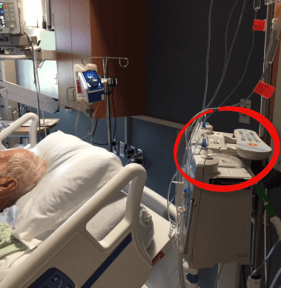
dadCallLightMom and I arrived at the CCH around 9:00 A.M. Dad was still sleeping, but some of the lights were on in his room and once again he was restrained and his call button was out of his reach. I held his hand for a few minutes while he slept. I wanted him to wake up, so I found a cloth, soaked it in warm water, and placed it over his eyes, which did the trick. After he woke up, we chatted about typical morning topics, like the weather. He was a bit disoriented about where he was for a couple of minutes, but we finally got into the groove and talked about the flowers in my parents’ courtyard at home.


trumpetPlant
Angel Trumpet

He told John, his nurse, about their Angel Trumpet plant and how he and my mother first saw its flowers when they returned from a trip. Dad started in the middle of the story and I’m sure that John didn’t understand all of what Dad said, but I knew what he was talking about. I wondered how many conversations like this one were considered nonsensical.


John told us that Dad’s blood pressure had dipped a couple of times last night. At the first occurrence, they administered Lopressor, but the second time, they were able to remedy the situation with a bolus push of saline. I don’t know if it made any difference medically, but I always preferred the saline bolus over vasopressors. In simple terms, the saline bolus adds more fluid to the blood, which increases the pressure. It’s probably not an ideal situation for dialysis patients, but I had never heard anyone mention that as a concern or a risk.

Dr. Brito, the attending physician, stopped by and spent a long time charting on the terminal in Dad’s room. She could tell from our conversation that Dad was lucid and engaged. I told her that I had asked John this morning if he would loosen the restraints while we were in the room. After listening to our conversation and knowing that Dad’s nasal feeding tube was gone, she said that they would discuss removing the restraints during rounds.

Stan arrived around 10:00 A.M., and Mom and I left for church about 15 minutes later. When we saw Stan after church, he said that he and Dad had had a nice visit and that John had removed Dad’s restraints around 11:30 A.M. Dad’s blood pressure dropped some while Stan was there, but he said that they planned to monitor him and had not started any medication—namely vasopressors.

When Mom and I returned to the CCH after lunch, Dad was dozing, but he woke easily. We chatted some more about hospital rules and about how he had to stay in bed unless supervised by hospital personnel. Before our conversation was over, he fell asleep and snoozed for about 30 minutes. John stopped by, and when we asked him about the possibility of getting Dad out of bed, he said that he would be glad to put Dad in the Stryker chair later in the day if we were there. Dad spent an hour or so in the chair and was in good spirits for the rest of the day.

Mom and I returned home without having an opportunity to share our demands with the doctor.

September 14. It was Monday and Dr. Ciceri was this week’s attending physician. I had never met him, but Mom knew him from Dad’s first stay at the CCH in June. Dad had dialysis this morning, so I worked from my parents’ home until lunchtime. Mom arrived at the CCH at 12:40 P.M., and I joined her 30 minutes later. We learned that Dad had had a rough time during dialysis today. About an hour into his session, his blood pressure dropped. In addition to the Midodrine that Suzanne, his dialysis nurse, had administered prior to starting his session, she also administered Albumin via an IV during the entire session. Shortly thereafter, he had experienced tachycardia and required Levophed. When his situation still hadn’t improved, Suzanne contacted the nephrology fellow and he had her end the session 40 minutes early. Dad looked pretty lethargic when he was returned to his room. When I asked about the results of his morning lab work, I noted that for the first time since August 19, his WBC count was elevated out of the normal range.

I wanted to speak with the nephrologist to see if there was any way in which to make dialysis sessions more tolerable for Dad. I asked Michelle, Dad’s nurse, to see if Dr. Concepcion, the nephrologist, was still in the building. She called the dialysis lab and learned that he and his fellow had left the building earlier this morning. At 1:45 P.M., she paged Dr. Ciceri for us and told us that he would stop by to see us later.

At 1:55 P.M., Marty and Dr. Ciceri stopped by to talk about Dad’s current status and our request to have him transferred to the VA hospital. After Marty had confirmed Dad’s eligibility to receive VA medical benefits, Dr. Ciceri spoke to someone in the admissions office at the VA hospital. Because Dad had received a vasopressor during dialysis today, he wasn’t considered stable enough to transfer. He needed to be off of vasopressors for at least 24 hours. The doctor said that he would reevaluate Dad’s condition tomorrow.

Because of Dad’s low blood pressure, his physical therapy session was canceled. Dad was very lethargic during most of the day. At 2:15 P.M., Brenda, a tech, administered a bedside EKG. Dad perked up somewhat during the late afternoon and seemed to be in good spirits.

Mom’s friend, Marilyn stopped by with some books. She and Mom visited briefly in the CCH  lobby, and Mom went home shortly after Marilyn left.

September 15. Mom arrived at the CCH at 8:40 A.M., just as Dad was just waking up. He seemed much different from the lethargic and ill-looking person he had been the previous day. He had been awake for only a few minutes when Jennifer arrived for his physical therapy session. He told her that he was feeling good and that he had no complaints. She had him stand and to pivot and sit and stand from the edge of the bed. At the end of the session, she was able to situate him in the Stryker cardiac chair. Jennifer was pleased with his attitude and his progress, and so was Mom. Jennifer finished her session with Dad at 9:20 A.M., and he remained in the chair until 2:00 P.M.

prezEvery morning, the doctor, nurses, or both, performed a short assessment of Dad’s mental status. From the third week after he entered the Scott & White system, he had been unable to tell the medical providers the name of the president of the United States. Although there might have been a few days in which he couldn’t remember, I suspect that most of the time he was being stubborn. He wasn’t a fan of President Obama and forgetting his name was a personal protest of Dad’s. I sometimes wondered if his refusal to acknowledge the president affected the assessment of his mental status.

Dr. Ciceri stopped by and told Mom that he had ordered several tests. He also shared the good news that Dad was now off the vasopressors.

Dad had been complaining about an echo in his hearing aids, so Mom took his hearing aids to be repaired. Before she left, she and Dad had a crazy discussion about the location of the audiologist. His delirium turned their conversation into a no-win situation for Mom, and she eventually left to complete her errand.

Mom contacted Gina, her hairdresser, to see if she would come to the CCH and give Dad a haircut. His hair had become long and scraggly, and Mom couldn’t stand it. When she told Dad, he objected, saying that he would wait until he could see his barber. Mom went to the nurses’ station to borrow a hand mirror. All it took was one glance at himself in the mirror and the discussion was over. Gina would stop by next Thursday, nine days from now.

Dad hadn’t been very successful at suctioning himself today. Shortly before Mom left for the day, she noticed that the sound of the suction machine seemed different. At the time, several nursing students were working at the CCH. Mom latched onto one and had him look at the machine. The young nursing student was able to fix the problem, and Mom thanked him profusely, calling him a techie. After the nursing student left, Dad was much more successful at clearing his own secretions.

September 16. Dad was feeling pretty good again this morning, and coincidently, his WBC count was on a downward trajectory. He had now been off of Levophed for over 24 hours. The nephrologist had planned to remove a lot less fluid than usual, so it seemed that the day was getting off to a great start. Dad required Midodrine a couple of times during his dialysis, but he tolerated the session fairly well.

When Mom learned that Dad had been off of the vasopressors for 24 hours, she asked Marty when he would transfer to the VA hospital. Marty told her that she would send the updated information to the VA hospital but the VA hospital would make the transfer arrangements. She would let Mom know more about his transfer as soon as she knew.

Now that the transfer seemed like a done deal, Mom told Dad. They had a somewhat strange conversation because of Dad’s confusion about where he was and where he would be going.

During Dad’s physical therapy session with Jennifer, he told her that he had a bit of an upset stomach, but other than that, he had no other complaints. Although he became somewhat fatigued near the end of their session, she was able to get him to complete several exercises. When they were finished, she helped him into the Stryker cardiac chair, and left him with Mom.

Mom had an afternoon appointment with Dr. Ebert, her cardiologist. The doctor wanted Mom to start taking blood thinners again. Mom had been taking Xarelto when she had her stroke in May. During her hospitalization, Dr. White, her attending physician, told her to stop taking it for at least three weeks, and the neurologist had recommended that she stop taking anticoagulants altogether. Dr. Ebert now wanted to prescribe Eliquis, a different anticoagulant. The thought of her taking blood thinners again concerned me, but Dr. Ebert had been pretty cool and honest with me when I met her in May. I had to trust some doctor, but it seemed as if the specialists focused on single organs and not the whole person.

Shortly before Mom left the CCH for the day, Adan dropped by Dad’s room and gave Mom the name of the speech pathologist at the VA hospital and assured Mom that she was great. As she left, Mom felt pretty good about the day and optimistic about getting Dad transferred from the CCH before his acute medical coverage expired in 15 days.

September 17. Yesterday had seemed like such a good day and so full of promise for the coming days. We were ready to build on yesterday’s progress and see Dad transferred to the VA hospital.

During dialysis, Dad had a pretty strong cough. Although he was able to cough up and clear a lot of thick mucus with his Yankauer, he still required periodic suctioning from the nurse and respiratory therapist. The constant suctioning support was a disappointing indication that he was still nowhere near ready to have his trach red-capped. Although Dad needed some Midodrine during dialysis, he didn’t require a vasopressor, so he would still be able to transfer to the VA hospital. Dr. Ciceri thought that Dad’s mental status was pretty good, although he still couldn’t name the president. Dad had not had any fluid removed during dialysis, so he felt a little better than usual when dialysis was over.

Dad’s heart rate became elevated during the day and when Jennifer stopped by for Dad’s physical therapy session, she was told by the nurse that he could have only bed exercises. Mom asked Jennifer if she would come back later during the day for another session. She said that she would see what she could do, but she didn’t return.

The abbreviated physical therapy session wasn’t nearly as disappointing as the visit from Marty. Marty reported that her counterpart at the VA hospital, Tracy, told her that the hospital was on divert status for dialysis beds. This meant that they could not admit another dialysis patient. Until they could, Dad would not be eligible for a transfer. Marty assured Mom that she would continue to check on the diversion status. I didn’t hold out much hope that a dialysis patient would leave the VA hospital within 15 days.


Sorta better, but not so much

September 8, 2015. Before Mom arrived at the CCH, Stacy, Dad’s nurse, informed the physical therapist that the doctor didn’t want Dad to receive physical therapy today because of his hypotension. Dad’s blood pressure had been low since his dialysis session yesterday. Dad’s WBC count was still within the normal range, although in four days it had inched upward from 6.9 to 9.2. The assumption was that as long as his WBC count was within the normal range, his hypotension was not caused by an infection.

When Mom arrived, Dad was in good spirits and they had a nice visit before she had to leave for a couple of appointments with her own doctors. She met today’s attending physician, Dr. Carl Boethel, and had time for only a brief visit with him before she had to leave. She learned that the results of Dad’s blood cultures had come back negative. We never really understood the significance of the blood cultures, but we always welcomed negative results.

During the weekend, Mom, Stan, and I had tried to brainstorm some alternative solutions for Dad’s diminishing Medicare coverage. It finally dawned on us that Dad was a veteran of the Korean War, and the VA hospital was located between my parents’ home and church. Instead of fighting the practically impossible odds of getting him admitted into the SNiF before his benefits expired, we thought that we’d see if we could get him transferred to the VA hospital. On the day that we had left Memorial, I had overheard a conversation about a patient being transferred from Memorial to the VA hospital. I recalled thinking that I hadn’t thought that the VA hospital was an option. If transferring from Memorial to the VA hospital was an option, we hoped that transferring from the CCH to the VA hospital was also an option. When Mom arrived at the CCH, she told the receptionist that she needed to speak with Marty, but Marty was home taking care of a sick child.

When she returned from her appointments with the neurologist and dermatologist, Mom asked Dad if he had met with the physical therapist. When he said that he had not seen her, Mom intercepted the therapist when she exited from the adjacent room. It was then that Mom learned about the doctor’s orders to suspend therapy for the day. Mom and I were very concerned about Dad’s weakened condition and Mom was not happy that he had remained in the bed all day. Both of my parents wanted Dad to get out of bed and onto the chair. Mom tried to get the nurses to move him to the chair, but to no avail. The fact that he had been restrained since Mom left for her doctor’s appointment didn’t help their mood either.

Mom undid Dad’s restraints a couple of times during the remainder of the day so that he could use the Yankauer, but he had a difficult time handling it and tore it apart.

As if he knew that he was needed, at 4:00 P.M. Pastor Don called Mom to see if he could stop by for a visit. He arrived at 4:45 P.M. and the three of them had a nice visit. Visits from men outside of the medical industry seemed to have a calming effect on Dad and diminished his delirium during the visit.

With all the drama surrounding Dad, it would be easy to forget about Mom’s issues. In addition to her recent stroke, she had also been battling bouts of skin cancer. I was pleased when I learned that she received gold stars from her dermatologist and neurologist.

September 9. Today was my wedding anniversary and I was at home in Houston with Stan. At the CCH, Dad woke up disoriented, and when he arrived at dialysis, Suzanne, his dialysis nurse, thought that he seemed very confused. Statistically, it wasn’t much different, but his WBC count had ticked up by the smallest amount. Although his WBC count was still within the normal range, I was apprehensive about the trend. It seemed that I was the only one who was concerned, and I was 160 miles from the action.

Mom was able to spend a few minutes talking with Dr. Whitney Prince, today’s attending physician. She told Mom that Dad was scheduled to receive the PEG tube tomorrow.

After Mom left for the day, Andrea, Dad’s night nurse, found him with his legs hanging out of the bed, which was practically his default position. The way that he kept sliding down the bed, you’d think that he slept on silk sheets. Other than that little intervention with Andrea, Dad slept through the night without any drama.

September 10. Because of his scheduled PEG placement today, Dad was NPO when the morning shift started. While Dad was waiting for his transfer to Memorial for the procedure, Marty told my parents that she had faxed his clinical records to the Marlandwood West nursing facility. According to Marty, they told her that because Dad was taking antibiotics, they could not accept him. She also said that the dialysis center would prefer that he require less suctioning before they would accept him. The hand restraints were also a blocker. Unfortunately, we couldn’t make Dad understand the problems that he caused with his repeated attempts to get out of bed. He now had only 22 days of hospitalization Medicare coverage. We hoped that the VA hospital would turn out to be a viable option.

At 10:30 A.M. the Scott & White paramedics arrived and transported Dad to the Interventional Radiology (IR) department at Memorial. It seemed that he didn’t have a set time on the IR schedule and Dad had to bide his time until 1:15 P.M., which was when they prepped him for the procedure. The procedure went well, and he finally returned to his room at the CCH at 3:40 P.M. My mother was told that he still had to use the nasal tube for another 24 hours, and then he should be able to start using the PEG.

Mom stayed at the CCH for a short time after Dad returned before she went home for the evening.

September 11. At 3:30 A.M., Andrea, Dad’s night nurse, discovered that Dad had disconnected the tube from his new PEG. She didn’t notice any visible damage to his abdomen as a result of his handiwork, and she reconnected the tube. He eventually went back to sleep and slept until his nurse woke him for dialysis. Suzanne, the dialysis nurse, noticed that he had thick white secretions, and although his WBC count was still within normal range, in two days it had inched up to 9.9 from 9.3. In the period of a couple of weeks, his WBC count had increased from 6.5 to 9.9. I understood that I had to look at the whole person and should not concentrate on the numbers, and blah, blah, blah, but the trend of these lab results made me a little nervous.

Dr. Whitney returned today as the attending physician and she stopped by to assess Dad during dialysis.

When Mom arrived, she noticed that Dad was tightly restrained to his bed. When she asked why, she was told that Dad kept trying to pull out his trach. Dad’s speech was slurred and Mom could barely understand him. His oxygen saturation had been low, so his speaking valve was removed, which made communicating with him even more difficult. Speaking valves block a small amount of air intake, so if he wasn’t getting enough oxygen, removing the speaking valve could solve the problem.

Jennifer arrived in the late afternoon for his physical therapy session. At first, Dad said that he didn’t want physical therapy today, but Mom persevered and he participated. Once he got started, he seemed to enjoy the session. After he performed the bed exercises, he was able to sit on the edge of the bed and move around on the bed and swing his legs. Before Jennifer left, she and the nurse put Dad in the Stryker cardiac chair and he slept in the chair for about an hour, with his hands restrained to the chair.

Mom was a little frustrated with the day. According to the whiteboard in Dad’s room, he was supposed to have the nasal feeding tube removed today, but John, Dad’s nurse, was hesitant to remove it. Finally, at 4:00 P.M he started the tube feed through the PEG, but he still didn’t remove the nasal feeding tube. Mom had also wanted to talk with Marty about having Dad transferred to the VA hospital. Unfortunately, Marty didn’t come to work today so Mom would have to wait until Monday to talk with her. At 4:45 P.M., Mom found John and told him that she was leaving for the day.

I had left Houston after work and arrived at my parents’ home in time for an update on Dad and a much-needed glass of wine before dinner.

img_1194September 12. Mom and I arrived at the CCH at 8:00 A.M. Dad was still restrained and his call button was on the floor. John, Dad’s nurse, told us that his heart rate had been elevated to 135 and he became tachycardic. After they gave him some vasopressors, his heart rate returned to a more normal 68.

John said that Dad had had a good night, but when I asked him about the restraints, he said that Dad had tried again to decannulate himself, so the restraints had to remain.

When the new attending physician, Dr. Veronica Brito, stopped by for a pre-round check, we asked her about the restraints and the possibility of getting Dad into the Stryker chair. We had never met this doctor, but she told us that she was on the regular rotation with the CCH. Because of vacations and some shift changes, we had missed seeing her during Dad’s earlier stay at the CCH. She told us that the nurses didn’t think that Dad was strong enough to get in the chair. I was annoyed and she and I had an intense discussion about exercise, restraints, and dialysis. I told her that we wanted a plan to get him off of the restraints and that it was one of the issues that was keeping him here. She said that he had other problems that were keeping him here–like his dialysis. I told her that the dialysis wasn’t keeping him here and that primary thing keeping him from West was the restraints. She said that he was still very sick and that we had to respect his health. I told her that at Memorial, it seemed very important for him to get in the chair every day, even if three nurses had to drag him to it. I told her that I couldn’t understand why getting out of bed didn’t seem important at the CCH.

At 10:30 A.M., I was surprised when John and Hector, an aide, moved Dad from the bed to the Stryker chair. John said that he didn’t think that Dad should go outside where he couldn’t be monitored by the nurses. Mom and I wanted to see how Dad fared in the chair this morning, and if Dad’s vitals remained within a good range, maybe we could take him outside this afternoon. Shortly before we left for lunch, a nurse stopped by and finally removed Dad’s nasal feeding tube.

When Mom and I returned after lunch, Dad was in the Stryker chair and John and Hector prepared him for our cardiac chair road trip. His invasive devices had to be unhooked from the wall and attached to mobile-equivalent devices. Mom manned the oxygen tank and I drove the chair. We weren’t permitted to go outside, but we explored every hallway in the building. We chatted a lot, although I couldn’t understand most of what he said. He said that he was glad that I was there because he said that I was his tiger, compared to Mom, who he said was more like a kitten. Statements like that proved how little he knew about Mom’s role and daily battles on his behalf. If we could ever get him out of this place, I’d have to address some of his misperceptions.

Mom and I left the CCH at 4:45 P.M. and Stan arrived at the house shortly after we returned to the house. This was another one of his short trips in which he would take care of the yard, sit with Dad while we were at church, and then return home. We told Stan about the day and the new attending physician. Although we had had an intense discussion with her, she seemed to listen to us. All in all, it had been a pretty good day.


One step forward, two steps back


September 5, 2015. When we opened the Temple Daily Telegram, we were greeted with the unfortunate news of another Scott & White doctor dying, this time in a climbing accident. Scott & White had now lost two doctors during Dad’s hospitalization.

I arrived at Dad’s room at 9:45 A.M. The window shades were open, but the lights were off and he was still asleep. The first thing that I noticed was that he was restrained with his wrists bound to the side rails, which prevented him from being able to call for assistance or suction himself. I used the call button to call the nurse, but she cut me off while I was speaking. I was pretty annoyed when I called her, but being cut off mid-sentence really irked me. I stormed out of Dad’s  room to the nurses’ station and told the nurse that if she was going to leave him in a helpless state, I expected her to stop by his room every 15 minutes to tend him, or loosen the restraints to the point that he could suction himself. The nurse and respiratory therapist accompanied me back into Dad’s room. The three of us were followed by the charge nurse, who gave me a dressing down for yelling at her nurses at the nurses’ station. I wasn’t yelling, but there was no doubt that I sounded very annoyed. As I walked back to Dad’s room, I asked them if they possessed any humanity at all.

As Dad woke up, he started becoming agitated about his restraints. He also kept saying that he was done here and wanted to leave. Who could blame him?

At 10:20 A.M., Alyssa, his nurse, stopped by to tend to a wound on his right foot.  She also tended to his oral care for the morning. Dad wasn’t wild about having his teeth cleaned, but he finally let her do it.  I tried my best to explain how important oral care was to his situation, but he didn’t believe that we were helping him.

At 10:40 A.M., a couple of nurses stopped by to reposition him. I had to remind them to give him enough slack in his restraints so that he could suction himself.

lumen60I left the CCH at 11:40 A.M. to have lunch at the house with Mom and Stan. They had stayed at the house to do some yard work.  Mom had found a couple of snake skins, which I took to use with some of my lumen printing. I thought that they might add a nice touch to my fig leaf prints.

Mom and I returned to the hospital at 2:00 P.M. Dad kept wanting to get out of bed, and I kept trying to get him to understand that he had to follow the rules and stay in bed or else they would restrain him. Alyssa then told me that Dr. Anderson wanted Dad restrained 24/7.

At 2:45 P.M., his feeding tube became clogged. Alyssa couldn’t clear it, so she went to enlist some help from Melissa, another nurse. While she was out of the room, Victor, the respiratory therapist, came in to clean Dad’s trach dressing and to suction him. Dad had mentioned to me that he didn’t like this respiratory therapist. He would insert the suction tube down the trach to the point that Dad would gag, then he’d sort of giggle and push it deeper until Dad’s legs would shake. It was a disturbing spectacle to watch and wasn’t typical of all of the respiratory therapists.

While he was in the room, Victor told us that Dad was still be being suctioned a few times a day. Until Dad could remove his secretions better, they couldn’t contemplate red-capping him.

After Victor left, I gave Dad a bunch of pep talks about coughing and suctioning to the point that he asked me if I was his cheerleader. Sometimes I could be a little over the top, but I felt like I was practically willing him to improve.

At 4:10 P.M., the nurses came back to Dad’s room to try to clear out his clogged feeding tube. They tried moving him around in the bed to see if the movement would help clear up the clog. They then loosened up the tie on his right hand so that he could use it to hold the Yankauer, his suctioning wand. After they had given him some slack in the restraints he said that he usually used his left hand for the Yankauer, which made the nurses laugh. They changed the restraints again so that he could suction himself with his left hand.

Mom and I left for home around 4:30 P.M. Dad looked so lonely. I hated to leave him. On the way out, one of the nurses told us that he had asked her for scissors. When she told him that she couldn’t do that, he told her that she wouldn’t have to tell anyone about it. Everything about Dad’s behavior seemed so surreal. He was delirious to the point that he was like a different person, but occasionally his sense of humor surfaced. Even the nurse thought his request was funny.

Stan treated Mom and me to a dinner at J&B’s. After dinner, we stopped back by the hospital to say goodnight to Dad, but he was asleep. The only person who saw us was Victor.

I was so worried about Dad and his restraints. I just couldn’t envision the doctor ever having them removed. Of course, it would have been nice to see Dr. Anderson so that we could discuss it. When we did catch sight of him, he just walked by without acknowledging our presence.

Although Dad’s hands were restrained, his feet weren’t. Three times during the night, Connie, his nurse, found him with both of his legs dangling out of the side of the bed. Before putting his legs back in the bed, she tried to convince him that he needed to keep his legs in the bed.

September 6. Before we went to the CCH, I emailed three of my best friends about an upcoming trip to Wisconsin that was scheduled for late September. The trip was a birthday gift from my girlfriends and I was looking forward to the break. My Dad’s condition had been a little touch-and-go recently, but I was still hopefully optimistic that he would be well enough for me to feel comfortable leaving him for five days.

img_1190Mom and I arrived at Dad’s room around 9:15 A.M. Dad was getting an IV for a heart flutter. I asked the doctor about his restraints and about his plan for removing them. Because the Seroquel didn’t seem to be addressing his delirium, the doctor told me that he was switching him to Risperidone. He said that Dad pulled out his feeding tube three times overnight. I believed him at the time, but there was nothing in Dad’s chart that supported such a statement. When I asked about what was keeping him at the CCH, he said that they needed to check to see whether the dialysis center would take him.
In the last day or so, it seemed that Dad had lost his manual dexterity, which affected his ability to suction himself. It was hard to watch him fumble with the Yankauer and not be able to hold it up to his mouth. Mom and I agreed that we should ask the doctor to see if Dad could have some occupational therapy to help regain his ability to suction himself.

Mom and I left for church shortly after 10:00 A.M. and Stan stayed with Dad during our absence. At church, the sermon was about waiting. Sometimes it seemed like the pastor wrote his sermons specifically for us.

After lunch, Mom and I returned to the hospital around 2:00 P.M. Dad announced that he was ready for a ride in the chair.

Michelle got him in the Stryker chair, showed me how to use it, and we took off. It’s a wild chair with wheels that move independently of each other, so you can move sideways. With Mom in charge of the portable oxygen tank and me in charge of driving the chair, we went up and down the halls, out the front door and back in. I also took him towards the back of the hospital and out the delivery doors, which was where he entered this place via ambulance. The doors opened easily enough to let us out, but they did not reopen when we tried to return. As long as we were outside, I tried to give Dad the lay of the land. When my parents first moved to Temple, they lived just a short distance from this facility. He really had no concept of where he was, and I think that he enjoyed the time outside and the mini geography lesson.

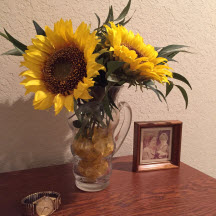
silksuns_thumbWhen we were ready to return to the air conditioning, I tried the back door buzzer, which notified the nurses’ station that someone was at the receiving entrance. The nurses kindly told me that it wasn’t safe to go out that door. I took Dad out for one more spin, but through the front door. When we returned to his room, he said that he wanted to go back to his room. I told him that he was in his room. To orient him to his surroundings, I backed him out of his room and pushed him back in. I also showed him his sunflowers and told him that as long as he saw those flowers, he was in his room. He then fell fast asleep. We called Michelle, his nurse, to tell her that we were leaving. She fastened a gait belt around him so that he wouldn’t slide out of the chair and said that they would move him back to bed before the shift change. Mom and I then left at 4:30. We stopped off at HEB and picked up a pizza for our dinner.

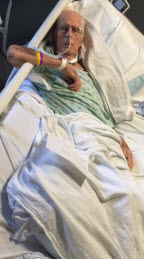
Labor Day, September 7. Mom and I arrived at the CCH at 1:00 P.M. Dad usually returned to his room from dialysis between 1:00 P.M. and 1:30 P.M., so we were surprised to see him and Michelle, his nurse, in the room. The lights were off, with the only light coming from the small windows. Michelle was at his bedside with a couple of vials of blood in her hands. She said that he had had a bad morning and that his blood pressure had dropped and his MAP had dipped into the 50s. Because of his low blood pressure, they ended his session an hour early. They removed only 64 ml of fluid, a tiny amount, and had just cleaned his blood during the session. She said that the normal dose of Midodrine that he usually took for his blood pressure didn’t help so they started him on some vasopressors, which finally increased his MAP to 65. The doctor ordered a blood workup to see if Dad was developing a sepsis condition. The nurse said that he was rousable, but he seemed pretty knocked out to us.

Michelle said that he had been more responsive before dialysis, but he was becoming less responsive. When the nurse tried to get a response from him, he scowled in pain, but wouldn’t open his eyes. The nurse said that they would check his venous blood gases and that they also ordered some blood cultures, but they wouldn’t get those results for a couple of days. The doctor came back and said that Dad was like just this before he got sick last time, which didn’t make sense to me because his condition had been improving before he aspirated in July. He added that Dad might be in septic shock again, but he didn’t know why yet. In the meantime, he ordered an additional broad-based antibiotic—in addition to the one that he was already taking.

Stan and I had traveled to Temple in one car and I hadn’t brought my computer with me, so I couldn’t stay in Temple. We had planned to leave at 2:00 P.M., but I asked Stan if we could wait an hour longer. I hated to leave my parents with my father in this condition. I left Dad’s room and called Mom’s friend, Marilyn, to see if she could stop by to stay with Mom for a while. Like a true friend in time of need, she said that she would arrive by 3:00 P.M. When I returned to his room, he started to wake up. He quickly got annoyed with the pneumatic compression devices (PCD) on his legs, and he asked why this keeps happening to him.

The doctor also suspected that Dad had acquired CDiff. Until they received the results of that lab work, they had to assume that he had it. While we were in Dad’s room, the nurse taped an isolation sign on the door. I stayed and visited with him a little longer, and then  I told him goodbye, and he kissed me goodbye.

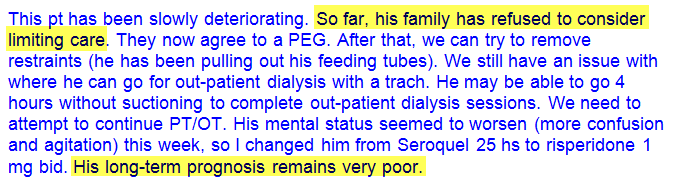
Mom was very concerned that the doctor caused Dad’s worsening problems. While she was probably wrong, we sensed some attitude from this doctor, and found the following note from him in Dad’s chart:

words_sept7

Stan picked me up at the CCH shortly after 3:00 P.M. and I said goodbye to Mom and Marilyn.

Stan and I encountered heavy traffic during our drive back into Houston. It seemed as if everyone was returning to Houston at the same time. When we got to Buc-ee’s, about 40 miles from home, Stan stopped for a beverage. While he was inside, I called Mom to check on Dad. She said that he was doing better and that Michelle had rolled him onto his side, and he fell asleep. What was interesting about this news was that Dad had always slept on his side, and this was probably the first time during his hospitalization that he was rolled onto his side. His myriad devices and restraints had been forcing him to sleep on his back.


It’s pointless; he’ll never learn how to swallow

September 1, 2015. Dad was awake at 3:40 A.M. and was convinced that there were animals in his room. Regardless of what Michelle, his nurse, said, he insisted that they were there and he wanted her to move his bed so that he could get a better view of them. Michelle tried her best to reorient him to his surroundings by asking him some questions, but he would answer only a few of them. After he became somewhat oriented, she gave Dad his call light and left his room. A few additional hours of sleep didn’t seem to help Dad, as he still seemed somewhat confused when he woke up later.

When Jennifer arrived for Dad’s physical therapy session, Dad said that he wasn’t feeling very well, but would try to participate. She got him to do some bed exercises and eventually got him to sit on the edge of the bed. From that point on, he refused to participate and said that he wanted to lie down. She was able to assist him into the Stryker cardiac chair and then left him with Mom. Mom took him outside, and he was amazed by it; he had not been outside in almost four months, and he thoroughly enjoyed the different sensory experience.

I was in Houston, but right about that time, I received a text message from Pastor Don, who asked for Mom’s mobile phone number. He must have been near the CCH because he texted me right back that Mom and Dad were outside the building but were heading indoors. Mom had never seen Don’s car before and didn’t realize that he was in the parking lot.

After my parents returned to Dad’s room, Dad wanted to know if he and Mom were going shopping. Given his current circumstances, it was an odd question but was typical of a question he might have asked some five months earlier. While three nurses moved Dad from the Stryker chair back into bed, Pastor Don came inside and the three of them had a nice visit. There was something about visits from male friends that seemed to make Dad more lucid and engaged. We had had a similar experience when our neighbor, Tom, visited.

Dad had been receiving fentanyl for his shoulder pain, and he was sleeping when Mom returned from lunch. Mom had been told that they were reducing his dosage, but he sure seemed sleepy. After he woke up, he and Mom had a nice afternoon. She told him about the rehab facility that she and I had visited and she also told him about rehab therapy that he could receive at home.

September 2. Shortly after midnight, Dad was wide awake and very confused. Konnie, his nurse, tried to reorient him, but Dad could not recall his birth date, the time, the date, or the president. Konnie spent quite a while reorienting Dad, and then Dad slept until he was awakened shortly before 7:00 A.M. for dialysis. However, according to Suzanne, the dialysis nurse, Dad was still pretty disoriented when he arrived for his session.

When Mom arrived, Dad immediately started talking about going home, and he kept on topic for the entire day. He just could not understand why he couldn’t leave and eventually got mad at Mom for not taking him out of this place. The nurses tried to help by giving him some medication to calm his agitation.

dad08-2015Addison, one of the speech pathologists that we knew from Memorial, arrived to administer another bedside swallow study. The last one, which was administered by Holly, was a total bust. Dr. White had ordered this evaluation at my request a couple of days ago. Unfortunately, Dad responded about as well to Addison as he had to Holly a few days earlier on August 31. He refused to participate and Mom had to read him the riot act to get him to work with Addison. His swallows were delayed for a few seconds and he coughed each time he swallowed. When Addison instructed him to use his Yankauer to suction himself, he flatly refused. She tried to explain the consequences to him, but the effort was wasted breath on her part. A few minutes after Addison completed the evaluation, the respiratory therapist suctioned out the brown and purple fluid that he had aspirated during the test. Because of another failed bedside evaluation, Addison could not recommend him for the modified barium swallow study (MBSS), which would further assess his readiness to have his trach red-capped. Dad’s delirium seemed to be getting worse, and I couldn’t help but wonder what they had given Dad earlier in the day to calm him.

Shortly after 3:30 P.M., Susan stopped by for Dad’s physical therapy session. Dad had been asking all day to get out of bed. That he kept trying to get out of bed to walk to the bathroom was ironic, because he could not stand without some assistance, let alone walk. When Susan finished his session with him, she moved him to the Stryker chair with the air mattress. She admitted that Dad was making progress, albeit, very slowly.

Mom had been a little disappointed about the day. Dad had made little or no progress toward the goals laid out for him by the doctor, and Dad’s time with hospitalization coverage was quickly slipping away.

September 3. If only Dad could sleep through the night. Once again, he was awake in the middle of the night, and he set off the bed alarm when he attempted to get out of bed. He told the nurse that he needed to get out of bed so that he could go to his office and work on his finances. Konnie, the nurse, tried to reorient Dad to the fact that he was at the CCH and not at home. Dad became verbally aggressive with him and started hitting and kicking Konnie and the nurses who came to the room to assist him. Konnie finally administered Haldol, although Dad still remained pretty combative for a while afterward. His lungs were full of secretions and he needed to be suctioned, but Dad refused to let the respiratory therapist suction him. Finally, the nurse contacted the doctor, who ordered the nurses to restrain him.

When Dr. Anderson arrived later than morning, he decided to address Dad’s delirium by doubling Dad’s bedtime dosage of Seroquel. I had to assume that the increased dosage would decrease his need for restraints. The doctor had ordered that they remain in place because Dad was pulling at his devices earlier in the morning.

Dad had a much better physical therapy session today with Susan. In addition to executing the exercises, she had him use the walker to navigate from the bed to the chair. When she had finished her session with him, she left him in the Stryker chair. After Dad was situated in the chair, Esther put on his restraints.

Mom arrived as Dad was getting into the chair at the end of his physical therapy session with Susan. After the past few days, during which Dad was too weak to complete some of his exercises, Mom was thrilled to see his progress this morning.

Mom approached Dr. Anderson about letting Dad have some ice. Dad had been allowed to have some ice chips a few times each day when he was at Memorial. Holly and Addison, the speech therapists at Memorial, had told us that even if he aspirated a little of the water from the ice, it would be absorbed by his lungs. Mom thought that if he had some ice chips a few times each day, he would get some practice swallowing. The doctor said that there wasn’t any point in letting Dad have any ice because he would never learn how to swallow. Dr. Anderson added that it was “pointless [to give him ice] because Dad had aspirated so many times” since he left Memorial. Before he left the room, Mom told the doctor that she was going to check out the local dialysis center. In his typical encouraging manner, Dr. Anderson said that she’d “have to go a long way to find a dialysis center that would accept him.”

Mom had made an appointment with the director of the Scott & White dialysis center. Mom later told me that the meeting went well and that she left the meeting with the impression that the trach would not prevent Dad from receiving dialysis there.

Shortly after Mom left for her appointment with the director of the dialysis center, Dad asked Esther, his nurse, why he was restrained. She reminded him about his aggressive behavior during the night. When Dad asked to have the restraints removed, Esther told him about the requirements for removing them. He said that he understood and indicated that he would be more cooperative.

A few minutes after his restraints were removed, Dr. Sangeetha Ranganath, the infectious diseases specialist, stopped by for another assessment. Dr. Ranganath was a sweet Indian woman, but she spoke rapidly with a soft voice and an accent that Mom couldn’t understand. Mom later learned that Dr. Ranganath said that they were keeping him on the same antibiotic for another few weeks.

Dad spent about six hours in the chair and Mom felt like he had had a pretty good day and had made some progress. For her, the day was a mixture of potentially good and discouraging news. Her encounter with Dr. Anderson further hardened her negative feelings toward this doctor. However, she had come away from her meeting with the director of the dialysis center with the impression that they would be able to accommodate Dad.

Konnie was Dad’s night nurse again, and once again, he had difficulty getting Dad to understand that he had to remain in bed. Konnie was only partially successful in reorienting Dad to his situation and had to apply the restraints. He checked on Dad a few times during the night and it seemed like Dad stayed asleep.

September 4. For Dad, one day sort of morphed into the next. For him, today was dialysis day, but for the rest of us, it was the start of the Labor Day weekend. When Dad was wheeled into the dialysis center, he was still wearing his bed restraints. Dad kept attempting to get out of his bed, and Leon, the dialysis nurse, thought that Dad was very confused and disoriented.

While Dad was in dialysis, Mom met with Adan, formerly a speech pathologist at the CCH. She and I had been told by several physicians that Dad should have his feeding tube replaced with the PEG. Unfortunately, we had come to the point where we really didn’t trust some of the attending physicians. She trusted Adan and felt like she could go to him for advice. At the conclusion of their meeting, Mom was ready to tell Dr. Anderson that we wanted to proceed with the PEG procedure.

When she eventually saw the doctor, she told him of her decision. He said that he would order the procedure, but Dad might not get the PEG until Tuesday, the day after Labor Day.

One of Mom’s good friends, Sally, had admitted herself into a SNiF after hip surgery. Mom called her to get a first-hand account of her experience and what we might expect with Dad. With the exception of the food, she said that her experience was positive. She also mentioned that SNiF residents could get a pass to go home on the weekend. This was a benefit that we hadn’t considered.

During the afternoon, Jennifer stopped by for Dad’s physical therapy session. He was very uncooperative and was fixated on scissors and a hair appointment that he supposedly was late for. Jennifer was able to get him to perform only a few range-of-motion exercises during their session.

After work, Stan and I drove to Temple for the long weekend. After dinner, Mom, Stan, and I visited Dad at the CCH. We had the nurse move Dad into the Stryker chair, and then we wheeled him outside and visited with him for about 45 minutes. At 7:45 P.M., we returned Dad to his room, and the three of us returned to the house.

After we left, Dad was moved back into the bed, where the nurse reapplied his restraints.

rescuedslipperWhen the three of us arrived at the house, Mom told us that last night she had washed her slippers and had left them on the bench in the courtyard.When she woke up today, only one slipper remained. The neighbors share stories of the wildlife in the area. I decided to try my luck slipper hunting in the backyard. Sure enough, I found it under a tree, none the worse for wear. Something that seemed like a tasty treat must have left its predator with a little dry mouth. Dad would love this story.
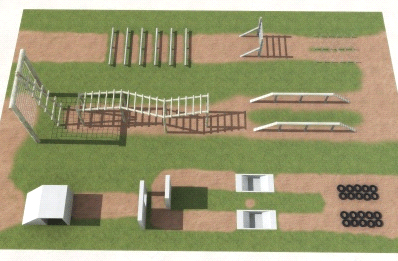
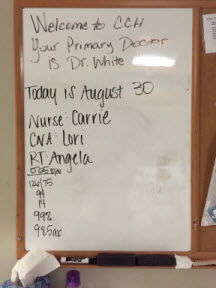
 

Talk about your obstacle courses!

August 29, 2015. Dad’s day started around 5:00 A.M. when he was visited by Mary, a wound care nurse. The CCH wound care nurses not only tended to wounds, which you might expect, they also trimmed nails and would give Dad a shave. Neither Dad nor Mom was a fan of facial hair, so they both felt better after he received a spruce up from wound-care nurses.

img_0978When Mom and I arrived at the CCH at 7:45 A.M., Dad was sleeping. A few minutes later, the respiratory therapist woke him, finished his breathing treatment, and administered his oral care. While she was finishing her session with Dad, Dr. White arrived. He and I stepped out of the room and discussed a treatment plan for Dad that would enable him to transfer from the CCH to a skilled nursing facility (SNiF) before his hospitalization benefits expired. If we could get him into a SNiF, he could receive up to 100 days for rehabilitation therapies. When I met with Marty yesterday, she and I agreed that we would like to see him leave the CCH within a couple weeks so that he wouldn’t use up all of his lifetime reserve days of Medicare coverage.

Dr. White thought that Dad had some challenges that could prevent him from transferring to a SNiF. The doctor thought that the feeding tube would be a problem, along with Dad’s mentation and diminished strength. He also suspected that the trach tube might be another obstacle, but he wasn’t sure. He did say that based on the CT scan from yesterday afternoon, Dad’s lung condition was improving.

The doctor said that he could start the process of removing Dad’s trach tube, but he’d been moving cautiously in that regard in case they needed to intubate Dad again. I asked if Dad could start receiving swallow therapy and he said that he’d request a swallow evaluation on Monday. Dr. White said that he’d have Marty give us a list of SNiFs so that we could contact some of them to get an idea about the goals we needed to meet to transfer Dad by Oct. 1st. I told him that I’d like to aim a little higher and get him transferred sooner. He also said that Dad’s nights had been uneventful since he got out of bed a few days earlier. He also said that he would meet with Rachel, the nurse practitioner, to see if she could offer any insight into conditions that could prevent him from being admitted to a SNiF.

When I returned to his room, Dad asked to see his list of exercises. When I couldn’t lay my hands on it, he became somewhat annoyed and agitated that it was lost. I finally got him to calm down when I assured him that I’d help him redo the list.

He grimaced a lot during the morning and finally told us that his shoulder was hurting him a lot. We called for Christine, the nurse, and requested some pain medicine. A few minutes after she gave him the meds, he started complaining about sharp pains in his head. After conferring with the nurse, we suspected that the pain in his shoulder was radiating to his head. After the pain medicine took effect, he stopped complaining about pain.

Kevin from x-ray stopped by around 10:00 A.M to x-ray Dad’s shoulder. While Mom and I sat in the waiting room, I told her about my conversation with Dr. White. She didn’t want Dad to go to a SNiF, and said that she and Dad had promised each other that they would not institutionalize each other. I hadn’t expected this response. A good friend of hers had checked herself into a SNiF during her convalescence from hip surgery. I had no intention of institutionalizing Dad, but we were running out of hospitalization benefits and had to find a place where he could complete his recovery. I told her that not using a SNiF would mean that she would have to hire caregivers to come to the house. She probably would not be able to leave him alone if he was at the house. I was also pretty sure that Medicare would not cover this expense. She said that she didn’t care and would be willing to do what was necessary to keep him out of a nursing home. We dropped the subject for the time being when we returned to Dad’s room.

Dad was a lot more comfortable when the bed extension was on his bed. Unfortunately, when the extension was on the bed, the bed wouldn’t fit into the elevator, so most of the time, the extension sat in the corner of the room. Because the weekend afforded him a couple days without elevators, Christine attached the bed extension.

Dad fell asleep pretty fast when the pain meds kicked in, which seemed like a good time for Mom and me to slip out for lunch.

When we returned after lunch, Dad was lying diagonally in the bed. After Christine got him resituated, Dad and I spent much of the afternoon redoing his exercise routine. I had to talk him down from some of the exercises that he used to do in boot camp some 65 years ago. I hoped that he would be as gung-ho at execution as he was during planning. So far, the physical therapist could barely get him to stand up on the side of the bed.

The three of us watched some of the golf tournament in the afternoon, but Dad had received more pain medicine and he kept drifting off to sleep during our conversations. After one such dozing off at 4:45 P.M., Mom and I went home.

Mom and I continued our tense discussions about moving Dad from the CCH to Marlandwood West, which was a SNiF in the neighbor that, on paper, seemed like a great option for him. Mom still wasn’t convinced, and she was also very concerned about the upcoming week because Dr. Anderson would be returning as the attending physician. It was probably just a freakish coincidence, but nothing seemed to go well for Dad when Dr. Anderson was there. With all that we had going on, I decided to stay in Temple a little longer. Instead of going home on Sunday, I agreed to stay through 4:00 P.M. on Monday. In addition to seeing Dr. Anderson, I would try to stop by Marlandwood with Mom and check out the facility. At this point, we had been arguing about what we envisioned the environment to be like. We needed to see it first-hand.

While Mom and I were at home discussing rehab options, back at the CCH, Dad was attempting to get out of bed so that he could use the bathroom. Luckily, Andrea, the night nurse, intercepted his escape and convinced him to remain in bed. Fortunately, Dad stayed in bed for the remainder of the night.

August 30.  Every morning that he was in the hospital, Dad received a briefing of sorts from the nurse about the importance of staying in bed and using the call light when he needed assistance. From what I had witnessed so far, Dad had not taken these daily briefings to heart. Truth be told, between his delirium and some of his meds, I doubted that he could remember these chats with the nurses for more than a few minutes.

Mom and I arrived at the CCH at 9:05 A.M. to find that Dad was still sleeping. We learned that Dr. White was making his rounds, but he had already been to Dad’s room. We woke Dad and eventually convinced him to wear his hearing aids and wear glasses. Glasses and hearing aids might not seem like a big deal, but wearing them wasn’t always a given with him. Stan arrived at 10:00 A.M. to spell me and Mom while we attended church.

The church service lasted 15 minutes longer than usual, so we didn’t arrive home until 12:30 P.M. We were surprised that Stan wasn’t already there, but he arrived shortly after we arrived. Dad had been asking about the finances, but they were on his computer, which I had disconnected so that I could work from his desk. When we finished lunch, Stan hooked up Dad’s computer again in case he asked me to look up some financial information for him.

After saying goodbye to Stan, Mom and I returned to the CCH at 2:00 P.M. When we entered Dad’s room, we found that Angela was in his room and Dad was partway out of the bed. I tried again to see if we could raise the fourth rail but to no avail.

We had not been able to speak with the doctor today. When we asked Carrie if she could find him for us, she said that Dr. White had left the building. We had seen him walk by several times, so either she was misinformed or he had left and had subsequently returned. Regardless, we never saw him again.

For most of the afternoon, Dad slept while Mom and I watched the Barclay’s golf tournament. I hated that he slept so much, but at least we weren’t arguing about the importance of staying in bed or why he couldn’t go home. Mom and I finally left for home shortly after 4:30 P.M.

August 31. Mom had a doctor’s appointment this morning, and when she returned, she and I drove to Marlandwood, the SNiF that was located less than three miles from my parents’ house. Like many nursing facilities, it housed rehab patients who were building back their strength so that they could safely return home. Half of the facility was devoted to permanent residents.

While at the Marlandwood facility, Mom and I visited with Stacy and Colleen, representative of the facility, about moving Dad. We weren’t wild about the semi-private rooms, but we were impressed with the respiratory therapist and the PT and OT personnel. They seemed devoted to building up their rehab patients for their safe return home and they had no qualms about any of Dad’s conditions that we raised. Mom and I were very optimistic about Dad’s situation until we returned to the CCH and talked with Rachel, the nurse practitioner. According to her, Dad could not receive offsite dialysis with a trach unless he could remove his own secretions. She also said that he would need to be able to change out his trach, should a problem arise during dialysis. She reminded me that having the four rails up on the bed was considered restraint, and a SNiF would not accept him if he had been restrained. It was a terrible conversation. I know that everyone loved Rachel, but she had never offered up anything but obstacles. We never heard a single suggestion from her to help us in our plight.

dohAt 2:55 P.M., Holly stopped by for a bedside swallow assessment. She came armed with ice, grape juice, and pudding, but Dad totally refused to participate. I couldn’t take it for another minute. After trying unsuccessfully to get him to exert any effort, I yelled at him and left the building. By 3:05 P.M. I was in my car and on my way home. Between the numerous obstacles and his inability to overcome them, I was frustrated to the breaking point and I felt like I was about to explode. I stopped by the house to pick up my computer and drove home–fuming all the way. Once again, it seemed like Dad’s biggest obstacle was Dad.



Waxing and waning cognition

August 25, 2015.  Dad had a good night, and by “good,” I mean that he stayed in bed and didn’t try to pull out any vital devices. Dr. White thought that Dad was pleasant and could answer most of his assessment questions, but Dad’s cognition waxed and waned, depending on the time of day. The doctor said that until Dad regained some of his strength, he wasn’t going to consider red-capping the trach, let alone removing it.

The healthcare providers weren’t the only ones who thought that Dad was confused about his whereabouts. Dad thought that he was at home and Mom had to explain to him that he was at the hospital and home was where she went at the end of every day.

Another of Dad’s problems was severe protein calorie malnutrition. I felt partly to blame because I had practically insisted that they reduce his tube feeds during dialysis. I couldn’t help how I felt. There was no way that Dad could survive another aspiration event.

OLYMPUS DIGITAL CAMERAMom had been encouraged yesterday when Dad seemed interested in signing the paperwork necessary to obtain matching funds from Shell for the Locke Academic Scholarship at CMU. Unfortunately, although he was still very interested in the scholarship, he couldn’t sign his name. Mom gave him a pen, but he didn’t seem interested in practicing, either. She thought that perhaps she could sign the form for him if they could get a notary to witness his intent and consent. Mom told the CCH chaplain of their predicament and he said that a notary public worked at the CCH. He said that he would see what he could do for them.

When she was notified about Mom’s request, Marty, from the administration office, stopped by Dad’s room and told Mom that because of Dad’s mentation problems and confusion, the CCH’s notary could not witness any signatures on his behalf. She went on to say that because finances were involved, the notary at the CCH could not notarize the patient’s document. Sometimes Marty annoyed the heck out of me. Instead of simply stating that the CCH was not permitted to notarize financial documents, she made a point of stating that Dad was not of sound mind. The bottom line was that he could have been as sharp as a tack, and they wouldn’t have been able to help my parents. I could not understand why so often the staff at this facility felt the need to go above and beyond to demoralize patients and their families.

At 1:30 P.M., Jennifer, the physical therapy assistant, stopped by for Dad’s therapy. Dad told her that other than a pain in his right shoulder, he was feeling pretty good today. He also kept mentioning to her that he had a document that he needed to get notarized. Jennifer had her work cut out for her to keep Dad focused on his exercises, but she was able to get him to finish some bed exercises and to sit on the edge of the bed. She had to use her hand to keep Dad from falling over on the bed. She wasn’t able to get him to stand up, but after he finished his physical therapy session, Jennifer and Carrie, the nurse, put Dad in a cardiac chair that they referred to as the Stryker chair. This chair was totally cool and much different from the cardiac chairs at Memorial. It had four wheels that turned independently of each other. When you pushed him in this chair, you had the flexibility of moving sideways and in circles. Unfortunately, you could also move in those directions when you were trying to move in a straight line. Today he simply sat in the chair in his room.

A couple of hours after Mom went home, and at the time of the shift change, the bed alarm sounded in Dad’s room. The night nurse, Debra, hurried into Dad’s room and found him on the floor. Evidently, he had decided that he could get out of the bed to use the bathroom. As soon as he stood up, he pretty much sat down on the floor. With the assistance of another nurse, Debra got him back into bed and reset the bed alarm to its most sensitive setting.

Less than three hours later Dad’s bed alarm sounded again. This time, Debra reached Dad’s room before he got out of bed. She reminded him again that he needed to use the call button when he needed assistance. Before leaving the room, she raised three of the side rails on his bed. Because Dad often scooted down the bed and sort of slid out of the bed through the open rail, I asked if it could also be raised. I was informed by the nurses that raising all four rails was synonymous with restraining a patient, at least in the eyes of Texas law.

Dad was able to stay in bed for the remainder of the evening.

August 26. Today marked another ominous milestone. It was the 90th day since Dad started dialysis, which officially made him ESRD (end-stage renal disease), or dialysis dependent. The 90th day was also dialysis day and Rebecca, his nurse,  darkened his door at 7:00 A.M. and wheeled him up to the dialysis center for another eight-hour session.

When Mom arrived at the hospital at 11:30 A.M., she learned that Dad’s WBC count was down to 6.5, which was very normal. Dad’s room was empty, so she asked when the patients usually returned from dialysis. Rebecca said that he would be finished sometime between 1:00-1:30 P.M. Instead of waiting for a couple of hours in his room, Mom decided to drive over to Memorial to speak with the Scott & White SeniorCare Insurance representative. Dad was fast approaching what we were told was the end of his hospitalization insurance coverage and Mom needed to learn more about where he stood and what sort of options were available to us.

Shortly after Mom returned to the hospital she learned about Dad’s escape and attempted escape from the bed last night.


pict0143
Jim’s three sons

After Dad returned to his room, he asked Mom about his brothers and how many boys his middle brother, Jim, had. He also told Mom that he had been taken away to some special place. Mom explained to him that he had been having dreams and that he hadn’t been taken anywhere, except for dialysis, which was located in the CCH. After Mom clarified the confusion about Dad’s nephews, they seemed to have a more coherent conversation.


newsweek-trumpWith the exception of a couple of golf tournaments, Dad hadn’t been watching any television since May 6. To catch him up on the latest political happenings, Mom brought him the Newsweek magazine that had Donald Trump’s picture on the cover. At the time, Mr. Trump still didn’t seem like he’d make it to the general election, let alone the White House.

Before Mom left for the day, Pastor Don stopped by for a visit. He always seemed to instinctively know when to stop by and cheer up my parents, and he provided the perfect end to Mom’s day at the hospital.

August 27. The blood test results that I used to live by now seemed to be hanging out in the normal zone. You’d think that I would have started to exhale, but I was still very worried about the infection that seemed to lurk in his lungs. It didn’t help matters much that Dr. White had requested another consult from infectious diseases. We hadn’t seen Dr. Sangeetha Ranganath for a few weeks. Mom didn’t catch everything that the doctor said, but Mom did hear that she changed Dad’s antibiotic.

A few days earlier, Dad had had me write down 16 exercises that he planned to perform to build up his strength. Before I returned home to Houston, he had instructed me to leave the list of exercises in his room where he could find them. He seemed months away from being able to perform any of the exercises, but when Jennifer stopped by today for his physical therapy session, he was fixated on them. He kept telling Jennifer that he wanted her to find the exercises for him to complete. She finally was able to redirect him to the task at hand and got him to perform some of the bed exercises, but he flat out refused to perform sit-stands or sit in the chair; in fact, he insisted on getting back into bed. She and Mom both tried to explain how these exercises were important for building his strength, but their pleas fell on deaf ears. Who knows; maybe he wasn’t wearing his hearing aids. Mom was very discouraged. She and I were desperate for Dad to build up his strength, yet he seemed unwilling to participate.

The hospitals were starting to take a toll on Mom. During the past month, she had developed a cough that she couldn’t seem to shake. The danged place was always cold, and she and I kept sweaters in Dad’s room. Throughout the day, she popped cough drops to soothe her throat.

August 28. I drove to Temple this morning and arrived at my parents’ house while my father was still on dialysis. Mom and I met briefly with Dr. Heath White before Dad returned to his room. The doctor said that he had met with Dad earlier and he seemed to be feeling pretty well today. As usual, he mentioned Dad’s waxing and waning delirium, but he also mentioned that his WBC count was holding steady at 6.5. Dad was a little late returning to his room because he had been scheduled for a chest CT scan immediately after dialysis.

The doctor recommended that they replace Dad’s nasal feeding tube with a PEG, which is inserted into the stomach through the abdominal wall, rather than the nose. My father-in-law had had a terrible experience with the PEG, which heavily influenced me to avoid it. I also was concerned with my father’s penchant for pulling out vital invasive devices. Pulling out a nasal tube is one thing; pulling out a PEG would be something far more serious. We told Dr. White that we would consider his recommendation. He was now the third doctor who had recommended this procedure. I surely wish that we had gone the PEG route during his initial stay in Memorial. Perhaps he wouldn’t have aspirated if he had had a PEG. We’d never know, but I had my suspicions.

Dad seemed to be in good spirits when he returned to his room. I hadn’t seen him for several days, and he seemed glad to see me again. We spent a few minutes catching up on the past week, but our conversation deteriorated into a discussion about him leaving. No matter what Mom and I said, he couldn’t understand why he couldn’t go home today.

I decided to leave the room for a few minutes and stopped by the business office to talk with someone about Dad’s remaining benefits. I knew that Mom had spoken with them while I was in Houston, but I was still confused about where we stood and what our options were. Marty was available and she explained that Dad had 35 more days of hospital coverage. She also explained that we would be able to get 100 days of coverage from a skilled nursing facility (SNiF). Other than the fact that I knew that one of my cousins had been in a SNiF, I didn’t know much about them.

Shortly after I returned to the room, Jennifer stopped by for a physical therapy session with Dad. He greeted her by telling her that he felt that he could stand and sit in the chair in his room, versus the cardiac chair. However, she hadn’t been in his room very long before he started complaining of fatigue, which was common for dialysis days. He also told her that he wanted to go home today. Although patients usually get into the Stryker chair from a lying-down position, Jennifer said that she would show Dad how he could stand and pivot into the chair from the bed. Dad felt that he was up to the task and was surprised when he couldn’t do it. Jennifer tried to use his failure to complete the task as a teaching moment about the importance of physical therapy, but I didn’t think that it did much good. She was able to transfer him to the chair after she put a gait belt on him.

Dad stayed in the chair for the remainder of the afternoon. Considering how dialysis usually saps his strength, he was having a pretty good afternoon. While he was still in the chair, the respiratory therapist stopped by and said that his breathing had improved and that they probably would not need to put him back on CPAP tonight.

Around 4:00 P.M., I called for Michelle, his nurse, to help move him back into bed. Dad had had a full day and was starting to get tired. Except for the few tense minutes of discussion about leaving, we had had a pretty good day. Mom and I left the hospital hoping that Dad would sleep well.


So much for that great start

August 21, 2015. Dad’s day got off to an exciting start at 1:30 A.M. when the central monitor alarm sounded, indicating that Dad’s heart had stopped. Dad’s nurse and the charge nurse rushed into Dad’s room and found him to be very agitated. He had disconnected all of his leads and had removed his central line dressing. When the nurses explained to him that they needed to replace the leads, he struck one of them and refused to have his leads and dressing replaced. They tried to convince Dad about the importance of monitoring his heart rate and keeping his central line covered to prevent infection. Dad would not cooperate with the nurses and demanded to speak with the doctor. The nurses contacted the on-call physician and the staff nurse, both of whom came to Dad’s room. Dr. Henry, the on-call doctor, sat with Dad and talked with him for about 30 minutes. During that time, Dr. Henry told Dad that if he continued to pull out wires and lines, they’d have no choice but to restrain him. To that threat, Dad said, “Well, I’ve been restrained before.” They sedated him, put him back on CPAP support, and he eventually went back to sleep.

Img_0992Today was dialysis day, so Mom and I spent the morning at home doing chores and picked 284 tomatoes from the vegetable garden. We had picked so many tomatoes this summer that Mom and I were eating tomato sandwiches every day—sometimes twice a day. We arrived at the CCH at 12:30 P.M. and encountered Dr. Smith in the lobby. He told us about how Dad had acted out overnight. He said that Dad’s MRI was not normal, but added that the MRI for an 86-year old was not normal anyway. Because the MRI wasn’t conclusive, the doctor didn’t know whether Dad’s acting out was transient or permanent. Although they could sedate him at night while he was on pressure support, they really couldn’t sedate him when he was off the ventilator. What was disturbing about last night’s event was that Dad was lucid and that he knew that he was in the hospital. Dr. Smith said that Rachel, the nurse practitioner, was working for the next couple of nights, so he’d have her check in on Dad.

Regarding my request to have the tube feeds suspended during dialysis, Dr. Smith said that Dad’s feed rate had been reduced to 10 ml per hour during dialysis, which was a compromise between what I and Dad’s dietitian wanted. The minimal tube feeds probably weren’t in Dad’s best interest, but Dr. Smith understood my fierce concern about reducing the risk of aspiration.

During dialysis, Dad didn’t seem to exhibit any of the distress or agitation that he exhibited five hours earlier. Susan, the dialysis nurse, remarked that Dad had been very talkative during dialysis and told her about his cardiac history.

When I spoke with Dad’s nurse, Cassie, she told me that Dad had remembered her and said something like, “Long time, no see.” She said that some of his conversations would be lucid and then he would drift off to some other topic. She said that he mentioned something about seeing “Dorothy” and someone else, but Mom and I couldn’t think of who that might be. After hearing that he had also spoken about being at Jim’s house, Mom and I assumed that he was speaking about his brother, Jim, and Jim’s wife, Dora. Both Jim and Dora had been deceased for a few years.

Cassie also said that she’d check to see if Dad could be scheduled for Seroquel at night. Before I left for Houston, Cassie told me that his WBC count was 9.0, which was normal. As least something was normal.

I headed home for Houston with a heavy heart. I had been so optimistic last evening and now I was pretty concerned. Not only did he seem to be a totally different person, it now seemed as if Dad was his biggest threat to his own recovery.

Susan, the physical therapist, stopped by during the late afternoon to assess Dad’s condition and set up his goals. Dad’s strength had continued to weaken and his balance was impaired. His first goal was to be able to transfer from the bed to a chair.

Shortly after Susan left the room, Chris, the occupational therapist arrived to perform his assessment and establish goals. Unfortunately, Dad needed to progress with his physical therapy before he’d strong enough to work with the occupational therapist.

By the time Mom arrived home from the CCH and called me, I was at home in Houston. During the day, when Dad was asked where he was, he replied that he was at Walt’s house or maybe Jim’s house. Mom had to tell him that both of his brothers had been dead for several years. During their conversation, he brought up the subject of using the bathroom. During their bizarre conversation, it became apparent to Mom that Dad thought that you used the bathroom by getting on a table. When Mom explained that a table wasn’t involved, Dad wanted to know how it worked. Mom explained about toilets, and she had to spell the word. He proceeded to refer to toilets with a French accent. When they finally got off of that subject, Dad expressed an interest in getting into a wheelchair and going outside.

Fortunately, Dad had an uneventful night and didn’t require any restraints.

August 22. At 9:05 A.M., Cassie, Dad’s nurse, entered Dad’s room to find that he had decannulated himself. Just the thought of it made me queasy. Cassie called for the respiratory therapist, who reinserted his trach tube. This made two days in a row that Mom was greeted with a distressing update from Dr. Smith as she entered the CCH.

When Mom entered Dad’s room, Dad was sleeping, and he slept until 3:00 P.M. When he woke up, the respiratory therapist replaced Dad’s speaking valve. As was so often the case, the conversation turned to the subject of the bathroom. Dad insisted that all he needed was two strong men and he could get out of bed and use the bathroom.

After Mom left for the day, Dad stayed on the trach collar until 7:30 P.M. It seemed that Dad had another uneventful night. I didn’t know if he was tired from dialysis and physical therapy or if he was under the influence of his antipsychotic medications, but he slept through the night. At this point, I didn’t care why he slept. I just wanted him to get through the night without hurting himself.

Img_1012August 23. Sundays at the CCH were pretty uneventful. There was no dialysis or therapies and you didn’t see the doctors after the morning rounds unless there was a problem. You’d think that the parking lot would be full of cars, but the CCH wasn’t teeming with visitors. The place seemed empty, dark, and depressing. The doctors at Memorial had told me on more than one occasion that a primary reason for transferring Dad from the ICU to the CCH was so that he could be exposed to more light. These rooms had small windows and even with all the light on, the rooms still seemed dark.

After Mom attended church, she stopped by the CCH to see Dad. He seemed to be in pretty good spirits and wanted to talk to me. Shortly after I had eaten lunch, I received a call from Mom. She handed her cell phone to Dad. He and I tried to talk, but he couldn’t hear me very well. It seemed that he wasn’t wearing his hearing aids, so he handed the phone back to Mom. I was happy to hear that he had had an uneventful night and that the day was going well for him.

August 24. Dad’s day started with dialysis. He was starting to become confused about where he was during dialysis and it often seemed to him as if he was leaving the building or going through a series of tunnels. The trip to dialysis was actually a trip down a short hall and an elevator ride to the second floor. On this day, they removed 2,300 ml of excess fluid during dialysis, which reduced his weight from 152.9 to 144.5 pounds. On May 6, he entered Memorial weighing 161 pounds, which was a reasonable weight for a 6’1” adult male. He seemed like a shadow of his former self.

As we had been told before Dad’s transfer from Memorial a few days earlier, Dr. Heath White was back at the CCH as the presiding physician. He had now been the presiding physician for my mother during her hospitalization and for my father at each admittance at Memorial and CCH. He probably felt like we were stalking him. Dr. White found Dad to be pleasant, but confused. Dad’s WBC count was now 6.6, which was very normal and considerably lower than it was the last time that Dr. White had seen Dad and predicted his death.

Dialysis leaves most dialysis patients tired, and Dad was no exception. When Jennifer, the physical therapist assistant, stopped by at 3:30 P.M., Dad was too tired to participate. Mom asked if they could make sure to stop by on days when he didn’t have dialysis.

Cayaana, Dad’s night nurse, found Dad’s mentation to be somewhat impaired. During the start of her assessment, he seemed to be aware of his whereabouts and his situation, but after about 30 minutes, she found that she had to remind him about where he was.

Dad’s mentation problem could be challenging and was raising concerns for Mom. In particular, in honor of my mother, my father had been funding a scholarship for outstanding political science majors at Colorado Mesa University. Shell, my father’s employer for 30+ years, matched my father’s contribution. The deadline for submitting the application for 2016 was approaching. Before she left the CCH for the day, my mother mentioned the deadline to Dad. Mom was pleased to see that this topic sparked a few moments of clarity and he said that he would sign the application tomorrow.

Fortunately, his night was uneventful and he did not require restraints.

He speaks! At last.

August 18, 2015. Mom and I arrived at the hospital at 7:40 A.M. to find that Dad was sleeping and unrestrained, which was a nice change. I spoke briefly with his nurse, Pam, and learned that his WBC count had inched up again to 13.3. I hoped that we would learn something about the results of the BAL test on Dad’s secretions. I woke him and wiped his eyes and face with a cool cloth.

At 8:30 A.M., the wound care team stopped by to assess Dad’s various sores, including a new blister that had just developed yesterday on his right hand. The constant repositioning of Dad by the nurses annoyed Dad but was supposed to reduce the likelihood of bed and pressure sores. I can’t imagine what his condition might have been like without the constant movement. Janie, the respiratory therapist, stopped by at 9:15 A.M. and moved him from CPAP support to the trach collar. She said that the doctor wanted to see whether Dad could handle an eight-hour trial today.

Dad had a moment where he indicated that he was getting out of bed. I wasn’t sure whether he needed the bathroom or just wanted out of the bed. I persuaded him to remain in the bed. My father had always been very focused on completing tasks and achieving goals. This character trait seemed to be amplified in his delirious state. Since his first stay at the CCH, he had been intent on getting out of bed to use a proper bathroom. Unfortunately, accomplishing this goal was not possible at this time, and reminding him of that reality was my daily task.

Around 10:45 A.M., Mom left the hospital to run some errands. We still hadn’t seen the doctors, but we had heard that the MICU had a full house. Also, they seemed to assess patient condition on a curve. If your condition was less critical than the other patients, then you might not see the doctors until early afternoon. We couldn’t find fault with this convention, but it made any sort of planning difficult.

Dad had been coughing up a lot of thick yellow secretions today and seemed to be pretty sleepy and confused. I was concerned that he might be battling some new, or recurrence of an old, infection. At one point he asked me to explain about the bathroom and review what would be happening today.

At 11:15 A.M., the machine that provided oxygen aerosol support for the trach collar stopped making its usual working sounds. The equipment problem didn’t seem to create any breathing problems for Dad, but Pam said that the oxygen line had popped off. Aside from the lack of sound, Dad didn’t realize that anything was wrong. After Janie, the respiratory therapist, arrived, she performed a little maintenance on the machine and provided a little trach care on Dad, which reduced his secretions somewhat.

During rounds, Dr. Ghamande acknowledged Dad’s elevated WBC count and said that they were still waiting for the results of the BAL. He said that barring any unforeseen complications, Dad should be able to transfer to the CCH in a couple of days. He said that they would keep extending Dad’s trach collar trials by a couple of hours a day and continue with CPAP support at night. He thought that Dad should be ready for a speaking valve very soon.

After the doctor left the room, Lanette, Dad’s case manager, told me that according to Cheryl, Lanette’s counterpart at the CCH, Dad has used all of his 90 days of annual Medicare hospitalization coverage, plus 46 of his 60 reserve days. This meant that he would be uninsured in 14 days. I experienced a wave of panic and a knot in my stomach. I couldn’t see any way on earth that my father could go home in two weeks. I had been keeping track of Dad’s days and according to my notes, he had been hospitalized for 105 days, not 136. Until this moment, it hadn’t occurred to me that you could run out of Medicare coverage. It made sense, but I was operating in survival mode and not financial mode. The other unpleasant surprise was that his supplemental insurance was tied to his Medicare coverage. So, although he continued to pay the Medicare and supplemental insurance premiums, he would be uninsured. I sat down with my calendar and recounted the days a couple of times to sanity-check myself. My results differed from Lanette’s, and I called her and contested her calculations. She said she would contact Cheryl, but I was pretty sure that the error was Lanette’s.

Mom returned from her errands and lunch at 12:30 P.M. and I left the hospital for home at that time. Shortly after Mom arrived, a couple of nurses moved Dad to the cardiac chair. While he was in the chair, Travis and Mike, the physical therapists, came by and exercised Dad’s legs. They said that Dad’s progress was very slow and that he had lost considerable strength in his upper and lower extremities. The 105 days in bed had taken a toll on Dad’s strength.

While Dad was still sitting in the cardiac chair, Dawn, a trach nurse, stopped by for a routine trach change. Dawn told Mom that she was handling Svenja’s cases while she was on vacation. By the time that Dawn finished the trach care and left the room, Mom needed to head back to the house.

Mom and I returned to the hospital shortly after 7:00 P.M. Dad was in a very agitated state and insisted that he was going to get out of the bed. Amanda, his nurse, tried to redirect his attention by repositioning him in the bed. Unfortunately, Dad was delirious and was beyond redirection.

When patients use the trach collar to breathe, the trach collar is deflated, which enables the patient to speak around the trach. It’s not the best form of communication, but between the ability to speak around the trach and the letter board, Dad had been able to communicate with us and the various health providers. He started talking about leaving the Mormon church, and then switched to yelling about quitting the hospital union. He warned Mom to run from the Mormons and not let them get to us. He also spoke of membership in the hospital, and he told me and Mom that we should not join the hospital. Maggie, the charge nurse and one of Dad’s former night nurses, came in and chatted with him for a little while. Coincidentally, Maggie was a member of The Church of Jesus Christ of Latter Day Saints. Fortunately, she kept her sense of humor during his ranting about Mormons. He kept talking about bathrooms and coffee and not being around miserable people. After 8:30 P.M., his mental state progressed from agitated to aggressive. Amanda had to get the help of another couple of nurses to restrain him. Dad actively fought the restraints and while flailing his arms, struck one of the nurses. It was an experience that I hope to never repeat. Amanda had administered Seroquel in Dad’s feeding tube before they started restraining him, and she said that he should calm down soon. Mom and I left the hospital, more shaken and drained than we had been in many days, and we prayed that Dad would have an uneventful night. As hopeful as we had been a couple of days ago, we were now worried.

August 19. Mom and I woke up this morning to a broken air conditioner. The normal temperature for central Texas in August approaches 100 degrees. Fortunately, my parents had zoned air conditioning, so the house wasn’t unbearably hot. We were able to schedule a service call before we left home.

Mom and I arrived at the hospital shortly after 7:30 A.M. and saw that Dad was still restrained. We noticed that he was on the trach collar and was breathing hard. We quickly learned that he had been on the trach collar all night. The night staff had taken it upon themselves to extend his eight-hour trial to more than 20 hours. We asked Charma, his nurse, to call Dr. Stewart. When Dr. Stewart arrived, he had Janie, the respiratory therapist, put Dad back on CPAP support. While Janie was making the change, she removed some large clogs from Dad’s throat by using saline to lavage the tracheostomy tube. She said that after Dad’s lungs had had some time to rest, they could move him back to the trach collar. We wanted him to get back on a schedule of using the trach collar during the day and CPAP at night. The doctor wasn’t too thrilled that Dad had not been moved back to CPAP support during the night. While the doctor was in the room, he told us that Dad’s WBC count was now 11.9, which was an improvement from yesterday.

imagesDr. Stewart then told me and Mom that he wanted to meet with us in a conference room to consult with us about some of Dad’s future possibilities. He started off this consultation by stating that they considered Dad’s recovery to be one of their best achievements and acknowledged our part in that success. He went on to say that he suspected that if Dad did go home, he could have more episodes of pneumonia. He continued by saying that Dad might never fully develop the ability to swallow, and if he did, he could very likely choke on his food and develop pneumonia again. He went on to say that although Dad might never be able to eat peas and carrots, we should let him eat what he wants, regardless of the consequences. He said that there was a good chance that Dad would go home with a trach tube. After that disheartening meeting with one of our favorite caregivers, Mom and I returned to Dad’s room.

Brandon, who was helping Janie, came in at 9:00 A.M. to administer some oral care, which was a disaster. Dad wanted no part of it and spit out the mouthwash. It was ironic how much Dad hated the procedures that were most important to his recovery.

During the morning rounds, the attending physician, Dr. Shekhar Anant Ghamande, told us that Dad had some new drug-resistant infection, which was why there was some purulence in Dad’s secretions. To combat it, they would start Dad on Meropenem, one of the three antibiotics that they could prescribe for this infection. Aside from the infection in his lungs and the pressure sores, Dad was progressing well. The doctor also said that Dad could get a speaking valve today! I had the doctor tell Dad the good news, but Dad asked only if he could go home.

Barbara, one of the hospital chaplains, stopped by to visit Dad. We had come to know her pretty well during Dad’s stay, and she had been very helpful. As I had mentioned earlier, the chaplains were the people to ask about anything in the hospital. During Barbara’s visit, she confided to me and Mom that she was retiring at the end of the month.

When Barbara left, I saw Dr. Pan, the nephrology fellow, in the hall with Dr. Nimrit Goraya, the nephrologist, Dr. Goraya said that they had planned to dialyze Dad for eight hours, but because he didn’t have much edema, they would shorten it to six hours. Instead of being finished at 3:00 P.M., they would finish around 1:00 P.M.

Mom and I left the hospital around 11:30 A.M. for lunch. I spent the afternoon working from home and met with the AC repairman, our hero for the day. Shortly after Mom returned to the hospital after lunch, she met Pastor Don in the MICU waiting room, and they had a nice visit before entering Dad’s room.

Mom called me during the afternoon to tell me that Dad still didn’t have a speaking valve. She couldn’t remember if he was to get one today or tomorrow. I told her that the doctor had said that he should get the speaking valve today. I had her tell Dad’s nurse call Dawn, Svenja’s backup while she was on vacation.

trachPMSpeakingValve
Passy-Muir speaking valve

Shortly before 4:00 P.M., Dawn stopped by to change Dad’s trach tube. This change was different from yesterday’s change because this time she also changed the size of the trach. The new size would enable easier swallowing, which would help Dad control his own secretions. Whenever we swallow or clear our throats, we’re handling normal secretions. The presence of a trach tube makes that normal activity more difficult. This new trach tube had a smaller outer diameter, but a larger inner diameter. This sizing combination would enable Dad to inhale more oxygen and swallow easier. The icing on this new trach-tube cake was that the new trach tube could accommodate the Passy-Muir speaking valve. As soon as Dawn placed the speaking value on the trach tube, Dad was able to speak again. WooHoo! Unfortunately, she had to remove it to put Dad back on CPAP support.

Mom came home shortly after the trach tube change-out and told me that Dad was still on CPAP. I called the nurse and reminded her that he was supposed to go back onto the trach collar at 2:00 P.M. The dilemma was that he could not sleep with the speaking valve, so even if he could sleep with the trach collar, he couldn’t speak. During times when he was receiving CPAP support, he couldn’t have the speaking valve. We just had to get him back on a schedule that would enable him to speak during the day.

When we arrived at the hospital shortly after 7:00 P.M., Dad was still on CPAP, but Renee, the respiratory therapist was in the room. I spoke with her and Amanda, Dad’s nurse, about my concerns, and they said that they would get him back on schedule during the night.

Renee switched Dad to the trach collar for the remainder of our visit so that Dad could talk with us. We had some strange conversations with Dad. It seemed like he thought that he was back at work. He finally adjourned our meeting at 8:00 P.M., and told me and Mom to leave.

A cool front had passed through the area and Mom and I took a couple of moments to enjoy the cooler night air. As we drove home, we marveled at the spectacular sunset. We stopped at the field behind the new Valero gas station to look at the sunset before heading home.