From the bum’s rush to a snail’s pace

Thursday, June 18. Mom and I drove in separate cars to the hospital and arrived shortly before 8:00 A.M. Dad was still sleeping and still on CPAP. Although I knew that the CPAP gave his lungs a break, it made him look as if he was breathing hard. Blair, his nurse, told me that his WBC count was down to 9,900, which put him back into normal territory. According to Dr. Sanchez, Dad had had an uneventful night, and was doing much better today.

Janie was the respiratory therapist and, for some reason, Dad just didn’t cotton to her. He especially disliked the deep suctioning and respiratory treatment that she administered that morning. That good time was followed by the always fun mouth cleansing. Although Dad hated it, mouth cleansing is very important for patients who aspirate. If you’re going to aspirate your saliva, it should be as clean as possible. At the end of this session, Janie switched Dad from CPAP to the trach collar so that he could breathe independently. Being on the trach collar also meant that we could attach the speaking valve.

Dr. Walker, the nephrologist, said that Dad would need dialysis this day, and he’d also need to visit IR to have his dialysis catheter changed out, which was one of the prerequisites for his transfer to the Scott & White Continuing Care Hospital (CCH). She was pretty sure that Dad wouldn’t transfer to the CCH today. She added that there was a pretty good chance that they would dialyze Dad tomorrow, too. The CCH dialyzed on Monday, Wednesday, and Friday. Having dialysis tomorrow would get him in sync with their schedule.

Dad still had his chest tube, and he couldn’t leave until it was removed. Dr. Sanchez assured us that he would remove Dad’s chest tube later in the day, but I would have to hear about it second hand. I had to return to Houston for a couple of days, and I left the hospital at 10:00 A.M. As I was turning onto FM 93, which intersected with my parents’ street, I saw two ambulances turn down their street. I learned later that day that their next-door neighbor had died from a gunshot wound. It was almost too much to take in.

Dad completed his second four-hour dialysis session. The doctor thought that he tolerated it “fairly well,” but these four-hour sessions left Dad drained. Dad had a little difficulty breathing during the afternoon and was returned to CPAP support. He had lost a little blood during the catheter change out, and the IR department had a difficult time stopping the bleeding. The blood loss was enough to cause his hemoglobin level to drop, which meant that he required another unit of blood.

Friday, June 19. Dad had slept well during the night on CPAP support and was moved to the trach-collar at 7:00 A.M. According the nurse, Dad’s WBC count was down to 9,000, which was terrific news. This good news was tempered by the arrival of the dialysis nurse. As the nephrologist had predicted the previous day, Dad had more dialysis during the morning. Although Dad seemed to be progressing well, the doctors decided to delay his transfer until Monday so that they could monitor his hemoglobin levels. Later that day, Sandra, one of the church’s lay leaders, stopped by to visit Dad. This visit was the first of many from this exceptional and caring woman.

June 20. Stan and I drove from Houston to Temple separately—Stan arriving before lunch. When I arrived midafternoon, I was cautiously alarmed when I learned that Dad’s WBC count had ticked up 400 points to 9,400. Although I was assured that it was not statistically significant, any increase in his WBC count made me nervous. Mom said that he had had some pretty thick secretions, and the respiratory therapist had suctioned several times before I arrived.

We returned to the hospital after dinner so that we could say good night and speak to his night nurse.

Father’s Day, June 21. Mom and I arrived at the hospital and visited with Dad before we attended church. Dad was sound asleep, but we were pleasantly surprised to see Daytime Natalie in his room when we arrived. For the past few days it seemed that we were getting a string of new nurses—people who didn’t know him or his medical history. Natalie told me that Dad had received deep suctioning earlier that morning. She also told me that his WBC count was up to 11,400, a 2,000 point increase from the previous day.

Compared to a of couple days earlier, today he seemed lethargic and very sleepy. When he finally woke up, he kept saying that a procedure had gone wrong during the night, and he demanded to see the doctor. Because there was no evidence of any procedure during the night, when Dr. Velazco arrived, he ordered another respiratory treatment, an ABG, and an X-ray for Dad. Stan arrived shortly thereafter and Mom and I went on to church. Father’s Day wasn’t starting out as well as we had hoped.

After lunch, the three of us returned to the hospital to celebrate Father’s Day. Dad opened his cards, but he didn’t want to open any gifts. It was raining when Stan left for Houston around 3:00 P.M. We didn’t like to leave our cats at home alone too long. Stan had made this trip several times since Mother’s Day, but I never relaxed until I knew that he had arrived home safely.

It hadn’t been the greatest Father’s Day. Other than hearing that Stan had made it home safe and sound, the best news of the day was that the ABG didn’t show any problems with Dad’s blood gases. Mom and I left for the evening at 5:00 P.M. feeling just a little depressed. It seemed like we kept meeting obstacles that we couldn’t overcome.
Preparing for the next phase

June 14, 2015. Because it was Sunday, the trip to the hospital was a stop en route to church. Because we attend the late service, Mom, Chris, and I arrived a little later than usual to visit with Dad. Dad’s nurse, Erin, was new for us. We learned that she usually worked in the Medical ICU (MICU) with another favorite MICU nurse, Drew. We were developing a real respect for the nurses in the south tower.

Dad’s vitals weren’t stellar, and his WBC count was up to 14,000. Although he had breathed on his own during the night, he was now back on CPAP and seemed to be struggling to breathe, although his oxygen saturation was still at 95%. Dr. Sanchez thought that maybe Dad’s WBC count was elevated because of his strenuous breathing, or perhaps because of the infection and fluid in his lungs. I’m not a doctor, but I suspected that the infection was the culprit.

For the past 38 days, Dad had had a variety of goals having to do with strength and infection levels, and the like, but now the goals were starting to change. The hospital staff was intent on moving him out of CTICU, but his respiratory condition prevented him from moving to a different floor. Instead, he needed to move to a continuing-care hospital. However, before he could transfer, he had to reach some specific benchmarks. Among other things, he had to be able to withstand the four-hour dialysis sessions and his hemoglobin levels needed to stabilize. To reduce the risk of infection, the doctor also ordered the changeout of Dad’s central line and he removed the A-line from Dad’s right hand. Dr. Sanchez also wanted Dad to breathe on his own until 8:00 P.M. To enable that goal, my father received some pretty aggressive respiratory treatment, which was followed by him coughing up of a lot of thick secretions.

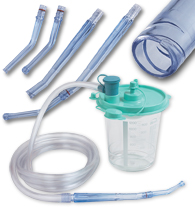
YankerFamilyWhen we arrived at the hospital on Monday, June 15, Dad was upset because the Yankauer (yonker) wand was missing from his suction line. When you’re recovering from pneumonia, expelling secretions from your lungs is a big deal. In addition, the trach tube made it more difficult to handle the normal secretions that build up in the throat. The nurses would tell him to use the call button when he needed assistance, but when he used it, you’d hear, “Yes? What do you need?” Uh; he couldn’t speak, so when he was alone, he had to wait until someone happened by.

Dad’s WBC count had dropped to 11,900, but he was having pain around his chest wound. His hemoglobin had also dropped again, which puzzled the doctor. It seemed like he was losing blood, but they couldn’t determine a clear source. To rule out a bleeding ulcer, Dr. Sanchez ordered an esophagogastroduodenoscopy, but it didn’t identify any evidence of bleeding in his stomach. On the flip side, Dad’s oxygen saturation and MAP remained good all day.

Among the entourage of doctors, pharmacists, residents, and fellows was the case manager, Laura, and she started becoming a more visible participant. She brought us literature about the Scott & White Continuing Care Hospital (CCH) and encouraged us to stop by and visit with April, the CCH nurse manager.

trachPMSpeakingValveDuring the afternoon, Svenja, the Trach Goddess of Scott & White, stopped by and downsized Dad’s tracheostomy tube. She discovered that the current tube was stuck, and she had a little difficulty removing it. Fortunately, removing the tube drew only a small amount of blood, and the new tube was inserted quickly and without any difficulty. The new tube had numerous benefits: it had a smaller outer diameter, a larger inner diameter, and could accommodate the Passy-Muir speaking valve. When Svenja attached the speaking valve to the tube, Dad’s voice was strong and clear. Dad had been unable to speak since the morning of June 8. Even the nurses were thrilled to hear him speak again.

pmSpeakingValveAs much as he was pleased to talk, he was equally disappointed when the nurse removed the speaking valve. Besides his not being able to sleep with the speaking valve in place, the valve also had to be removed whenever he received any sort of oxygen support.

My cousin and I stayed at home after lunch that Monday. While Chris gardened and I worked from my parents’ office, my mother returned to the hospital; however, she came home early. She didn’t think that my father looked well and she wanted me to return to the hospital with her. When we arrived, his room was empty. Dad had been moved to IR, where they inserted another tube in his right chest. Because they took him without signed consent, we were escorted through the back hallways and elevators to the IR department so that Mom could take care of the paperwork. Dad finally returned to his room shortly before 6:00 P.M. Dr. Sanchez said that they’d probably have to tPA this chest tube, too. On the trip back to the hospital after dinner, we had stopped to admire a rainbow. It had seemed like such a hopeful sight. I guess we take our signs where we can find them.

IMG_0789Tuesday, June 16, was another day of mixed news. Dad was talking and his WBC count was down to 8,300—a normal reading. The speech therapist, Holly, stopped by and administered a bedside swallow study—the first since he received the tracheotomy tube. Unfortunately, he failed it miserably. He coughed up pretty much all of the liquids. Holly gave us some very large, lemony Q-Tip-looking thingies to swab the back of his throat. Although just thinking about it makes you want to gag, it was supposed to stimulate swallowing. This therapy was to be repeated about five times daily.

We still hadn’t seen the doctor when we left for lunch at 11:15 A.M., but we needed to leave. Chris, my cousin who had been visiting for the past week, was leaving at 12:30 P.M. to return to Phoenix. The airport is about 60 miles from my parents’ house, so we were fortunate that Chris was able to hire a limousine service to transport her. Then, Mom and I were home again, alone.

swabsticks2When we finally saw the doctor at 3:45 P.M., he tPAed Dad, which eventually released another 400 ml of fluid from my father’s chest. Before we left for the night, I swabbed the back of Dad’s throat with the lemon swabs. Dr. Sanchez told me and Mom that Dad’s transfer to the continuing-care hospital was imminent and to visit the continuing-care hospital the next day. At this point, we’d become weary of this place and were anxious to leave and were anxious to visit Dad’s new digs.
On Wednesday, June 17, Mom and I held our breath as we entered the hospital. It was hot outside, the parking lot was misery, and we really never knew what to expect when we got to Dad’s room. On this day, Dad’s WBC count had inched up to 11,500.

Much of our time that day was spent talking with Laura, the case manager, about moving Dad. We had many questions about payment and Medicare benefits. After Mom ran some errands, I picked her up at 11:30 A.M., and the two of us met with April, the nurse manager at the CCH. She seemed very pleasant, and we felt like this would be a good place for Dad to recover before heading home.

I worked from the house for the rest of the day, and Mom stayed with Dad. Dr. Sanchez told Mom that the X-ray showed that the chest tube and tPA had done their job. He also said that on the following day, Dad would have his chest tube removed and the dialysis catheter replaced to reduce the risk of infection. If all went well, he’d receive typical dialysis and be transferred to the CCH later in the day.

Although we were glad to be leaving Scott & White Memorial, it felt as though we were getting the bum’s rush.

The letter board

It was Sunday, June 7, 2015. After the events of the preceding couple of days, we were eager for some good news. Mom and I stopped by the hospital on the way to church and were pleased to learn that Michelle, one of our favorite nurses, was assigned to Dad. We were relieved to learn that he had had an uneventful night, which was always our goal for him. Although this day seemed to be starting well, the intubation yesterday had halted all of Dad’s forward progress with his swallow therapy. Following extubation, he’d be NPO again and he’d have start back at square one with bedside swallow evaluations.

During Dr. Velazco’s morning rounds, he told us that they planned to remove the final chest tube today. He also announced that they would perform a tracheotomy on Monday. He wanted to know whether he should tell Dad or if we wanted to tell him about the procedure. I told him that I would break the news to my father on Monday. He responded to me by saying that they would postpone the procedure until Tuesday. He assumed that Dad would want a day’s notice and I had to convince the good doctor that a day’s notice would not be in my father’s best interest. I had to also instruct the day and night staff to avoid saying anything to my father.

While Mom and I attended church, Stan visited with Dad. Stan was always good company for Dad, but visits with patients on ventilators are awkward and uncomfortable—even for saints like Stan. While on the ventilator, the respiratory therapists perform breathing trials. During breathing trials, the oxygen concentration is reduced, with the goal being to get as close to 21% as possible for as long as possible. Today’s therapist informed us that Dad was doing well and was currently receiving a low level of oxygen.

Monday arrived, and I wasn’t looking forward to this trip to the hospital. Shortly after I arrived, Dr. Velazco entered the room. I gripped Dad’s hand and told him about the tracheotomy. Not surprisingly, he seemed a little nervous. I told him that I believed that having a tracheostomy was best for him, and it seemed like he believed me. Dad’s dialysis session was interrupted for about an hour, during which time Dr. Velazco and another doctor performed the tracheotomy.

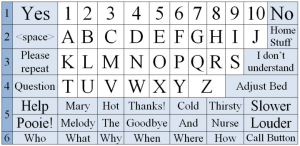
Now that Dad has a tracheostomy, he can’t talk. He had made a letter board for his mother when she developed Guillain-Barré syndrome, and now Dad requested that we find it during our lunch break. After searching unsuccessfully for it, I decided to create one, and searched the internet for some ideas.

Tuesday, June 9 was my birthday. Stan was back in Houston, but Chris, my cousin was due to arrive later in the day. Because I had to attend an early staff meeting, Mom and I didn’t arrive at the hospital until 9:30 A.M. According to Michelle, Dad had already sat in a chair for two hours and had had his feeding tube replaced. His WBC count was down to 10,700, and the doctor had removed his right chest tube.

Dad was receiving lower levels of oxygen when we arrived in the morning, but was returned to full ventilation in the afternoon. The tracheostomy provided a benefit that we hadn’t anticipated. Before the tracheotomy, full ventilation required intubation. Following the tracheotomy, the difference between full ventilation, BiPAP, and CPAP involved changing the levels of oxygen going to the tracheostomy. That benefit alone seemed worth the price of admission, although I wasn’t the one who had a hole in my throat.

letterBoardThanks to his wonderful nurse, Dad also had a procedure of a different type. Michelle, who keeps her beautician license up-to-date, gave Dad a nice shave. He hadn’t shaved since he entered the hospital on May 6, and the change was dramatic. He looked almost like his usual self.

All things considered, today seemed like a good day. My parents and I celebrated my birthday in the hospital, but after dinner their neighbors, LoSharris and Tom, came over to my parents’ house for cake and ice cream with me, Mom, and my cousin, Chris. It was also Tom’s birthday and it was nice to have a little party.

On June 10, we learned that Dad had had a pretty good night and was currently on CPAP. The plan was to keep him on lower levels of oxygen during the day and then provide him ventilator support during the night, which would give his lungs a rest. If his breathing kept improving at this rate, the trach nurse would fit him for a speaking valve.

The feeding tube was a constant challenge, and today it became clogged. Megan, Wednesday’s nurse, tried using Coke to clear it, but to no avail. Listening to the discussions about all the ways you can use Coke made me glad that I didn’t drink the stuff. After struggling to insert the replacement tube, an X-ray finally showed that the new tube was correctly positioned.

My cousin Chris and I had some interesting letter board conversations with my father, which prompted us to add a few more words to the board. Communicating with a letter board was exhausting, but together Chris and I could usually figure out what Dad wanted to say.

When we returned to the hospital after dinner, we met Drew, the night nurse. Something about him seemed very familiar. When he mentioned that my mother looked better than the last time he saw her, I realized that he was my mother’s nurse for her first night in the hospital. Because of her stroke, Mom had no memory of him. He was her nurse for only one night, and he usually worked in the south tower, which was why we hadn’t seen him since May 15. Before we left for the night, Drew had fixed Dad’s arterial line splint, adjusted his dialysis catheter lines, and adjusted the feeding tube, making it more difficult for Dad to pull out in his sleep. After watching him take care Dad, I was thankful that Drew had been Mom’s nurse that terrible night.

In spite of the tracheotomy, today seemed like another good day—the third good day.