
Still waiting to exhale

interlockingJuly 28, 2015. Six days since Dad returned to Memorial. The good news was that Dad was still with us. The bad news was that the doctors didn’t sound very hopeful about his recovery. Most of the positive feedback came from the nurses, and they weren’t doing cartwheels. Perhaps it was my imagination, but I thought the doctors, including Dr. White, were placating us. On the morning after Dad aspirated, I was advised by Dr. Anderson to let Dad die. I couldn’t shake the feeling that the doctors thought that we had made an ill-advised decision to continue with his aggressive treatment.

When Mom and I arrived at the hospital, we were pleased to see that Andrea was his nurse again. She was Dad’s nurse when he was readmitted to Memorial, and she was a terrific caregiver. She told us that Dad had briefly opened his eyes when she spoke to him earlier.

I asked Andrea about the results of his lab work, and his WBC count was up from yesterday, which meant that his body was still waging war against some infection. Shortly after our conversation with Andrea, the parade of residents started.

Dr. Pan, the nephrology resident, stopped by, quickly assessed Dad, and said that they did not need to dialyze him today.

Dr. Hidalgo, the neurology resident, stopped by and said that Dad’s ammonia levels were high, which might have an effect on his lack of responsiveness. Dad’s MRI was scheduled for later in the morning, and the doctor said she’d get back to us with the results of his MRI as soon as the test was finished.

The nurse manager stopped by to check on Dad’s feet and was surprised at how good they looked. The fact that the circulation had returned to his extremities was the best news that we’d received since his readmittance to Memorial. The wound care tech stopped by to look at his toes, and reduced the elevation of his feet.

Dr. Haenel, the hematology resident, stopped by and said that Dad’s platelet count was 27 (thousand), which was up slightly from yesterday. Although his platelet count was still very low, it seemed that it was stable for now, and he would not need a transfusion today. She said that they’d be watching his platelet count for any changes.

Dr. White and his entourage stopped by at 10:15 A.M. Not surprisingly, the good doctor was still very guarded about Dad’s prognosis but was mildly pleased that he had opened his eyes. Because pain killers can affect responsiveness, the doctor said that they would decrease Dad’s dosage of Fentanyl, which they had prescribed for pain. Personally, I wasn’t sure what good pain medicine did for an unresponsive person, but I assumed that they knew what they were doing. Dr. White mentioned that the hematologist had said that Dad’s elevated ammonia count might be affecting his mentation. Dr. White didn’t think that the slight elevation was enough to be the cause of his mentation problem and lack of responsiveness, but he said that would prescribe something to remove ammonia from Dad’s system. He also told us that the radiologist had compared Dad’s latest CT scans with his two previous scans, and the radiologist didn’t detect any change in his brain or other organs. He didn’t sound like this news was a big deal, but for the two people who craved any glimmers of hope, it was.

questionmarksThe big surprise of the week occurred right after Dr. White left Dad’s room. During the procession of residents and the attending physician, a woman kept appearing in the doorway, and would then leave. When the room was finally empty of providers, she entered Dad’s room and introduced herself as Aimee from the Patient Relations department. She told us that a hospital employee had contacted her office about Dad, and suggested that she meet with us about the events that led to his return to Memorial. I pulled out my iPad of notes and shared our concerns about some of our interactions with one of the CCH doctors. Aimee told us that they would investigate our complaint and get back to us in 30 days. I assured her that although we had complaints about one person, for the most part, we were pleased with the level of care that Dad had received from his providers. When she left, Mom and I were stunned and kept trying to guess who contacted Aimee’s office.

Mom and I left the hospital at 11:30 A.M. for lunch, ran some errands, and returned to Dad’s room at 2:00 P.M. We had hoped that while we were gone that Dad would have had his MRI, but he had not left the room.

Throughout the day, Andrea adjusted his Levophed dosage in an attempt to wean him off this last vasopressor. She said that while we were gone he opened his eyes again, but he was still not responsive. To me, it seemed as if he was sleeping with his eyes open.

At 2:15 P.M., the hematology team arrived. They said that they believed that Dad’s platelet levels were stable, even though they were still very low. They would continue to watch him, but they predicted that his bone marrow would begin producing platelets in about 15 days. I don’t know if these people understood the impact of their words, but I found it pretty promising that they were thinking in terms of the future for Dad.

Mom and I left the hospital at 4:30 P.M. and returned at 6:30 P.M. I noticed that Dad’s dosage of Levophed had been reduced again, which was great. We met his nurse, Dustin. Andrea had told me that he was great and that we would love him. When we met him, he didn’t really seem engaged, and informed us that he was also assigned to a new patient. Nurses generally spend the bulk of their time with new patients, so I was a little concerned about the level of care that Dad would receive overnight. During the couple of minutes that we spent with Dustin before he went to see his other patient, he told us that Dad did not have the MRI today but would probably go to radiology the first thing tomorrow morning.

While we were waiting for Dustin to return, Dad started moving his head and shoulders and repeatedly opened and closed his eyes. His eyes seemed to focus on me, and he grabbed my hands a couple of times. He seemed to be coughing and we couldn’t tell if he was having difficulty breathing. Mom got a nurse, who suctioned his trach, but she didn’t remove much in the way of secretions. It was so difficult to know what was happening to him. He couldn’t make any sounds, so we weren’t certain that he was coughing.

Crystal, the respiratory therapist, returned at 7:45 P.M. to administer oral care and ventilator maintenance. While she was suctioning Dad, he started desaturating, and his oxygen levels dropped well below 90%. She increased his oxygen level on the ventilator to 100% during oral care and then reduced it to 60% before she left. His oxygen saturation levels remained above 90% while we were there. His pulse had also been pretty high. It kept moving from a low of 98 to a high in the lower 120s, and once reached 133. What made these wild swings in his vitals so unnerving was that they constantly triggered the alarms on his monitors.

Before we left at 8:45 P.M., we spoke with the resident about Dad’s sudden movements. We had not seen Dustin since 7:00 P.M. For the first time since Dad was readmitted, we went home feeling a little less than comfortable about the level of care that he would receive during the night.

Why can’t doctors speak English?

July 29, 2015. Dr. Hildago, the neurology resident, was in Dad’s room when we arrived at 7:45 A.M. She told us that his ammonia levels were back to a normal level and that his eyes would now follow her hand, which was an improvement over yesterday. We were still anxiously waiting for the radiology department to schedule him for the MRI. Dialysis had already started, but it could be interrupted for the MRI.

ackHis pulse was running in the 130s again, and his oxygen saturation levels were low. To compensate for the low oxygen levels, the respiratory therapist increased his oxygen levels on the ventilator to 60%. A few minutes later, the ventilator started alarming, which prompted the nurse to page the respiratory therapist. Evidently, one piece of the ventilator was cross-threaded, which was what caused the system to alarm. The alarms were starting to drive us crazy and I could swear that I could hear them when we were away from the hospital.

Dad’s heart rate was like a roller coaster all morning. A resident stopped by and said that we might be able to stop the wild fluctuations if we gave Dad some Fentanyl, the pain killer. If that was true, then perhaps I now understood why they would give an unresponsive person pain killer.

A technician stopped by at 8:55 A.M. to administer an EKG. Dr. Burkholter and his neurology team stopped by 45 minutes later. He did observe that Dad was a bit more responsive than he was Monday, but his responses were not robust. He wouldn’t know more until they could see the MRI.

wordsWhen Dr. White and his band of providers arrived outside of Dad’s room, I heard comments about Dad being tachycardic and encephalopathic. It took several Google searches before I came close to the correct spelling of either term. When he finally entered the room, the doctor said that Dad was on the right antibiotic, although his WBC count kept increasing. He added that they would probably perform a bronchoscopy on Dad later today to ensure that everything was OK with his lungs. He commented that it was good that Dad seemed to be waking up, but he said that he suspected that Dad’s tachycardia was related to his change in mentation. I had watched a lot of medical dramas in my day, but I still wished that he’d talk about Dad’s rapid heart rate instead of tachycardia.

When Svenja, the Trach Goddess of Scott & White, had last visited my father, she said that if Dad improved, she would switch out his tracheostomy. She returned today to switch out the current trach tube for a softer one that would be more comfortable for Dad. Svenja was another comforting provider, and I was glad to see her again.

At 11:00 A.M., I went to the hospital cafeteria for coffee. While I was gone, Mom said that Dad opened his eyes full wide and looked around the room. By the time that I returned to the room, he appeared to be sleeping again.

We had several visitors during the afternoon. Sandra, one of the Lay leaders from the church, stopped by for a short visit and said a prayer. A little later, Kelli, the charge nurse from the north tower ICU, stopped by for a short visit. She was leaving for vacation and wanted to check in on Dad before she left. The providers in the south tower were great, but sometimes I really missed the nurses in the north tower, especially Kelli. Not long after Kelli left, Addison, a speech therapist, also stopped by to visit for a few minutes. I liked visiting with Addison and Holly, the two speech therapists. When they entered the room, it felt like they brought in sunshine with them. My mother felt the same way about Adan, the speech therapist at the CCH. Perhaps there’s something special about people who become speech therapists.

IMG_0806Shortly before 4:00 P.M., I was presented with a bronchoscopy consent form, which was quickly followed by the arrival of the mobile bronchoscopy unit. Shortly before 4:30 P.M., they started the procedure, which had become almost routine to me. I wondered how routine it had become for Dad. I hoped that he had been oblivious to all of them.

While Mom and I were waiting for Dad’s procedure to end, Wynn Moore stopped by to say hello and tell us that she was leaving town for a few days. It seemed like everyone was going someplace. There was such a dichotomy between life inside and outside the hospital.

As we were leaving for dinner, Charris, a resident who had been assigned to Dad since his readmittance, told me that she was off for the next couple of days but would be back on the night shift for the weekend. I was disappointed that I wouldn’t see her for a few days. As it turned out, I never saw her again, which was a shame.

We returned from dinner at 6:45 P.M. and met Dad’s night nurse, Cinnamon. The day shift personnel wouldn’t be leaving for about 20 minutes and Mom and I wanted to say good-bye to Kelli, although I hoped to still be here when she returned in five days.

When we returned to Dad’s room, he was receiving only a tiny dose of Levophed, his remaining vasopressor. Cinnamon thought that she’d be able to reduce that amount somewhat or entirely by the end of her shift at 7:00 A.M. Unfortunately, his oxygenation was still poor and he was receiving 65% oxygen from his ventilator.

Cinnamon seemed very attentive to Dad. Mom and I felt better than last night with him in her care than we had with Dustin the previous night.


We held on to positive moments

July 27, 2015. I was working from my parents’ home, and I would log on to my office network at 3:45 A.M. I had coworkers in India and Israel, and by starting at this time, I could work with them for two or three hours before I went to the hospital.

Shortly after 4:30 A.M., it occurred to me that my Millennial cousin might be more of a texter than an emailer. To ensure that he would read my email that I sent him last night, I texted him to tell him that I had emailed him the previous night. Sure enough, about an hour later he called me on my mobile phone.  He wasn’t able to give me many answers, but he did provide me with information that I could research further so that I could converse with the doctors and ask reasonably intelligent questions.

Mom and I arrived at the hospital at 8:00 A.M., only to learn that Dad was still unresponsive. According to Kristina, his nurse, he would open his eyes and grimace only to a sternal rub and other painful stimuli. The sternal rub can be painful for anyone, but Dad had just had open-heart surgery a couple of months earlier, and I couldn’t bear to watch this exercise. He would not respond to or follow any verbal commands. I later watched the doctor inflict this pain, and it was hard to watch. Worse yet was the slow-motion response from my father. It’s an image that I can’t shake.

sunflowervaseCarlos, the dialysis nurse, arrived at 8:15 A.M. and proceeded to prepare Dad for dialysis. At the same time, Dr. Fernandez, one of the fellows who worked in the ICU, performed a brief assessment of Dad’s condition. Following his assessment, he sat down with me and Mom and told us how pleased he was to see our devotion and attention to Dad, and added that he wished that all his patients had families like us. As he left us, he said that he thought that our prayers would be answered. It was a moment that would carry us for a few days.

Shortly after his dialysis session started, I put the radio headphones on Dad’s head. I left the headphones on him for about 30 minutes, but we still didn’t see any response.

Because Dad’s blood pressure and temperature dropped during dialysis, Dad’s nurse had to increase his vasopressor. It was discouraging to see the dosage increased, but it was still lower than it had been yesterday.

From the moment that we would arrive at the hospital, I would scan the halls to try to determine where the doctor was on his rounds and when he would arrive to Dad’s room. After he and his party arrived, I’d stand in the threshold so that I could eavesdrop on their conversation, which was usually more enlightening than his meeting with us. It’s also where I picked up some medical jargon. Today Dr. White and his entourage appeared outside Dad’s door at 10:20 A.M. As usual, he held court with his team of residents, fellows, pharmacists, and the nurse for several minutes before entering the room. He eventually agreed that things seemed to be progressing in the right direction—except Dad’s noggin. He also said that because Dad’s platelets were low again, he would request a hematology consultation. On a very positive note, the lowering of the vasopressors had improved the blood flow in Dad’s extremities, and Dad would not lose any toes!

When Mom and I returned from lunch at 1:00 P.M., we found Dr. Hildago, a neurology resident, in Dad’s room. Between the two of us, Kristina and I updated the doctor on Dad’s 83-day medical history.

After the neurology resident left, we were pleasantly surprised to see Pastor Don and his wife, Wynn, enter the room.  Seeing the two of them had sort of a cleansing effect on our stressed-out emotions. Mom and I always enjoyed their visits and hated to see either one of them leave.

Dad’s tube feed had resumed yesterday, and the dietitian stopped by to assess his nutritional requirements and status. The current flow of Nepro was less than half of what it had been when he aspirated. The dietitian recommended that it be increased to 40 ml/hr, which would provide him with about 1,700 calories day.

sunflowervase2At 2:15 P.M., the hematology team arrived. Because Dad’s lab work showed that he had Thrombocytopenia, Dr. White had requested a hematology consultation. According to the doctor, Dad’s platelets dropped when he became septic and required vasopressor support. From what the doctor said, Dad’s sepsis condition also increased his platelet consumption. To make matters worse, Dad’s infection and the antibiotics both suppressed the bone marrow production of platelets. For these reasons, the hematologists were not surprised that Dad’s platelet count continued to be low. They said that they would give him platelet transfusions whenever his platelet count dropped below 20. Following the platelet transfusion the other day, his platelet count now sat at 26, which was still pretty low.
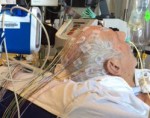
Moments after the hematology team left, Dr. Burkholder, the neurologist, arrived with a couple of residents in tow. He told us that Dad should have an EEG sometime later today and an MRI either tomorrow or the next day, depending on various schedules. This brief encounter with the doctor was typical of how we interacted with the specialists. The resident or fellow would arrive and spend quite a bit of time assessing Dad, and then the doctor would pop in for two minutes, basically repeating what the resident had told us earlier.

eegDad’s oxygen levels had been fair, and when Nikita, the respiratory therapist arrived, she increased his oxygen level on the ventilator from 40% to 50%. As she adjusted the ventilator settings, she said that she’d probably decrease the levels back to 40% later in the day.

Kristina had shown me how to exercise Dad’s arms. When she saw me moving his arms, she showed me how I could also move his legs. I had barely started exercising his legs when the EEG tech arrived.

After the EEG, which takes longer to set up than to administer, Mom and I left the hospital to run some errands and eat dinner.

sunflowervase2When we returned to Dad’s room at 7:00 P.M., we were thrilled to see that Tyler was Dad’s night nurse again. Nights were scary for me and Mom, and knowing that Dad was in good hands gave us some peace of mind. Dad’s vasopressor dosage had inched down again, which was also wonderful to see.  Unfortunately, the oxygen setting on the ventilator was still set to 50%, which meant that Dad’s oxygenation was still shaky.

While Tyler was getting set up for the night, I exercised Dad’s arms and noticed that he seemed a little flushed. Usually the hospital room felt cold enough to set Jell-O, but for a change, Mom and I weren’t shivering. When I checked the thermostat, I noticed that it was set for 75 degrees—a setting that we hadn’t seen before and would never see again. Tyler quickly adjusted it back to 68 degrees.

When Mom and I left for the night, Tyler was oiling Dad’s dry feet and said that he planned to wash Dad’s hair. If only Tyler could work every night.


Taking it one hour at a time

sunflowers1July 24, 2015. The call that we dreaded from the hospital during the night hadn’t come. We didn’t know what to expect today, but we had to take it one hour at a time.

 
When Mom and I arrived at the hospital, we found that Dad was back on dialysis, for the fourth time this week. According to Andrea, his nurse, Dad was less responsive this morning, which was not what we wanted to hear. She added that, according to his morning lab work, he was still suffering from metabolic acidosis. She had been able to wean him off of one of the vasopressors, but his blood pressure dropped below 65 MAP during dialysis, and they had to restart the vasopressor. When I asked her about his WBC count, she told me that it was up to 18.9, a 300% increase in less than 48 hours.
 
petals1Dr. White started his rotation today as the attending physician. We now had what seemed like a long relationship with this doctor, and he didn’t pull any punches with us. He told us that because of all the vasopressors that Dad was taking for his low blood pressure, his toes were being affected and he might lose a couple of them. The doctor strongly suspected that Dad’s circulation problems would begin to move up his extremities. Dad’s liver was also in shock, and the good doctor said that he was surprised that Dad had been able to withstand the dialysis. He also stated that Dad’s pupils were nonresponsive and he did not withdraw from pain, even when taken off sedation. He reiterated Dr. Sanchez’s prognosis from yesterday in that he did not expect Dad to survive this episode. At the end of this uplifting visit, Mom and I felt that we might need to make a decision tomorrow or Sunday.
 
Pastor Don stopped by around 1:45 P.M., and Mom and I had a very emotional visit with him. I just couldn’t believe that this was happening, and Don said that it was OK for me to be mad at God. I was mad, frustrated, and heartsick, but I don’t think that I reached the point of being mad at God. Among other things, Don asked us if we had considered hospice. I wasn’t sure whether hospice care was available at the hospital or some other location. At that point, I hadn’t considered anything, and I wasn’t ready to think about it. 
 
Shortly after Don left us, I walked over to the north tower to visit with some of the CTICU nurses. I found a couple of our favorite nurses and provided them with a brief update on Dad’s status. When I returned to Dad’s room, I learned that Andrea had been able to wean Dad off of two of the five vasopressors, and his blood pressure seemed to be stable. This was the first good news since Dad’s return to Memorial, and I could feel myself exhale. I said a silent prayer that we could wean Dad off the remaining vasopressors before he lost any extremities.
 
Later in the day, Pastor Don stopped by again with his wife, Wynn. Mom had met her two nights earlier, but this was the first time that I had met her. I found her to be delightful and I was pleased to learn that she worked in the chaplain’s office at the hospital.
 
Vasopressors increase blood pressure by constricting the blood vessels. This constricting of blood vessels is particularly acute in the extremities and in situations like Dad’s, toes and fingers sacrifice blood flow for the benefit of the vital organs. Andrea tried to find Dad’s pulse in his feet with her hands, but couldn’t. She eventually was able to find a pulse in both feet with a Doppler ultrasound. The relief among those of us in the room was palpable when we heard the sound of blood flow.
 
petals2Mom and I went home for dinner and returned to the hospital at 7:15 P.M. Charlie, the respiratory therapist, had just finished Dad’s trach and oral care and ventilator maintenance. Dad was still on three vasopressors. Mom and I met Donna, the night nurse, before leaving for the night. She told us that Dad had additional blood draw after dialysis and that his WBC count was now 22.7, up another 4 points from this morning. His WBC count hadn’t increased at this rate since his first aspiration episode in May.

 
I should have been encouraged that Dad had survived another day, but I was concerned about Dad’s worsening responsiveness. I couldn’t stand the thought of losing him without being able to communicate with him one last time. I had mentioned to Andrea that I wanted to talk with a respiratory therapist to see if there was a way in which we could communicate with him.
 
July 25, 2015. Mom and I arrived at Dad’s room at 7:15 A.M. We were pleased to see Andrea again, but nurses work only three days each week, so we knew this was our last day with her. Dad’s WBC count was now 19.2, down slightly from yesterday afternoon, his hemoglobin was down, and his acidosis condition had improved to the point that he was now slightly alkaline. Dad had been receiving a bicarbonate drip, which they now decided to stop. The vasopressors were still affecting the blood flow in Dad’s feet. We held our breath again as we watched Andrea struggle to find a pulse with the Doppler ultrasound.
 
Dad was sleeping a lot, and Andrea said that he was not responding to commands, but he opened his eyes for her. He opened his eyes for me, too, but I couldn’t get him to squeeze my hand.
 
Charris, one of the residents assigned to Dad, told us that when Dad arrived a couple of days ago, they performed a mini bronchoscopy on him to take some cultures from his lungs. They now knew that in addition to the aspiration pneumonia, he also had an infection (pseudomonas) in his lungs. Severe cases of pseudomonas generally occur in people who are already hospitalized with another illness or condition, or people who have a weak immune system. It seemed that everything that ailed Dad now was hospital acquired.
 
Dr. Pan, the nephrology resident, stopped by and told us that because Dad was not very acidosic and didn’t seem to have much extra fluid, they would not dialyze him today. He said that the nephrology team would assess Dad on a daily basis to determine whether to dialyze.
 
Dr. White stopped by during rounds at 8:00 A.M. He agreed that we’d seen a slight improvement in Dad since yesterday–probably due to the dialysis. He was able to feel the pulse in Dad’s feet with his hand, and he said that Dad’s feet looked better than they did yesterday. I knew that I shouldn’t have been so concerned about his toes when his life was at stake, but I was relieved that the pulse in Dad’s feet was getting stronger as they weaned him off of the vasopressors.
 
petals3Now that Dad was back on the ventilator, he couldn’t talk. I got some wild idea yesterday that I had to give Dad a chance to communicate with us if he was going to die. Andrea said that she would contact the respiratory therapist to see if it would be possible to enable him to talk. The respiratory therapist contacted Svenja, the Trach Goddess of Scott & White. We hadn’t seen her since June, when she first changed Dad’s trach. When she heard about Dad’s condition and our desire to communicate with him, she agreed to give it a try. Unfortunately, all of her efforts failed to work, and we probably sapped some of Dad’s strength. The exercise woke him up for a couple of minutes, but he fell asleep almost immediately when Svenja reinflated his trach collar.

 
When Mom and I returned from a lunch break, we found that Dad was still asleep and impossible to rouse. Most of his vitals were still good, but Andrea told us that his platelet count had dropped, and he needed a platelet transfusion. We sat in the room with Dad for a few more hours and finally went home for dinner. It was difficult to stay in the room with him in his current condition, but it felt worse to leave him. Although his vitals were stable, his condition was still grave, and the failed attempt to communicate with him had wilted my already sagging spirits.
 
We returned to the hospital at 7:00 P.M., in time to meet Tyler, the night nurse. Mom and I liked him immediately, and he seemed intent on weaning Dad off of the vasopressors. While talking with the nurse, the respiratory therapist, also named Tyler, attended to Dad’s trach, the ventilator, and Dad’s oral care.
 
Before we left for the night, Tyler put some lotion and booties on Dad’s feet to help with his peeling and cold feet. Tyler told us that he would be working for four nights that week, and we really hoped that he would be assigned to Dad. When Mom and I left for home at 8:30 P.M., we felt a small sense of optimism that Dad would have a good night, and maybe we would too.
 

And the nightmare begins again

skyWednesday, July 22, 2015: 3:45 P.M. I had just left a meeting at work and listened to the voicemail that my mother left 40 minutes earlier. “Melody, it’s Mom. I’m at the hospital with Dad and he’s not doing too well. He had a bad coughing spell during dialysis and they’re trying to bring his blood pressure down, but he’s got the shakes and delusions and all kinds of stuff. Call me on my cell, because I’m not going to leave him. Talk to you later. Bye-bye.”

A tingly feeling crept up my neck and face, and I hoped that she was overreacting.

Earlier that day, Dad was wheeled to the dialysis room on the second floor of the CCH. His WBC count had been holding steady at 5.6, but his creatinine level was still elevated. His stubborn creatinine levels prompted his nephrologist to predict that Dad was likely to remain dialysis dependent, news that we didn’t want to hear. During his morning rounds, Dr. Anderson found Dad to be awake and alert and said that his vitals were good.

At 10:30 A.M. Dad starting coughing hard during dialysis and couldn’t seem to stop. His condition seemed to worsen immediately. Dialysis was stopped and Dad was returned to his room. Dad’s oxygen saturation levels bounced between 75% and 90%. He was coughing and suctioning large amounts thin, clear looking secretions. Michelle, Dad’s nurse, said that he was alert and had a productive cough, but it was obvious to her that Dad was in distress. The respiratory therapist was summoned to Dad’s room. She removed the red cap from Dad’s trach tube and placed him on BIPAP with 40% oxygen—a big medical and psychological step backward.

Rachel, the nurse practitioner was called to Dad’s room to evaluate his condition, and she thought that his cough appeared to be calming down. Shortly thereafter, the nurse notified Dr. Anderson that Dad’s heart rate had elevated to 150. In addition, his clear-looking secretions changed and now appeared to be Nepro. His tube feed had been stopped in dialysis when he started coughing, so they were now certain that he had aspirated his tube feed during his coughing jag. Nepro in the lungs pretty much triggers pneumonia immediately. This would be the second time that he had had pneumonia in less than three months.

On dialysis days, Mom usually arrived at the CCH around 11:30 A.M., about 10 minutes before she anticipated Dad’s return to his room. When she arrived today, she was startled to see that not only was Dad already there, the room was also teaming with activity. Michelle briefly apprised Mom about what had happened, but Mom didn’t get the impression that Dad’s condition was dire. She watched the nurses administer some meds, prop up Dad in bed, and leave the room. From what Mom could tell, it didn’t seem like the meds or the upright position did anything to improve his situation.

A short time later, Dr. Anderson told Mom that they would move Dad to a larger room next to the nurses’ station so that they could more closely monitor and attend to him. After they moved him, Mom sat in his room, watching the constant flow of nurses while they injected one medicine after another into his IV. Several times she was asked to leave his room, although she didn’t always know why.

After sitting in Dad’s room for a couple of hours, Mom called her friend Marilyn. Being the good friend that she is, Marilyn dropped everything and went to the CCH to sit with my mother. Shortly after Marilyn arrived, my mother called me and left the ominous message on my voicemail. When I returned her call at 3:45 P.M., she was very concerned, and although they had just moved Dad from BIPAP to full ventilation, she was still not convinced that I should drive to Temple before the weekend.

Marilyn and Mom sat together in Dad’s room for a couple of hours. During that time, Dad’s condition had not improved and Mom became worried. To her, it seemed like they kept trying medications but to no avail. As Marilyn and my mother talked, Marilyn asked Mom if she should call Pastor Don, but Mom didn’t know how to contact him. Marilyn was pretty active in another United Methodist Church. She didn’t have Don’s contact information, but she knew someone who did.

Pastor Don’s mobile phone rang just as he and his wife, Wynn, started eating dinner at a local restaurant. Don promised to stop by the CCH as soon as they finished dinner. Mom called me again at 5:30 P.M., and said that she wanted me to come to Temple that night. Stan had come home for dinner and was about to return to his office for the night. His birthday was becoming memorable, but not for the reasons we wanted. I had already packed a bag in anticipation of Mom’s call, but decided to wait a couple of hours before leaving. Anyone familiar with U.S. 290 would understand why I didn’t want to brave that highway until after 7:00 P.M. I said good-bye to Stan, and he said that he’d come up to Temple in a couple of days.

Between Mom’s call to me and when I left Houston, Pastor Don and Wynn arrived at the CCH. Mom and Don spent some time together in the small chapel at the CCH, and Mom said that Don was wonderful and encouraging. Finally, at 9:30 P.M., Mom, Marilyn, Don, and Wynn left the CCH.

My drive west on U.S. 290 was a little surreal. The sunset was a spectacular display of stunning shades of orange. I was torn between appreciating the beauty of nature and praying that my father wouldn’t die on my husband’s birthday. I arrived at the CCH around 10:00 P.M., and made my way to Dad’s room. When I arrived, he was fully ventilated and surrounded by ice and fans in an attempt to bring down his temperature. I was met by his night nurse, Christine. She had arrived at 7:00 P.M., and was stunned by his sudden change. She told me that he had been doing pretty well, and she really enjoyed joking around with him during her shift. He had never spoken about her to me, but he’s a big kidder and it seemed like they had developed a friendly banter.

I went to his bedside and held his hand, but he didn’t know that I was there. Christine asked me under what circumstances I would want to be called during the night. I told her to consider her own father and the circumstances under which she would want to receive a call, and then I left. I had called my mother when I arrived at the CCH and she was waiting for me to arrive at the house. We were both exhausted, yet keyed up on nervous energy. We talked for a while before going to bed.

At 3:30 A.M., the phone rang and it was Michael, a nurse from the CCH. He mumbled something about how they were adjusting Dad’s medication. I listened for a moment, said “OK,” and then hung up. After the call, I wasn’t really sure why he had called. It was unsettling and confusing. I wished that I had been more alert. I learned later that he had called to tell me that my father’s condition had worsened and that Dad required additional medication and that they were going to insert an arterial line so that they could monitor his blood gases. He had probably told me that in some jargon that I couldn’t understand—especially at 3:30 A.M. Scarier still was that this phone call was to obtain consent for the procedure. About an hour later, Dad’s blood pressure dropped to 65/39, his respiration was 35, his extremities were cold, and he still had a slight fever. With full ventilation, his oxygen saturation was only 90%.

At 5:30 A.M., the phone rang again. This time it was Dr. Anderson. He told me that my father wasn’t doing well, and among a list of problems, he was pretty sure that Dad had had a heart attack during the night. He then said that they could keep on doing what they had been doing, and my father would probably die in 1-2 hours, or they could send him over to Memorial. Dr. Anderson went on to say that considering my father’s age and “extremely poor prognosis,” he assumed that we would not want to take “aggressive measures.”

God help me; I took a deep breath, and in that moment I flashed back to several conversations I had had with Dad in which he listed conditions in which he would not want to live or treatments that he would not want to endure. I told the doctor that I would call him back in a couple of minutes. I then woke my mother with the news from Dr. Anderson. I was relieved when she said, “We have to do whatever we can to help Daddy.” I immediately called the CCH and told Dr. Anderson to send my father to Memorial. He hesitated for a moment and said OK, but it sounded more like a question than an affirmation.

At 6:15 A.M., my father was moved to a stretcher and transported back to Scott & White Memorial to MICU. Following Dr. Anderson’s call, the clock seemed like our biggest enemy.


Things were going great, until they weren’t.

July 16. Dad was seen by the infectious diseases specialist, who (like Dr. Smith) wanted to take Dad off of the IV antibiotic. The lower strength of doxycycline, compared with the IV antibiotic he was taking, should help improve his kidney function. Antibiotics are tough on your system and can affect kidney function.  Not surprisingly, when the doctor visited with him, Dad told him that he wanted to go home.

As promised yesterday, Adan stopped by with some thickened chicken soup for Dad to try. Dad wasn’t wild about the consistency of the soup, but Adan was encouraged that Dad was swallowing the soup without aspirating it.

flower1Jennifer from PT arrived and Dad was ready to exercise. He immediately asked about her plans for him, and Mom wanted to know what he could do over the weekend. She didn’t want him “just lying in bed.” Although my parents were resigned to the fact that my father had to remain hospitalized until August 26, they didn’t want to stay there one day longer than absolutely necessary. Jennifer showed them a variety of exercises that Dad could do, and she encouraged him to sit in the chair at least twice a day over the weekend. Although he started out pretty unsteady, Dad was able to walk with assistance for about 250 feet. Jennifer was encouraged about how his mobility kept improving during their sessions.

July 17. The bad news was that it was Friday and Dad was scheduled for dialysis. The good news was that he’d have a two-day reprieve when today’s session was finished. Because it was dialysis day, he also had blood drawn. His lab results were very good. His WBC count was 6.5, his hemoglobin was 9.4, and his creatinine was 3.61. The hemoglobin and creatinine numbers weren’t good for the average person, but they were an improvement for him. They removed 2,877 ml of fluid, which was a significant increase over Wednesday. Although he was tired, he was still able to participate in some activities later that day.

Unfortunately, all of his physical therapy led Dad to believe that he could get out of bed by himself. He was reminded again by the nurse that if he needed anything, he should use the call button to request assistance.

Adan stopped by with some thickened tomato soup for Dad. It tasted as dreadful as it sounded, but he was able to swallow it. Adan was now cautiously optimistic about Dad’s prognosis. Mom and I were thinking ahead to Stan’s birthday the following week, and she asked Adan if he thought that Dad could eat a Jell-O cake (Don’t knock it until you’ve tried it.). Unfortunately, he said that the Jell-O was very slick and would be difficult to swallow. I was bummed. I had really hoped that we could have some sort of cake next week.

July 18. It was Saturday and the first weekend since May 15 that I stayed at home in Houston. When Mom arrived at the CCH, Dad was awake, but he said that he wasn’t feeling very well. He slept for another hour and felt better when he woke. Mom noticed that his feet stuck out of the bed when he slept. At 6’1”, Dad was taller that the hospital beds were long. According to the nurses, the beds were designed for 5’10” adults. Although she had asked before, Mom asked the nurse if she could find a bed extension for Dad’s bed. After searching for quite some time, she finally discovered an extension in the room across the hall, which had been occupied by a short woman.  The extra foot enabled Dad to sleep with his feet under the covers.

sunflowerThe nurse started a new IV, but they had no plans to remove Dad’s PICC line until Sunday or Monday. I had sent Dad more flowers, and he surprised me by calling me at home to thank me for them.  Although he was disappointed about how weak he had become and his extended stay, his attitude seemed to be getting more positive, and he was working hard to gain back the strength that he’d need to leave.

July 19. At 3:15 A.M., the night nurse woke Dad so that she could reposition him in the bed. When he objected, she reminded him about the importance of frequent position changes to prevent ulcers and to promote healing. He informed her that he didn’t need any help turning himself in bed and added that he did not want to be awakened during the night to turn. As you might expect, she asked him to show her, and he was able to fully turn on each side. She reinforced the importance of him turning, and then she left.

Rebecca, the day nurse, had a similar exchange with Dad when she reminded him that he had to turn himself in the bed every two hours.

When Dr. Ciceri saw Dad during morning rounds, he found Dad to be in good spirits and very conversant. If it wasn’t for the danged kidneys, you’d think that he’d be about ready to go home.  It was now 75 days since Dad’s surgery. It had also been two days since dialysis, and Dad was feeling pretty good. With Mom’s help, he did lots of bed exercises and walked all over the CCH in his wheelchair.

July 20. It was Monday again, which meant a new doctor and more dialysis. Unfortunately, Dr. Douglas Anderson, our “favorite” doctor, was back.  Before his 7:00 A.M. dialysis appointment, Dad was reminded once again that he had to use the call button and could not get out of bed without assistance. Dad’s pre-dialysis lab results were mixed. His WBC count was down to 5.4 but his creatinine level was up to 4.73, higher than they had been in weeks. Dad’s pre-dialysis weight was taken from the scale that is built into the bed. The down side of that nifty bed extension was that it added to the weight of the bed. According to the bed scale, which wasn’t recalibrated for the extra weight of the extension, he had gained 4.6 kg since Friday, which was highly unlikely. The dialysis nurse guestimated that he had gained 2.2 kg (5.5 pounds), and removed 2,872 ml.

Dad was pretty tired after dialysis—too tired to participate in swallowing trials with Adan. Adan said that he would follow up with Dad on Tuesday for a trial meal, and possibly diet advancement.  That news from Adan was pretty promising, but even better than that was the news that Mom received from her neurologist. According to her latest MRI, Mom’s brain showed no signs of impairment from her stroke in May.

July 21. Dad’s day started out pretty well and he was in good spirits. Adan stopped by in the early afternoon and had Dad try eating some thickened chicken soup. He thought that Dad had made good progress in the past few days and would bring Dad a tray on Wednesday or Thursday.

Shortly after Adan left, Jennifer arrived for his physical therapy session. During his sit-stands on the edge of the bed, his heart rate increased to 140. Jennifer was a little alarmed, but the nurse told her that increases like this weren’t uncommon for Dad. Because he was a little dizzy and off balance, he required some assistance when he walked. His balance improved the more that he walked, but he required at least minimal assistance during the session. As she had done on previous visits, Jennifer ended the session by having Dad sit in the chair. All in all, Jennifer felt that he was progressing toward his goals.

A couple of hours after Jennifer left, Christopher, the occupational therapist, arrived to formulate goals with my parents. The occupational therapist had been monitoring Dad’s progress with physical therapy and felt that Dad was ready for OT intervention.

July 22. It was hump day for most people but dialysis day for Dad. It was also my husband’s birthday. Although Stan’s day would be better than Dad’s, he was scheduled to work during the day and then all night. As compensation for working 20 hours, Stan would get the day off on Friday, enabling us to get an early start to our weekend in Temple where we would celebrate Stan’s birthday with my parents.

When Dad arrived at the dialysis department, the dialysis nurse noticed that his lung capacity was somewhat diminished with crackles to the bases, although she said that his cough was productive. His WBC count was sitting at 5.6, so I wasn’t too worried about infection, although I wondered if the doxycycline was addressing the infection in his lung. His creatinine level was down slightly, but not nearly as low as it had been last week.

At 3:05 P.M., I was at the office in Houston and attending a meeting with Patrick and Michele, a couple of my coworkers. Whenever I was in Houston, I kept my mobile phone close by in case my mother happened to call. To date, all of my phone conversations with her were initiated by me. At this moment, my phone rang and my mother’s name appeared on the caller ID. I couldn’t take the call, but noticed that she left a message. I was able to end the meeting a little early, and then listened to the following message: “Melody, it’s Mom. I’m at the hospital with Dad and he’s not doing too well. He had a bad coughing spell during dialysis and they’re trying to bring his blood pressure down, but he’s got the shakes and delusions and all kinds of stuff. Call me on my cell, because I’m not going to leave him. Talk to you later. Bye-bye.”

Dang.

Just. Want. To. Go. Home.

redCap2
Red caps rock!

July 12, 2015. Stan arrived at my parents’ home at 9:00 A.M. from Houston, and Mom and I left for the CCH shortly after his arrival. Before Mom and I left the CCH for church, the respiratory therapist stopped by and replaced Dad’s speaking valve with a red cap. Oh my gosh! It was almost like having no trach tube. He breathed normally and he sounded more like his usual self. Dad’s ability to remove his own secretions with the Yaunker would determine when they could decannulate him.  If Dad could not handle his secretions, the respiratory therapists would have to remove the red cap and suction him. While we were there, Dr. Smith stopped by and asked if Dad had been in the chair. I just hated knowing that our week with this doctor was about to end.

Stan visited with Dad at the CCH while Mom and I attended church, and then he stayed for another couple of hours while Dad sat in the chair. I was encouraged when Stan told me that Dad did most of the transfer from his bed to the chair, and once he was in the chair, his coughing stopped.

Later in that day, Cassie, the nurse, mentioned that Dr. Smith was considering switching Dad from intravenous to oral antibiotics. Among other things, the oral antibiotics were less harsh on the kidneys. Because Dad could not swallow pills, the oral antibiotics would be crushed and administered through his feeding tube.

keyFor the past few weeks, Mom and I had been unable to unlock the front door with the house key. Stan had sprayed graphite into the lock and that remedy had worked for a couple of weeks, but we were now back to square one. We didn’t have the time or inclination to fix it, so we just accessed the house from other doors. The front door lock was just an example of life’s little inconveniences that didn’t seem all that important at the time.

July 13. It was Monday, which meant that a new doctor started the week-long rotation, and Dad was scheduled for another 4-5 hours of dialysis. On the positive side, Dad was gaining less weight between dialysis sessions, which meant that they would remove less fluid from his blood. Today they removed only 1,497 ml, far less than the 4,000 ml or more removed only a week or so earlier. The nephrology personnel were cautiously optimistic that his kidneys might be perking up. What they actually said was that they “would watch him closely for a possible sign of recovery.”  Dad’s labs that day were a little contradictory. Although his creatinine levels had improved slightly, his WBC count had inched up. It was still well within the normal range, but this was the first uptick that we’d seen in the WBC count in a couple of weeks. Dr. Ciceri, the new doctor, mentioned that Dad seemed to be in good spirits and that he was very conversant. Perhaps I worried too much.

My parents live down the street from Bob Probe, an orthopedic surgeon with Baylor Scott & White, who was now chief of staff for Scott & White Clinic. This morning, while Dad was in dialysis, Mom and I visited with Dr. Probe and expressed some of our concerns about recent events. In particular, we wanted to tell him about my mother’s experiences at the hospital—specifically, her admittance to Scott & White Hospital as Trauma Patient Ohio. We also told him about my difficulty calling 911. Although he had no authority over the 911 system, he had many contacts who he said he would contact. We also shared some of the challenges that we had had with Dad’s care. In our experience with the hospital, we had learned that it was the patients’ responsibility to understand what was happening. We had seen firsthand that the doctors didn’t ensure that the patient could hear or understand what was being said. You’d have to pity the poor person who was admitted without a support system or advocate. As someone who is concerned about new-user experiences, I told him that to navigate the system, new patients and their families needed more information about resources, and perhaps the case managers could come around more often. From what Mom and I could surmise, the hospital personnel who filled this void were the chaplains, and some did it better than others. If the chaplains were the designated go-to resources, it would have been nice to know that on May 6. Dr. Probe said that he appreciated the perspective and the feedback. He took a lot of notes during our meeting, and Mom and I left the meeting under the impression that we would hear back from the good doctor. Spoiler alert: It’s been almost 14 months and we still haven’t heard from him, but hope springs eternal. He might have bigger fish to fry. Since our meeting, Dr. Probe was promoted to Chief Medical Officer of the Baylor Scott & White system.

Following our visit with Dr. Probe, Mom and I went home for lunch.  On my way back to Houston, I stopped by the hospital to say good-bye to Dad. He was dozing when I arrived, but woke easily and was pretty talkative. He looked pretty alert, and seemed to be feeling better than he had on most dialysis days. Mom arrived shortly before I left at 2:00 P.M. Soon after I left, Dad said that he was tired and had Mom leave for the day. When he was tired, he could fall asleep in midsentence. Later that evening, Mom tended to the garden and also gave it a good soaking. After all the rain just two months earlier, we were now suffering from a drought. Where rain was concerned, it was either feast or famine in central Texas.

July 14. Dad was alert and in good spirits when Dr. Ciceri visited him during morning rounds. Dad’s vitals were good, and it seemed like it was a perfect day to conduct the MBSS. The swallow study must be administered in the radiology department at Scott & White Memorial. Dad was ferried to the hospital in an ambulance and the test was administered by Holly, his speech therapist during his stay at Memorial. Unfortunately, the test that we had yearned for yielded some disappointing results. In short, he was diagnosed as a high risk for aspiration. They tested him with thin liquids, nectar and honey-thickened liquids, puree, and pudding. Even when swallowing with a chin tuck, he was not successfully swallowing anything but the pudding. Fortunately, Adan planned to continue working with him. The prospect of Dad not being able to eat again was unthinkable.

Dad was pretty tired by the time he returned from Memorial to his room at the CCH. Shortly after he arrived, Jennifer, the physical therapist, arrived for his session. He told her that he felt as though he had already been moving around all morning. Physical therapists tend to ignore such protests from patients, and she proceeded with therapy. Although Dad had some difficulty standing from a chair and the side of the bed, he was able to complete all the repetitions of his exercises and walked a few steps. He did much better when he “walked” in the wheelchair. When she was finished with their session, Jennifer left him in the chair, where he stayed for an hour. Mom was encouraged by all the therapy that he was receiving.

Mom stayed until 5:45 P.M. and was still there when our church friends, Kris and Sue, stopped by after work. They had stopped by once before, but didn’t know the password. I don’t remember ever being told about a password, and unless you visited after 8:00 P.M., the doors opened automatically. Sometimes this place was just weird.

Today seemed like a pretty good day for Dad. I would have felt better about it I hadn’t been so worried about his white blood cell count.

homeJuly 15. During dialysis, Dad told the nephrologist that he wanted to go home. The doctor told him that to be declared dialysis dependent (with End Stage Renal Disease), he had to be hospitalized and on dialysis for a total of 12 weeks. Although Mom and I had heard this news a few days ago, it was new news for Dad and prompted him to start asking questions about billing. The doctor contacted Marty Edens, the social worker, who dropped by to answer his questions. Marty couldn’t answer his specific billing questions, but she was familiar with Medicare and some of Dad’s situation. Dad told Marty that he “can’t imagine being here for six more weeks.” He repeatedly told her that he “made a wrong decision two months ago that put him where he was now.” I was glad that I missed this heartbreaking conversation and the follow-up discussion that Marty had with my parents later that day. My mother then requested a plan for his discharge. Marty told them that she could not give them a time frame regarding recovery, other than that if he continued to need dialysis, he would remain at the CCH until at least August 26, or until the doctors said he didn’t need dialysis, or they declared him to be dialysis dependent.

My exasperated parents then asked her when Adan would be able to come by. They both found some comfort and sense of progress in therapy sessions, especially speech therapy sessions with Adan. Adan stop by, had Dad eat some ice chips, and said that he would stop by tomorrow with some thickened soup for Dad to try.

Jennifer then arrived for their physical therapy session, but Dad was too tired after dialysis to exercise. Before she left, Jennifer said that Dad was now ready for sessions with occupational therapy.  They had withheld occupational therapy until he was a little stronger and no longer dependent on oxygen. The occupational therapist judged his prognosis to be fair, based on what he had read in Dad’s chart. His prognosis for just about everything was fair. I was getting tired of this “F” word.

Although Dad’s lab work and his vitals were holding tight, Dr. Ciceri thought that Dad might be somewhat confused, which can be a side-effect of prolonged hospitalization. On a more positive note, during Dad’s dialysis session, only 1,194 ml of fluid was removed, which was considerably less than earlier amounts and left him less fatigued. With Dad’s extra energy, he continually told nurses, doctors, and other providers that he “just wanted to go home.” Up until 71 days ago, my parents had been the poster adults for healthy seniors. They were active, engaged, and in control of their lives. Their current situation left them frustrated and just barely able to tolerate their current situation.


What a difference one person can make

July 5. On the way to church, Mom and I stopped by the hospital to visit with Dad and to try to get a moment of the good doctor’s time. Dr. Anderson didn’t seem to be a fan of the patients’ families, but we had told the nurse yesterday that we wanted to talk with him. Before the doctor graced us with his presence, Mom and I had a discussion with Dad about his inactivity. He seemed content to stay in bed, and we were just as determined to get him out of it.

When Dr. Anderson arrived, he remained in the threshold with his arms crossed high on his chest. Following the introductions, I asked him about Dad’s prognosis for getting a red cap on his trach. He said that they were monitoring Dad’s secretions and would attempt it as soon as possible. The conversation started to deteriorate when I asked him about Dad getting out of the bed and into the chair. He said that Dad was too weak to sit in the chair. When I challenged that proclamation, saying that all the doctors at Memorial wanted Dad in the chair every day, he still wouldn’t budge. He basically said that the Memorial doctors were wrong. When I asked about the frequency of Dad’s swallow therapy, he rolled his eyes and said that the (lemon swab) therapy that Dad had received at Memorial wouldn’t do any good. To make matters worse, Dad was satisfied that he didn’t have to get out of bed. The first word that popped into my head was warehousing, and Mom and I were incensed. They were not going to warehouse Dad.

While Mom and I were at church, many former and current health-care professionals asked us about Dad’s condition, and they all asked if he had been sitting in the chair. When we relayed our earlier conversation with Dr. Anderson, one of the parishioners encouraged us to put our concerns in writing and meet with the nurse manager and request a care plan for Dad. During the morning service, Pastor Don mentioned that Dad was one of his blessings. Don went on to say that Dad had been having a tough time, but he blessed Don every time Don visited with him. On the way back to my parents’ home after church, I stopped by the hospital to say goodbye to Dad before I went home to Houston. Before I left, I collected some information for Mom about the CCH from the CCH website. I wanted to ensure that she was adequately prepared for her meeting with the nurse manager. I also ensured that she was armed with an excerpt from the mission statement on their website.

cchPledge

July 6. Shortly after Mom arrived at the CCH, the case manager informed Mom that Dad would need to remain at the CCH until he had received dialysis for at least 90 days. Evidently, Medicare won’t consider a person dialysis-dependent until he has received at least 90 days of dialysis while hospitalized. What that really means is that they won’t pay for it. It also meant he couldn’t leave this place until August 26! It was difficult to believe that this policy was cost efficient, but who am I to question the U.S. government?

It was the first day of the doctor rotation, and a breath of fresh air, known as Dr. Randall Smith, blew into Dad’s room after dialysis. In addition to insisting that Dad get out of bed and into the chair, he actually spoke to Mom. A few people at the CCH would become important in our lives. Now that Dr. Smith had arrived, we had met three of them: Adan, Angela, and Dr. Smith.

Later that morning, Mom was able to see April Jones, the nurse manager. We don’t know if seeing her or having a different doctor made the difference in Dad’s care that week, but Mom’s mood improved significantly after their visit. We still can’t tell you what a care plan looks like, because we never saw one. Evidently, care plans are prepared every week and are part of the patient’s chart. Patients and their families are apprised on a need-to-know basis, or when something happens. We learned that our best bet was to form relationships with the therapists.

Adan, the speech therapist, visited with Dad and administered a bedside swallow test with water, ice chips, and lemon swabs. He also felt Dad’s neck muscles, and believed that Dad was swallowing. Instead of the original plan of one time a week, Adan would now try to meet with Dad three times each week. Although Dad’s progress was slow, Adan thought that he was progressing toward his goals.

Dad had dialysis today, but they removed only 2.8 liters, which was less than what they had been removing. His WBC count was inching down and was now at 8.5—another good sign of progress.

July 7. Dad started the day somewhat agitated and confused, but his mental status improved as the day progressed. When Jennifer from physical therapy arrived, Dad told her that he was “as weak as a kitten.” Following their session, Jennifer said that Dad’s strength was improving faster than he appeared to realize. She thought that he was making good progress with his transfers and standing, and that his activity tolerance had also improved. Could it be that all that physical activity improved his mood and mentation?

At the end of the physical therapy session, Jennifer left him in the chair, where he remained for an hour. Although Mom’s mood improved with Dad’s increased physical activity, she became a bit agitated with the “junk and bugs” on the floor. This wasn’t a new complaint. Conditions were pretty similar at Memorial, too.

Adan stopped by today with some thickened cranberry juice for Dad to swallow. Adan was going to see if he could get a MBSS test at Memorial next week. If Dad could pass the test, then he could start eating again.

July 8.  It was dialysis day again. The nephrologist thought that Dad looked euvolemic—or normal—so they would not need to remove as much fluid. However, because he became hypotensive during dialysis, they had to stop fluid removal. In the end, they removed less than 2 liters.

We also received mixed news about his lab results. Although his WBC count was down to 7.7 and his hemoglobin was staying put at 8.5, his creatinine levels still exceeded 4.0—significantly higher than normal range of 0.6—1.2.

One of the daily routines occurred between the nurse (every nurse) and my Dad. Every day, multiple times each day, my father complained about being repositioned in the bed. This interruption occurred every two hours that he remained in bed (another good reason to get in the chair). Every time that my father complained, the nurse recited the importance of turns to prevent skin breakdown. He could be a challenge sometimes.

IMG_0839July 9. Dr. Smith said that in terms of his respiratory status, Dad was doing well. Unfortunately, he still had too many secretions to have his trach tube red-capped. He also said that, although it was still elevated, Dad’s creatinine levels seemed to be dropping. He wasn’t going to make any predictions but thought that Dad might be having some recovery of his kidney function. Wouldn’t that be great!

Jennifer from physical therapy was pretty optimistic, too. She noted that Dad was able to pull himself up and reposition himself in bed with little or no assistance. Mom was pretty excited about Dad’s physical therapy session. He walked in the hall that day with the assistance of a walker. Following therapy, he sat in the chair again for an hour. Dad’s swallow therapy was progressing too, albeit much slower.

Following an afternoon of flying endorphins from all of Dad’s physical activity, their friend, Marilyn, stopped by for a short visit. When Mom got home that evening, she picked some cantaloupes and tomatoes from my parents’ killer garden. Dad had missed the garden-fresh cucumbers; maybe he’d be home in time to enjoy fresh-picked melons from their garden.

July 10. It was Friday, and dialysis day. The lab results were encouraging. All of his levels had improved since Wednesday. His hemoglobin was up, his WBC count was down to 7.4, and his creatinine finally fell below 4.0. I arrived from Houston shortly after 3:30 P.M. After a week of good news, I was eager to see him again. Unfortunately, he was still pretty tired and disoriented from his dialysis session. At 4:15 P.M., he asked us to leave for the day.

Mom and I decided to take advantage of our free time and worked in the garden. We picked about three dozen figs; I picked 13 tomatoes, five cantaloupes, and one cucumber. I thought that I had pulled up all the cucumber plants, but one escaped me and the cucumber was about the size of a melon.

July 11. Mom and I arrived at the CCH at 9:25 A.M., in time to see a whirlwind of activity around Dad. Evidently, his feeding tube was clogged again and the nurse’s aide was trying to clear it. When Dr. Smith arrived, the small room seemed filled to capacity. In addition to some of the typical daily goals, like the requirement to get out of bed and into the chair, he announced that he wanted to see if they could remove Dad’s central line. Central lines and dialysis catheters are like infection highways with exits into your heart and brain, among other vital organs. The doctor thought that Dad was improving to the point that he could have the central line removed and replaced with an IV for the administration of his meds. I had some mixed feelings about this. IVs don’t stay in for long periods, which meant more sticks, and he was a poor stickee. I inhaled, but kept my thoughts to myself. I didn’t know what Dad thought, but I inherited his challenging veins and wondered if we shared similar anxious thoughts. The tech was able to hit a vein on the first try, which was practically a miracle.

Although Dad’s creatinine levels were improving, his kidneys weren’t giving up nearly enough fluid. In a two-day period, they needed to release about 2 liters. What they didn’t give up was pulled off during dialysis. If only you could give your kidneys a pep talk.

Dr. Smith thought that Dad was still a few days away from having his trach tube red-capped. Dad still had some infection in his lungs and he was still coughing up a lot of secretions. Later in the day, the respiratory therapist suggested that Dad might get his red cap on Monday or Tuesday.

When Mom and I returned after lunch, Dad had a new feeding tube, but it was somewhat uncomfortable. The tube has a very small diameter and is very flexible. It contains a thin wire to aid insertion and which appears on x-rays, which in turn are used to ensure that the tube is properly positioned. After the doctor finally had had the opportunity to review the x-ray of the positioning of Dad’s new tube, the nurse removed the wire, which improved the comfort level. Then the nurse restarted the Nepro tube feed.

As sick as Dad still was, the little things seemed to really annoy him, which I guess I should have taken as a good sign. He absolutely detested the oral care treatments that he received several times during the day. He thought that the mouthwash was the vilest thing he had ever tasted and asked the respiratory therapist, “which gas station they visited to find that stuff.” Considering that he used the original Listerine at home that was really saying something about the taste. His oral care was important, so I didn’t respond to his complaints. I was more concerned when he complained a couple of times that his IV site was painful.

IMG_0845Before Mom and I left for the day, Dad told Mom to be sure to give the neighbors some of our cantaloupes. Mom said that she had planned to give them away and would start with our neighbors to the north after we got home.

Mom was really struggling from the over-cooled building and had me stop on the way home for throat lozenges. We also picked up a birthday card for one of my cousins. My Dad had been mailing birthday cards to his nieces, nephews, and their children. As the last of his generation, he wanted to maintain the connection with the younger generation of Lockes. Mom and I hoped that he’d be home in time to sign and mail the October birthday cards.

Our first full week at the CCH

June 28, 2015. Mom and I arrived at the Scott &White Continuing Care Hospital (CCH) at 9:05 A.M. Dad was still sleeping. We woke him and had Rebecca, the nurse, replace his speaking valve. As soon as he could talk, Dad started complaining about being awakened during the night for breathing treatments. When Dr. White stopped by, Dad complained again about being awakened, and Dr. White changed Dad’s orders so that he would not be awakened during the night for breathing treatments unless absolutely necessary. Today is Dr. White’s last day here for a month or so. Although we liked him, we hoped that we wouldn’t be around to see him again.

Although the doctor called Dad’s coughs productive, they exhausted him. By the end of the day, he was wiped out and was dreading dialysis tomorrow.

Dr. Michael Anderson started his week-long rotation on Monday, June 29. We hadn’t heard anything about him, but he rubbed Mom the wrong way right off the bat. We had become accustomed to having doctors talk with us, and Dr. Anderson wasn’t really interested in talking with the family.

During this first full week at the CCH, Dad had his first visit from Adan, the speech therapist. The plan was to meet with Dad once a week and then have another MBSS around the middle of the month. We weren’t very pleased with the frequency of the therapy sessions because we were so anxious about his inability to swallow without aspirating. Adan did say that Dad could have ice chips after oral care.

Dad was also visited by physical and occupational therapists, but they both had to stop by a couple of times because Dad was too fatigued after dialysis to engage with them. Mom told them both that afternoons after dialysis weren’t good times for Dad to participate in physical therapy because he was too weak. When they were finally able to assess Dad, they both said that he exhibited decreased strength, exercise tolerance, and balance. Physical therapy would start immediately with visits 2-3 times per week. Occupational therapy would start after he built up some tolerance to activity. They said that his prognosis was fair.

redCap2We kept hoping that he’d advance from the speaking valve to a red cap. The red cap plugs the proximal end of the tracheostomy tube. I like to think of it as training wheels for decannulation (removal of the trach tube). The doctor said that Dad still had too many secretions for them consider red-capping him. With the way he was coughing, I couldn’t disagree.

Although the respiratory therapists stopped visiting Dad during the night, the nurses didn’t stop their visits every two hours to reposition him. He complained about it several times a day, but the repositioning was necessary to promote wound healing. The wound from his fall in May had not healed, and lying on it all day and night slowed healing.

Dad seemed to be making slow progress, but with the exception of his assessment from physical therapy, he had not been out of bed. When he was at Memorial, the doctors were practically militant about him getting out of bed and into the chair, and Mom and I could not understand why the doctor here didn’t get him out of bed.

Dad was also visited by an infectious diseases specialist. He’d been on several antibiotics during the past 55 days. His WBC count was within normal limits, but they were going to continue the current course of treatment as long as they could detect patchy areas of fluid in his lungs.

Dialysis days really drained him—literally. During dialysis, they removed a minimum of four liters of fluid during each session. We had heard that these sessions would be four hours, but his sessions during this week were five hours. His extremities didn’t seem swollen, so we lay people thought that the quantity bordered on excessive. The doctor usually described Dad’s mental state as lethargic on those days. One day after dialysis, he told my mother that he didn’t think that he’d survive this ordeal. In addition to being his patient advocates, Mom and I also had to act as his cheer-leading squad to bolster his spirits, which was often the most difficult job. As serious as Dad’s health issues were, Mom was still recovering from her own health challenges.

July 2 was a pretty good day. During morning rounds, Dad told Dr. Anderson that he felt reasonably well, but repeated that dialysis was a “tough slog.” Dad was visited by a couple of physical therapists, and he exhibited some of his real personality. He laughed and joked with them during the PT session and was able to perform all activities. They observed that his mobility had improved and he was able to stand briefly.

Dad also got a shave and a mani-pedi, courtesy of Wound Care. I don’t know who was more pleased—Mom or Dad. Following the sprucing, they also pronounced his chest scar to be “beautiful.“

I had spent most of the week at home in Houston, but my husband and I were off from work on Friday, July 3, in observance of the Fourth of July holiday.  When Stan and I arrived at the hospital at 1:25 P.M., Dad was back from dialysis, but he was totally wiped out. After about 15 minutes of disoriented chit-chat, we convinced him to take a nap. His WBC count was up just slightly from Wednesday, and Dad told the doctor that he thought that his pneumonia was getting worse.

When you’re in the hospital, it’s difficult to get any real sleep. During his nap. his nurse woke him to give him a heparin shot (in the stomach). Soon thereafter, Victor, a respiratory therapist, woke Dad so that he could administer a breathing treatment.

flowers_1One of our church friends, Sandra, stopped by and brought Dad a small flag for his room. One difference between this ICU-ish facility and the ICU at Memorial was the policy about flowers. Flowers were not allowed in ICU rooms, but they were allowed here. I had sent Dad an arrangement a few days earlier, and with the flag from Sandra in the center, it looked very festive.

Very much like Memorial, the CCH is over air conditioned. I kept a sweater in Dad’s room to ensure that I would never have to suffer from the cold. By the time we left at 4:45 P.M., Mom was beginning to suffer from laryngitis. During Dad’s stay in the hospital, she developed a cough that wouldn’t abate.

July 4. I arrived at 9:00 A.M. Dad was awake and had just had his trach tube replaced. He was really having a tough time with his congestion after the change. Dad wasn’t able to wash his face in the morning, so whenever I was in his room in the morning, I’d wipe his eyes with a cool, damp wash cloth.  Dad and I visited until I left for lunch.

Mom and I returned to the hospital at 1:30 P.M. and were told that Dad still had too many secretions for the doctor to consider red-capping his trach tube. Around mid-afternoon, Michelle, the nurse, gave Dad a shot of heparin in the stomach. She also tried to fix dangling ends on his bridled feeding tube. Since he started on the feeding tube, he had pulled it out several times—often in his sleep. Recently, they had started using a bridled feeding tube, which reduces pullouts.

Later that afternoon, Earl and Marilyn, two of my parents’ good friends, stopped by for a short visit. Before he entered the hospital on May 6, Dad had proclaimed that he didn’t want any visitors while in the hospital. At the time, we thought his hospital stay wouldn’t exceed 10 days. It was now day 60, and we were relaxing his stated visitation guidelines.

After his visitors left, the respiratory therapist administered another breathing treatment. Shortly thereafter, Dad said that he was getting sleepy and suggested that Mom and I leave for the day.

Another holiday celebrated in the hospital. So far we had observed Mother’s Day, my birthday, Father’s Day, and now Independence Day in the hospital. He probably wouldn’t be released by Stan’s birthday on July 22, but it would be nice if he could eat cake by then.

Moving day!

June 25, 2015. The big day had finally arrived. Because the move was scheduled for 11:00 A.M., I decided to work for a few hours and then get to the hospital in time for Dad’s transfer. Mom arrived at the hospital at 8:00 A.M and was pleased to see that Dad was out of bed and in the chair. We were pleased when the nurse told her that he had been in the chair for two hours. Time in the chair helped his lungs and his endurance.

The doctor canceled the morning blood draw, but according to Dr. Velazco, the last blood draw showed that Dad’s hemoglobin level was up to 8.3, which meant that he wouldn’t need another unit of blood today. The doctor said that Dad appeared to be well enough to transfer to the Scott & White Continuing Care Hospital (CCH).

hurryUpI was running late and didn’t arrive until 11:00 A.M., so I was surprised to see that Dad was in bed and sleeping, because I was expecting his transfer to be underway. Shortly thereafter, Laura, the case manager, called to say that Dad’s move was rescheduled for 1:00 P.M. I still needed to wrap up some things at work, so I left at noon, and Mom stayed behind.

I returned to the hospital at 1:45 P.M. Dad still hadn’t transferred. I helped Mom remove the last of Dad’s personal items from his room. The EMS team arrived at 2:05 P.M and started prepping Dad for his move. They were a real personable crew, and with all the positive energy in the room, it felt like we were moving toward better times. We were eager to move on, but truth be told, after 53 days here, I was going to miss some of the nurses and therapists.

Mom and I waited until they wheeled Dad out before we left. Then, instead of following the ambulance to the CCH, I followed Mom to a local auto body shop. A few days earlier, Mom had hit the passenger-side mirror of her beloved Chrysler LeBaron convertible when backing out of the garage. In addition to the added stress of having to deal with the car damage, she agonizes over every scratch and ding. You can’t buy body parts for this car, so the shop guys were going to scavenge for a replacement mirror. They removed the injured mirror from Mom’s car, and we headed for the CCH.

When we arrived at the CCH, the mood of the facility seemed different, calmer than that at Memorial. For starters, the parking lot was much smaller, every space was relatively close to the front door, and you didn’t need to engage in hand-to-hand combat to get a parking spot.

We found Dad in his room and a nurse and an aide were updating his chart and reviewing his recent medical history. We hadn’t been there very long when we saw Dr. White, one of the doctors from Memorial. He had been Mom’s doctor for a couple of days and then Dad’s doctor a couple of different times at Memorial. We hadn’t realized that he was part of the CCH doctor rotation. He told us that this was his final rotation at the CCH.

Img_1012The primary rationale for transferring a patient from ICU to a continuing-care facility has to do with the environment—specifically, the light. We were told that that Dad needed exposure to more daylight and to a distinct daytime and nighttime. We hadn’t been at the CCH very long before I started wondering whether anyone from Memorial had ever set foot inside the CCH. Its odd-shaped rooms each had only one small window placed so awkwardly that I couldn’t see how the patient got any advantage from the much-vaunted changes in light.

Although the doctors at Memorial frequently referred to the CCH as “rehab,” the CCH personnel made it clear that they were not a rehabilitation facility, although they did provide occupational, physical, and speech therapy. After we arrived, we were told that rehab for Dad would come after he left the CCH—perhaps at a skilled nursing facility.

I questioned Dr. White about Dad’s plan of care while at the CCH. He said that he wanted to observe Dad for a couple of days before determining a plan.

June 26. Dad’s first full day at the CCH. It was also Friday, which meant that he had a date with dialysis. Because he received dialysis in his room at Memorial, we were always with him during these sessions. Mom assumed that she would also accompany him to dialysis at the CCH. The dialysis personnel let her enter, but they instructed her to don protective clothing. She soon realized that she was the only visitor. Dad slept most of the time that she was there, so she decided that going forward, she would not sit with him during dialysis. She would use this time to run errands and work around the house. She would ensure that she was in his room when he returned from dialysis.

After lunch I accompanied Mom back to the CCH. Shortly after I arrived, I asked the nurse for his lab results. She quickly told me that she could not release that information to the family, and I just as quickly told her that either I or my mother would be provided this information every day that they drew blood. Now that he was at the CCH, they drew blood at the start of his dialysis sessions. Our requests for his medical information weren’t questioned again.

Dad’s hemoglobin was up to 8.4 and his WBC count was down to 10.4. These lab results were good, but the great news came later that day when we learned that the wound care personnel would trim Dad’s finger and toe nails. It doesn’t seem like a big deal, but he had been hospitalized for 54 days, so nail trimming was huge. If only we could score a haircut. Dad was determined that he would not get a haircut until he could go see his barber, but he was starting to look a little shaggy.

Sometime during the day, Dad lost his left hearing aid. This wasn’t the first time that he lost a hearing aid, and it wouldn’t be the last time.

Being in a new facility meant that we had a whole new group of care providers to meet. We had developed so many positive and cooperative relationships at Memorial and looked forward to getting to know and trust the providers here. One that I would come to like and appreciate was Angela, a respiratory therapist. Dad wasn’t too wild about any of the respiratory therapists at either location, but some he really detested. Angela was a gentle touch, even when she had to administer deep breathing treatments or deep suctioning.

Mom and I visited until 4:00 P.M. and then left to buy some canning supplies. Those cucumbers weren’t going to become pickles by themselves.

June 27. Mom and I arrived around 8:45 A.M. It had rained quite a bit earlier in the morning, which was good news for pulling weeds in the vegetable garden. The first great news that we received was that the night nurse had found Dad’s hearing aid. It was Saturday, and not a dialysis day, so no blood was drawn for labs. The nurse mentioned that his electrolytes were down yesterday after dialysis but were better this morning.

Dr. White stopped by shortly before noon and said that he thought that Dad would probably move to the second floor in a week or two. The CCH is a two-story facility, and the sicker patients reside on the first floor. He also said that if Dad kept improving, they’d probably reduce the frequency of his lab work to twice a week. The doctor also said that occupational and physical therapy would start during the coming week. He didn’t mention speech therapy, and I hoped that it would be included, too. I didn’t learn until much later that the speech therapist at the CCH had already received his consult request and had reviewed Dad’s swallow therapy history from Memorial.

Dad had a bit of a strenuous afternoon. He coughed a lot, and each coughing spell seemed to leave him exhausted.

Img_0992That night after dinner, Mom and I headed to the garden. I picked the remaining cucumbers and then pulled up the cucumber plants—as directed by my father—to make room for the cantaloupe vines. Mom and I then picked about six dozen tomatoes. This was the summer of the tomato sandwich and the bread & butter pickles. We just hoped that Dad would come home in time to enjoy the bounty of his garden.