We held on to positive moments

July 27, 2015. I was working from my parents’ home, and I would log on to my office network at 3:45 A.M. I had coworkers in India and Israel, and by starting at this time, I could work with them for two or three hours before I went to the hospital.

Shortly after 4:30 A.M., it occurred to me that my Millennial cousin might be more of a texter than an emailer. To ensure that he would read my email that I sent him last night, I texted him to tell him that I had emailed him the previous night. Sure enough, about an hour later he called me on my mobile phone.  He wasn’t able to give me many answers, but he did provide me with information that I could research further so that I could converse with the doctors and ask reasonably intelligent questions.

Mom and I arrived at the hospital at 8:00 A.M., only to learn that Dad was still unresponsive. According to Kristina, his nurse, he would open his eyes and grimace only to a sternal rub and other painful stimuli. The sternal rub can be painful for anyone, but Dad had just had open-heart surgery a couple of months earlier, and I couldn’t bear to watch this exercise. He would not respond to or follow any verbal commands. I later watched the doctor inflict this pain, and it was hard to watch. Worse yet was the slow-motion response from my father. It’s an image that I can’t shake.

sunflowervaseCarlos, the dialysis nurse, arrived at 8:15 A.M. and proceeded to prepare Dad for dialysis. At the same time, Dr. Fernandez, one of the fellows who worked in the ICU, performed a brief assessment of Dad’s condition. Following his assessment, he sat down with me and Mom and told us how pleased he was to see our devotion and attention to Dad, and added that he wished that all his patients had families like us. As he left us, he said that he thought that our prayers would be answered. It was a moment that would carry us for a few days.

Shortly after his dialysis session started, I put the radio headphones on Dad’s head. I left the headphones on him for about 30 minutes, but we still didn’t see any response.

Because Dad’s blood pressure and temperature dropped during dialysis, Dad’s nurse had to increase his vasopressor. It was discouraging to see the dosage increased, but it was still lower than it had been yesterday.

From the moment that we would arrive at the hospital, I would scan the halls to try to determine where the doctor was on his rounds and when he would arrive to Dad’s room. After he and his party arrived, I’d stand in the threshold so that I could eavesdrop on their conversation, which was usually more enlightening than his meeting with us. It’s also where I picked up some medical jargon. Today Dr. White and his entourage appeared outside Dad’s door at 10:20 A.M. As usual, he held court with his team of residents, fellows, pharmacists, and the nurse for several minutes before entering the room. He eventually agreed that things seemed to be progressing in the right direction—except Dad’s noggin. He also said that because Dad’s platelets were low again, he would request a hematology consultation. On a very positive note, the lowering of the vasopressors had improved the blood flow in Dad’s extremities, and Dad would not lose any toes!

When Mom and I returned from lunch at 1:00 P.M., we found Dr. Hildago, a neurology resident, in Dad’s room. Between the two of us, Kristina and I updated the doctor on Dad’s 83-day medical history.

After the neurology resident left, we were pleasantly surprised to see Pastor Don and his wife, Wynn, enter the room.  Seeing the two of them had sort of a cleansing effect on our stressed-out emotions. Mom and I always enjoyed their visits and hated to see either one of them leave.

Dad’s tube feed had resumed yesterday, and the dietitian stopped by to assess his nutritional requirements and status. The current flow of Nepro was less than half of what it had been when he aspirated. The dietitian recommended that it be increased to 40 ml/hr, which would provide him with about 1,700 calories day.

sunflowervase2At 2:15 P.M., the hematology team arrived. Because Dad’s lab work showed that he had Thrombocytopenia, Dr. White had requested a hematology consultation. According to the doctor, Dad’s platelets dropped when he became septic and required vasopressor support. From what the doctor said, Dad’s sepsis condition also increased his platelet consumption. To make matters worse, Dad’s infection and the antibiotics both suppressed the bone marrow production of platelets. For these reasons, the hematologists were not surprised that Dad’s platelet count continued to be low. They said that they would give him platelet transfusions whenever his platelet count dropped below 20. Following the platelet transfusion the other day, his platelet count now sat at 26, which was still pretty low.

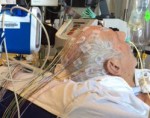
Moments after the hematology team left, Dr. Burkholder, the neurologist, arrived with a couple of residents in tow. He told us that Dad should have an EEG sometime later today and an MRI either tomorrow or the next day, depending on various schedules. This brief encounter with the doctor was typical of how we interacted with the specialists. The resident or fellow would arrive and spend quite a bit of time assessing Dad, and then the doctor would pop in for two minutes, basically repeating what the resident had told us earlier.
eegDad’s oxygen levels had been fair, and when Nikita, the respiratory therapist arrived, she increased his oxygen level on the ventilator from 40% to 50%. As she adjusted the ventilator settings, she said that she’d probably decrease the levels back to 40% later in the day.

Kristina had shown me how to exercise Dad’s arms. When she saw me moving his arms, she showed me how I could also move his legs. I had barely started exercising his legs when the EEG tech arrived.

After the EEG, which takes longer to set up than to administer, Mom and I left the hospital to run some errands and eat dinner.

sunflowervase2When we returned to Dad’s room at 7:00 P.M., we were thrilled to see that Tyler was Dad’s night nurse again. Nights were scary for me and Mom, and knowing that Dad was in good hands gave us some peace of mind. Dad’s vasopressor dosage had inched down again, which was also wonderful to see.  Unfortunately, the oxygen setting on the ventilator was still set to 50%, which meant that Dad’s oxygenation was still shaky.

While Tyler was getting set up for the night, I exercised Dad’s arms and noticed that he seemed a little flushed. Usually the hospital room felt cold enough to set Jell-O, but for a change, Mom and I weren’t shivering. When I checked the thermostat, I noticed that it was set for 75 degrees—a setting that we hadn’t seen before and would never see again. Tyler quickly adjusted it back to 68 degrees.

When Mom and I left for the night, Tyler was oiling Dad’s dry feet and said that he planned to wash Dad’s hair. If only Tyler could work every night.


Some clinical improvements, but still unresponsive

sinus-rhythm-stripJuly 26, 2015. Mom and I arrived at the hospital shortly after 8:00 A.M.; I looked at Dad, and then over to his IVs. Amazingly, Dad’s night nurse, Tyler, had been able to wean Dad down to one vasopressor. Dad’s day nurse, Kristina, also noted that he was down to one antibiotic. Unfortunately, his WBC count had ticked up to 21.2.  Dr. Pan, the nephrology resident, stopped by a few minutes after we arrived. He had reviewed Dad’s early morning lab results and recommended that they dialyze Dad again to remove more fluid, although they probably wouldn’t clean his blood.
Some of Dad’s other lab results looked a bit more promising. Although his poor liver was still in shock, his highly-elevated liver function had inched down slightly. The sparks of good news were tempered by Dad’s continued unresponsiveness.

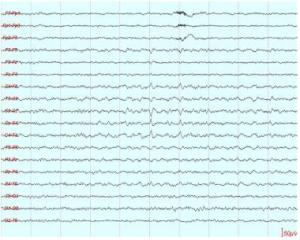
eeg_waveWhen Dr. White arrived, he acknowledged that while there had been some clinical improvement in my dad’s condition, Dad was still critically ill and his mental status was not improving. To ensure that Dad hadn’t suffered a stroke or a bleed, he planned to order a CT scan. Dr. White restated his concern about Dad’s toes and thought that he probably would lose at least one toe.

A few minutes after Dr. White and his residents left the room, Rob, a PA who had worked with Dad back in May, stopped by. He said that he had seen us in the waiting room the other day and thought that we looked familiar. After he realized who we were, he wanted to stop by and see how Dad was doing. We didn’t have great news, but so far, Dad had survived four days longer than the original prognosis.

Stan was in Temple for the weekend, and he arrived at the hospital at 10:15 A.M. to stay with Dad while Mom and I attended church. At the church, our friends were anxious to hear about Dad’s condition. One friend is a nurse practioner with the dialysis center and receives a daily schedule of dialysis patients in the Scott & White system. She was shocked when she saw Dad’s name on the Memorial list. My father wasn’t a patient of hers, so she couldn’t access the details about his transfer, but she knew that the transfer from the CCH to Memorial wasn’t good.

According to Stan, Dr. Issac, the nephrologist, stopped by right after we left for church and said that they would not dialyze Dad today. Dr. White wanted to further reduce Dad’s vasopressor therapy. The process of removing blood during dialysis lowers a patient’s blood pressure, which would have been counterproductive to the daily goal.

The tube feed, which had been stopped on July 22, was resumed today. The thought of the tube feed scared me, but Dad needed the nutrition, and this was the only way for him to get it. The rate was restarted at 20 ml/hour, which was considerably less than it had been when he aspirated on his tube feed four days earlier.

Stan said that Dad was transported to radiology at 11:40 A.M. for his CT scan. He was returned to his room shortly before Mom and I returned from church.

musical-notesWhile Mom, Stan, and I were at home for lunch, I decided I would try some music therapy with Dad.  KNCT, a local public radio station in central Texas, plays big band music on Sundays. Armed with a small radio and headphones, I hoped that having Dad listen to his favorite genre of music might spark some response from him. We returned to the hospital at 2:30 P.M., and I placed the headphones on Dad’s ears and turned on the radio. Maybe I’d seen too many movies, but I was disappointed when we didn’t detect any response from him. We also tried yelling at him, tickling him, and shaking his arms, but we still got no response.

Charris, his assigned resident, stopped by to talk with us about Dad’s apparent stupor. She showed us the CT scan results and the radiologist’s assessment. Everything seemed to be normal from a brain trauma point of view. She agreed that he was just about in a coma. She suggested that they request a consultation with a neurologist.

Around 5:00 P.M., a nurse entered the room and introduced herself as Melissa, Dad’s new nurse. Because the MICU had too many nurses for the number of patients, they had to send one home, so Melissa would be with Dad for the next two hours. Mom and I left around 5:15 P.M. to visit the next-door neighbors and share some of the bounty from my parents’ garden.

When Mom and I returned to the hospital at 7:00 P.M., Tyler was his nurse again and the other Tyler was the respiratory therapist. I probably shouldn’t have, but when Tyler said that he was doing something barbaric to see if Dad would withdraw from pain, I asked Tyler to stop hurting him.

Nurse Tyler’s goal was to further reduce Dad’s vasopressors overnight.  Tyler performed a pretty thorough assessment of Dad tonight while we were there, and then showed me how to use the music on Dad’s super expensive bed. I set up nature sounds, which later confused a nurse’s aide who stopped by to take Dad’s blood sugar. She thought that there were crickets in the room, which really isn’t too unusual for central Texas.

Mom gave Dad a goodnight kiss, and it looked like he kissed her too. We left the hospital for home around 8:30 P.M.

Before I went to bed, I emailed my cousin, David, who is a cardiovascular diseases fellow at Brigham and Women’s Hospital in Boston. I updated him about Dad’s condition and then asked about his thoughts pertaining to my father’s mentation. My question was way outside of his specialty, but I was hoping that he might be able to help me understand my father’s catatonic state.

Taking it one hour at a time

sunflowers1July 24, 2015. The call that we dreaded from the hospital during the night hadn’t come. We didn’t know what to expect today, but we had to take it one hour at a time.

 
When Mom and I arrived at the hospital, we found that Dad was back on dialysis, for the fourth time this week. According to Andrea, his nurse, Dad was less responsive this morning, which was not what we wanted to hear. She added that, according to his morning lab work, he was still suffering from metabolic acidosis. She had been able to wean him off of one of the vasopressors, but his blood pressure dropped below 65 MAP during dialysis, and they had to restart the vasopressor. When I asked her about his WBC count, she told me that it was up to 18.9, a 300% increase in less than 48 hours.
 
petals1Dr. White started his rotation today as the attending physician. We now had what seemed like a long relationship with this doctor, and he didn’t pull any punches with us. He told us that because of all the vasopressors that Dad was taking for his low blood pressure, his toes were being affected and he might lose a couple of them. The doctor strongly suspected that Dad’s circulation problems would begin to move up his extremities. Dad’s liver was also in shock, and the good doctor said that he was surprised that Dad had been able to withstand the dialysis. He also stated that Dad’s pupils were nonresponsive and he did not withdraw from pain, even when taken off sedation. He reiterated Dr. Sanchez’s prognosis from yesterday in that he did not expect Dad to survive this episode. At the end of this uplifting visit, Mom and I felt that we might need to make a decision tomorrow or Sunday.
 
Pastor Don stopped by around 1:45 P.M., and Mom and I had a very emotional visit with him. I just couldn’t believe that this was happening, and Don said that it was OK for me to be mad at God. I was mad, frustrated, and heartsick, but I don’t think that I reached the point of being mad at God. Among other things, Don asked us if we had considered hospice. I wasn’t sure whether hospice care was available at the hospital or some other location. At that point, I hadn’t considered anything, and I wasn’t ready to think about it. 
 
Shortly after Don left us, I walked over to the north tower to visit with some of the CTICU nurses. I found a couple of our favorite nurses and provided them with a brief update on Dad’s status. When I returned to Dad’s room, I learned that Andrea had been able to wean Dad off of two of the five vasopressors, and his blood pressure seemed to be stable. This was the first good news since Dad’s return to Memorial, and I could feel myself exhale. I said a silent prayer that we could wean Dad off the remaining vasopressors before he lost any extremities.
 
Later in the day, Pastor Don stopped by again with his wife, Wynn. Mom had met her two nights earlier, but this was the first time that I had met her. I found her to be delightful and I was pleased to learn that she worked in the chaplain’s office at the hospital.
 
Vasopressors increase blood pressure by constricting the blood vessels. This constricting of blood vessels is particularly acute in the extremities and in situations like Dad’s, toes and fingers sacrifice blood flow for the benefit of the vital organs. Andrea tried to find Dad’s pulse in his feet with her hands, but couldn’t. She eventually was able to find a pulse in both feet with a Doppler ultrasound. The relief among those of us in the room was palpable when we heard the sound of blood flow.
 
petals2Mom and I went home for dinner and returned to the hospital at 7:15 P.M. Charlie, the respiratory therapist, had just finished Dad’s trach and oral care and ventilator maintenance. Dad was still on three vasopressors. Mom and I met Donna, the night nurse, before leaving for the night. She told us that Dad had additional blood draw after dialysis and that his WBC count was now 22.7, up another 4 points from this morning. His WBC count hadn’t increased at this rate since his first aspiration episode in May.

 
I should have been encouraged that Dad had survived another day, but I was concerned about Dad’s worsening responsiveness. I couldn’t stand the thought of losing him without being able to communicate with him one last time. I had mentioned to Andrea that I wanted to talk with a respiratory therapist to see if there was a way in which we could communicate with him.
 
July 25, 2015. Mom and I arrived at Dad’s room at 7:15 A.M. We were pleased to see Andrea again, but nurses work only three days each week, so we knew this was our last day with her. Dad’s WBC count was now 19.2, down slightly from yesterday afternoon, his hemoglobin was down, and his acidosis condition had improved to the point that he was now slightly alkaline. Dad had been receiving a bicarbonate drip, which they now decided to stop. The vasopressors were still affecting the blood flow in Dad’s feet. We held our breath again as we watched Andrea struggle to find a pulse with the Doppler ultrasound.
 
Dad was sleeping a lot, and Andrea said that he was not responding to commands, but he opened his eyes for her. He opened his eyes for me, too, but I couldn’t get him to squeeze my hand.
 
Charris, one of the residents assigned to Dad, told us that when Dad arrived a couple of days ago, they performed a mini bronchoscopy on him to take some cultures from his lungs. They now knew that in addition to the aspiration pneumonia, he also had an infection (pseudomonas) in his lungs. Severe cases of pseudomonas generally occur in people who are already hospitalized with another illness or condition, or people who have a weak immune system. It seemed that everything that ailed Dad now was hospital acquired.
 
Dr. Pan, the nephrology resident, stopped by and told us that because Dad was not very acidosic and didn’t seem to have much extra fluid, they would not dialyze him today. He said that the nephrology team would assess Dad on a daily basis to determine whether to dialyze.
 
Dr. White stopped by during rounds at 8:00 A.M. He agreed that we’d seen a slight improvement in Dad since yesterday–probably due to the dialysis. He was able to feel the pulse in Dad’s feet with his hand, and he said that Dad’s feet looked better than they did yesterday. I knew that I shouldn’t have been so concerned about his toes when his life was at stake, but I was relieved that the pulse in Dad’s feet was getting stronger as they weaned him off of the vasopressors.
 
petals3Now that Dad was back on the ventilator, he couldn’t talk. I got some wild idea yesterday that I had to give Dad a chance to communicate with us if he was going to die. Andrea said that she would contact the respiratory therapist to see if it would be possible to enable him to talk. The respiratory therapist contacted Svenja, the Trach Goddess of Scott & White. We hadn’t seen her since June, when she first changed Dad’s trach. When she heard about Dad’s condition and our desire to communicate with him, she agreed to give it a try. Unfortunately, all of her efforts failed to work, and we probably sapped some of Dad’s strength. The exercise woke him up for a couple of minutes, but he fell asleep almost immediately when Svenja reinflated his trach collar.
 
When Mom and I returned from a lunch break, we found that Dad was still asleep and impossible to rouse. Most of his vitals were still good, but Andrea told us that his platelet count had dropped, and he needed a platelet transfusion. We sat in the room with Dad for a few more hours and finally went home for dinner. It was difficult to stay in the room with him in his current condition, but it felt worse to leave him. Although his vitals were stable, his condition was still grave, and the failed attempt to communicate with him had wilted my already sagging spirits.
 
We returned to the hospital at 7:00 P.M., in time to meet Tyler, the night nurse. Mom and I liked him immediately, and he seemed intent on weaning Dad off of the vasopressors. While talking with the nurse, the respiratory therapist, also named Tyler, attended to Dad’s trach, the ventilator, and Dad’s oral care.
 
Before we left for the night, Tyler put some lotion and booties on Dad’s feet to help with his peeling and cold feet. Tyler told us that he would be working for four nights that week, and we really hoped that he would be assigned to Dad. When Mom and I left for home at 8:30 P.M., we felt a small sense of optimism that Dad would have a good night, and maybe we would too.
 

Slipping back into Hell

July 23, 2015. Dr. Anderson called me at 5:30 A.M. and told me that they still were unable to raise Dad’s blood pressure. His EKG had changed and the doctor suspected that Dad had suffered a heart attack. The doctor wanted to know how aggressive we wanted to be in his treatment. They were limited with what they could do at the CCH, and if they kept doing what they were doing, Dad would die in one to two hours. They might be able to help him at the main hospital (Memorial), but with his age and current situation, Dr. Anderson recommended that we think about how much more we should so. I woke Mom to confer with her, and she wanted to do everything possible. I called Dr. Anderson back with our decision, and he said that Dad would be at Memorial in about an hour. Considering that he projected one to two hours for my father to live, the hour-long trip to the other hospital made me a little nervous.

hell2When I got off the telephone with Dr. Anderson, I texted Pastor Don and my husband about Dad’s situation. Mom and I got dressed and headed to Memorial. We didn’t know where to go, so we headed to what we knew: the Cardiothoracic Intensive Care Unit (CTICU) nurses station in the north tower of the hospital. We arrived at 5:50 A.M., and it occurred to me that we arrived at the same time on May 6 for Dad’s original surgery. We asked the CTICU nurses about Dad’s whereabouts, but either he had not arrived, or he was not yet in their system.

While at the CTICU nurses station, we saw a couple of nurses and respiratory therapists that we knew, and they showed us to the Medical ICU (MICU) waiting room in the south tower. While we were waiting, personnel from the day shift started arriving. As Kelli, one of the charge nurses from CTICU, walked through, she was startled to see us. We quickly apprised her of Dad’s condition, and she hurried off to see what she could learn about his whereabouts.

At 8:00 A.M., we were still sitting in the MICU waiting room, waiting to learn more about Dad’s condition and see him. We saw Jordan, a PA, and Dr. Sai, both of whom said that they would check on Dad and get back to us. When we were finally called to Dad’s room, we were met by Dr. Sanchez, who was the presiding physician that week. He said that Dad was stable, but his condition was grave and the doctor didn’t think that Dad would survive. He said that they would know more in 48 hours. I was so anxious for anything positive, the fact that he even mentioned a time beyond today seemed like good news.

hell2bEvidently, when Dad arrived from the CCH, he was on three vasopressors and his MAP was in the 40s, which is way below minimum. Now, he was receiving more than the maximum dosage of five vasopressors to keep his blood pressure at a MAP of 65, which is a minimum level. When asked by Dr. Sanchez about the extent to which we would go, we said that we wanted to do everything possible, stopping short of restarting his heart, should it stop.
Our first couple of hours in Dad’s room were like a tragic welcome-home event. Addison, one of Dad’s speech therapists, stopped by to say “hello.” Adan from the CCH had called her and told her about Dad’s episode. Dr. Velazco, another of the physicians who rotates through the ICU, stopped by. He still wore scrubs from surgery and was very upset about Dad. Occasionally, we were asked to leave Dad’s room, and during those times I kept encountering nurses and therapists from his earlier stay at Memorial. They were all shocked and generous with their supporting hugs.

After Dr. Sanchez and his entourage left, we got to know Tina and Andrea, the two nurses assigned to Dad. I really liked them and the way in which they cared for Dad. For all intents and purposes, the doctors had told us that Dad was a lost cause, but you wouldn’t know it from these two women. I also came to depend on Charis, a resident who was assigned to Dad. Lynette, the case manager, was also very attentive and told us to contact her if we needed anything. I suspect that she thought that Mom and I would need her assistance when Dad died.

hell2cThroughout Dad’s stay in the Scott & White system, I had developed a steely resolve to stay positive and to keep my parents positive. The last six hours had severely cracked my armor. When Charis first entered the room to talk with us about Dad and how the doctors were expecting his death, I sort of lost it. While fighting back tears, I started telling her that what I was feeling was like Orpheus watching Eurydice slipping back into Hell. The only light moment of the day came when my mother commented about the startled look on Charis’ face when I interjected Greek mythology into her briefing.

As the day progressed, Dad’s condition seemed to worsen. The doctors continued to administer broad-spectrum antibiotics. Only 24 hours earlier, his WBC count was 5.6. It was now approaching 13 and he was non-responsive to pain. In addition, he had developed septic shock, severe acidosis, and his liver was in shock. The doctors thought that putting him back on dialysis might help with the acidotic condition. Shortly before noon, Carlos, the dialysis nurse, arrived and started the eight-hour dialysis session. Dad’s blood pressure dropped, so they stopped removing fluid.

Around 12:30 P.M., Dad seemed to recognize me. I took that opportunity to tell him that I had purchased an indoor skydiving session for my husband for his birthday. He made a face, which seemed like the response that I would have expected from him. Around 1:00 P.M., Andrea was able to get him to squeeze her hand. She also touched some gauze to his eyes to see if he would react. Bases on his responses, Andrea thought that, neurologically, he was doing better. He had not reacted to any type of stimuli, including pain, when he was admitted.

hell2dWhen Mom and I went to lunch, we stopped by the CCH to pick up Dad’s belongings and flowers. Live flowers are not allowed in the ICU at Memorial. When we returned to Memorial around 2:30 P.M., he was wrapped in a Bair Hugger (heating blanket). His core temperature was now too low, partly because of the dialysis, and they needed to raise it.

During the remainder of the day, a variety of therapists and specialists stopped by to take blood and administer trach care and oral care.

As news of my father’s return spread through the ICU, more nurses stopped by his room. One unexpected visitor was Peggy, a hospital employee who monitored central (PICC) lines. She stopped by the room because she recognized us. We chatted a few minutes, and Mom and I quickly learned that she was not a fan of the CCH. She encouraged us to contact Patient Relations about the CCH and our experiences there.

Mom and I went back to the house for a late dinner break and didn’t return to the hospital until 8:00 P.M. We didn’t plan to stay long, but felt that we needed to meet his night nurse, Rebecca. Dad was off dialysis and his blood pressure was up, but it dropped sharply when Rebecca tried to start weaning him off of the vasopressors. She decided that she would probably keep the levels the same during the remainder of her shift, which would end at 7:00 A.M. When I asked her about the results of his ABG tests earlier that day, she said that his pH levels were still “out of whack,” which was disappointing news. We had hoped that the dialysis treatment would have improved his acidotic condition. Before Mom and I left for the night, we visited with Charlie, the respiratory therapist, while he administered trach care and an oral treatment. We stayed until about 8:30 P.M.

I don’t recall what we did when we returned home, but after the day that we had just endured, I suspect that a glass of wine was involved.

And the nightmare begins again

skyWednesday, July 22, 2015: 3:45 P.M. I had just left a meeting at work and listened to the voicemail that my mother left 40 minutes earlier. “Melody, it’s Mom. I’m at the hospital with Dad and he’s not doing too well. He had a bad coughing spell during dialysis and they’re trying to bring his blood pressure down, but he’s got the shakes and delusions and all kinds of stuff. Call me on my cell, because I’m not going to leave him. Talk to you later. Bye-bye.”

A tingly feeling crept up my neck and face, and I hoped that she was overreacting.

Earlier that day, Dad was wheeled to the dialysis room on the second floor of the CCH. His WBC count had been holding steady at 5.6, but his creatinine level was still elevated. His stubborn creatinine levels prompted his nephrologist to predict that Dad was likely to remain dialysis dependent, news that we didn’t want to hear. During his morning rounds, Dr. Anderson found Dad to be awake and alert and said that his vitals were good.

At 10:30 A.M. Dad starting coughing hard during dialysis and couldn’t seem to stop. His condition seemed to worsen immediately. Dialysis was stopped and Dad was returned to his room. Dad’s oxygen saturation levels bounced between 75% and 90%. He was coughing and suctioning large amounts thin, clear looking secretions. Michelle, Dad’s nurse, said that he was alert and had a productive cough, but it was obvious to her that Dad was in distress. The respiratory therapist was summoned to Dad’s room. She removed the red cap from Dad’s trach tube and placed him on BIPAP with 40% oxygen—a big medical and psychological step backward.

Rachel, the nurse practitioner was called to Dad’s room to evaluate his condition, and she thought that his cough appeared to be calming down. Shortly thereafter, the nurse notified Dr. Anderson that Dad’s heart rate had elevated to 150. In addition, his clear-looking secretions changed and now appeared to be Nepro. His tube feed had been stopped in dialysis when he started coughing, so they were now certain that he had aspirated his tube feed during his coughing jag. Nepro in the lungs pretty much triggers pneumonia immediately. This would be the second time that he had had pneumonia in less than three months.

On dialysis days, Mom usually arrived at the CCH around 11:30 A.M., about 10 minutes before she anticipated Dad’s return to his room. When she arrived today, she was startled to see that not only was Dad already there, the room was also teaming with activity. Michelle briefly apprised Mom about what had happened, but Mom didn’t get the impression that Dad’s condition was dire. She watched the nurses administer some meds, prop up Dad in bed, and leave the room. From what Mom could tell, it didn’t seem like the meds or the upright position did anything to improve his situation.

A short time later, Dr. Anderson told Mom that they would move Dad to a larger room next to the nurses’ station so that they could more closely monitor and attend to him. After they moved him, Mom sat in his room, watching the constant flow of nurses while they injected one medicine after another into his IV. Several times she was asked to leave his room, although she didn’t always know why.

After sitting in Dad’s room for a couple of hours, Mom called her friend Marilyn. Being the good friend that she is, Marilyn dropped everything and went to the CCH to sit with my mother. Shortly after Marilyn arrived, my mother called me and left the ominous message on my voicemail. When I returned her call at 3:45 P.M., she was very concerned, and although they had just moved Dad from BIPAP to full ventilation, she was still not convinced that I should drive to Temple before the weekend.

Marilyn and Mom sat together in Dad’s room for a couple of hours. During that time, Dad’s condition had not improved and Mom became worried. To her, it seemed like they kept trying medications but to no avail. As Marilyn and my mother talked, Marilyn asked Mom if she should call Pastor Don, but Mom didn’t know how to contact him. Marilyn was pretty active in another United Methodist Church. She didn’t have Don’s contact information, but she knew someone who did.

Pastor Don’s mobile phone rang just as he and his wife, Wynn, started eating dinner at a local restaurant. Don promised to stop by the CCH as soon as they finished dinner. Mom called me again at 5:30 P.M., and said that she wanted me to come to Temple that night. Stan had come home for dinner and was about to return to his office for the night. His birthday was becoming memorable, but not for the reasons we wanted. I had already packed a bag in anticipation of Mom’s call, but decided to wait a couple of hours before leaving. Anyone familiar with U.S. 290 would understand why I didn’t want to brave that highway until after 7:00 P.M. I said good-bye to Stan, and he said that he’d come up to Temple in a couple of days.

Between Mom’s call to me and when I left Houston, Pastor Don and Wynn arrived at the CCH. Mom and Don spent some time together in the small chapel at the CCH, and Mom said that Don was wonderful and encouraging. Finally, at 9:30 P.M., Mom, Marilyn, Don, and Wynn left the CCH.

My drive west on U.S. 290 was a little surreal. The sunset was a spectacular display of stunning shades of orange. I was torn between appreciating the beauty of nature and praying that my father wouldn’t die on my husband’s birthday. I arrived at the CCH around 10:00 P.M., and made my way to Dad’s room. When I arrived, he was fully ventilated and surrounded by ice and fans in an attempt to bring down his temperature. I was met by his night nurse, Christine. She had arrived at 7:00 P.M., and was stunned by his sudden change. She told me that he had been doing pretty well, and she really enjoyed joking around with him during her shift. He had never spoken about her to me, but he’s a big kidder and it seemed like they had developed a friendly banter.

I went to his bedside and held his hand, but he didn’t know that I was there. Christine asked me under what circumstances I would want to be called during the night. I told her to consider her own father and the circumstances under which she would want to receive a call, and then I left. I had called my mother when I arrived at the CCH and she was waiting for me to arrive at the house. We were both exhausted, yet keyed up on nervous energy. We talked for a while before going to bed.

At 3:30 A.M., the phone rang and it was Michael, a nurse from the CCH. He mumbled something about how they were adjusting Dad’s medication. I listened for a moment, said “OK,” and then hung up. After the call, I wasn’t really sure why he had called. It was unsettling and confusing. I wished that I had been more alert. I learned later that he had called to tell me that my father’s condition had worsened and that Dad required additional medication and that they were going to insert an arterial line so that they could monitor his blood gases. He had probably told me that in some jargon that I couldn’t understand—especially at 3:30 A.M. Scarier still was that this phone call was to obtain consent for the procedure. About an hour later, Dad’s blood pressure dropped to 65/39, his respiration was 35, his extremities were cold, and he still had a slight fever. With full ventilation, his oxygen saturation was only 90%.

At 5:30 A.M., the phone rang again. This time it was Dr. Anderson. He told me that my father wasn’t doing well, and among a list of problems, he was pretty sure that Dad had had a heart attack during the night. He then said that they could keep on doing what they had been doing, and my father would probably die in 1-2 hours, or they could send him over to Memorial. Dr. Anderson went on to say that considering my father’s age and “extremely poor prognosis,” he assumed that we would not want to take “aggressive measures.”

God help me; I took a deep breath, and in that moment I flashed back to several conversations I had had with Dad in which he listed conditions in which he would not want to live or treatments that he would not want to endure. I told the doctor that I would call him back in a couple of minutes. I then woke my mother with the news from Dr. Anderson. I was relieved when she said, “We have to do whatever we can to help Daddy.” I immediately called the CCH and told Dr. Anderson to send my father to Memorial. He hesitated for a moment and said OK, but it sounded more like a question than an affirmation.

At 6:15 A.M., my father was moved to a stretcher and transported back to Scott & White Memorial to MICU. Following Dr. Anderson’s call, the clock seemed like our biggest enemy.