August 20, 2015. As Mom and I drove to the hospital, we realized that today would probably be Dad’s last day at Memorial. We were glad that he had recovered enough to leave Memorial, but we had reservations about the CCH. Except for a couple of cases (good people we had encountered), our feelings about the facility were not positive.
Mom and I arrived at Dad’s room at 7:40 A.M. to find Dad’s legs halfway out of the bed. His nurse, Pam, got him back into bed and then called the doctor about Dad’s delirium. I wiped Dad’s eyes with a warm washcloth, and Pam gave him some Fentanyl, an opioid pain medication, in his feeding tube.
Janie, the respiratory therapist, administered a breathing treatment of Albuterol, followed by oral care. Dad signaled that he wanted the speaking valve now, but he’d been having some difficulty breathing, so he had to remain on CPAP. Janie said that she would move him over to the trach collar around 9:15 A.M. to see how he managed.
Dr. Brett Steven Ambroson stopped by and said that the infectious diseases specialist had recommended a couple of antibiotics for the next few weeks, but added that Dad would probably be on some sort of antibiotic for the rest of his life, or until the antibiotics eventually did no good. Gad.
Pam said that she spoke with the doctors about Dad’s delirium, and they wanted to fully vent him at night and had ordered an extra dose of Seroquel for him during the day, along with more Fentanyl. She said that the extra meds were ordered because of Amanda’s claim last night that Dad had hit her. This claim bothered me. It might seem like I was splitting hairs, but Dad had been struggling with the group of nurses to keep from being tied up. During the flailing of his arms, she was struck. He did not deliberately strike her. Mom and I were in the room and we saw what happened, and we didn’t realize that anyone had been hit during the ruckus. It was only when they had finally restrained him that one of the nurses said that he had hit it.
Dr. Stewart stopped by to talk with us about Dad’s situation, including the recommendation to fully vent him at night and then wean him off of the vent so that he could get more rest and get back onto the day schedule for the trach collar. He said that the doctors at Memorial would recommend stopping the Seroquel and replacing it with a pharmacy-grade Melatonin, known as Ramelteon. He said that they had had good results with it at Memorial and hoped that the CCH doctors would want to continue it.
At 10:20 A.M., Michelle, the dietitian, stopped by for a routine visit to see if Dad’s nutritional needs were being met. I had sort of a love/hate relationship with this very nice woman, which had more to do with the tube feed than her. Because Dad had aspirated on his tube feed during dialysis, I asked if he could have the tube feed suspended during dialysis. She wasn’t wild about that suggestion because Dad would be in dialysis for about 12-15 hours each week and the nutritional loss for him could be significant. She said that she would speak with her counterpart at the CCH to devise a nutritional plan for Dad. Since her last routine visit with Dad, he had received about 90% of his daily nutritional goals. As she had done during her previous visit, she also recommended the addition of probiotics and fiber to Dad’s diet.
Dad’s DNR order was not valid outside of the hospital, so Mom had to sign a new one for the ambulance ride from Memorial to the CCH. We didn’t expect anything to go wrong, but it still gave me the willies to sign this document and then send him on his way. We had one final visit with Dr. Ghamande and his team. He pretty much repeated what Dr. Stewart had told us earlier. He also mentioned that Dr. White would be the presiding physician at the CCH next week.
At 11:37 A.M., Janie returned to Dad’s room and moved him back to the trach collar in preparation for his transfer to the CCH.
Five minutes later, the EMTs arrived to prepare Dad for the trip back to CCH. Because the cuff was deflated on his trach collar, Dad was able to chat with the EMTs without a speaking valve. He seemed to be in good spirits and didn’t exhibit any agitated behavior. The EMTs’ preparations were finished in less than 30 minutes. As they started pushing Dad’s gurney out of his room, Dawn rushed into the room with Dad’s speaking valve and installed it on his trach.
Mom and I arrived at the CCH at 1:05 P.M. and sat in the waiting room for about 20 minutes before we could go see Dad. When we arrived in Dad’s room, we found him chatting amiably with Dr. Randall Smith, our favorite doctor by far. It seemed as though Dr. Smith was conducting a getting-to-know-you type of interview, but he was actually trying to assess Dad’s cognition. Before he left the room, Dr. Smith said that he was going to request a PT assessment for Dad today and have Speech Therapy get started on swallow therapy. We were so glad that Dr. Smith was the attending physician, if only for three more days. Mom and I finally went home for lunch around 1:15 P.M., and I started working online from home at 1:45 P.M.
Mom returned home from the CCH at 5:15 P.M. During the afternoon, I had inadvertently downloaded a virus from a training website and was now being held captive by one of our IT techs while he tried to fix my computer. I was eventually able to tear myself away from my terribly unproductive day and eat dinner with Mom.
We arrived back at the CCH at 7:05 P.M. Dad seemed to be enjoying his speaking valve and was speaking with a clear and strong voice. In that strong voice, he wished for a pair of tiny scissors that he could use to cut his restraints at night. In my perfect world, he wouldn’t have needed the restraints.
Gary, the respiratory therapist, arrived at 7:45 P.M. and administered Dad’s Albuterol nebulizer treatment and trach care. The treatment lasted for several minutes, during which Dad could not talk. As soon as Gary removed the nebulizer device, Winnie, the night nurse, arrived to administer the evening meds. Within a few minutes, Dad started drifting off to sleep. He had had a full day, full of non-stop talking for the past seven hours. We left the CCH feeling pretty confident that he would have an uneventful night and a good night’s sleep. Dad’s latest stay had gotten off to a pretty good start, and Mom and I were feeling much more optimistic about his return to the CCH.
August 18, 2015. Mom and I arrived at the hospital at 7:40 A.M. to find that Dad was sleeping and unrestrained, which was a nice change. I spoke briefly with his nurse, Pam, and learned that his WBC count had inched up again to 13.3. I hoped that we would learn something about the results of the BAL test on Dad’s secretions. I woke him and wiped his eyes and face with a cool cloth.
At 8:30 A.M., the wound care team stopped by to assess Dad’s various sores, including a new blister that had just developed yesterday on his right hand. The constant repositioning of Dad by the nurses annoyed Dad but was supposed to reduce the likelihood of bed and pressure sores. I can’t imagine what his condition might have been like without the constant movement. Janie, the respiratory therapist, stopped by at 9:15 A.M. and moved him from CPAP support to the trach collar. She said that the doctor wanted to see whether Dad could handle an eight-hour trial today.
Dad had a moment where he indicated that he was getting out of bed. I wasn’t sure whether he needed the bathroom or just wanted out of the bed. I persuaded him to remain in the bed. My father had always been very focused on completing tasks and achieving goals. This character trait seemed to be amplified in his delirious state. Since his first stay at the CCH, he had been intent on getting out of bed to use a proper bathroom. Unfortunately, accomplishing this goal was not possible at this time, and reminding him of that reality was my daily task.
Around 10:45 A.M., Mom left the hospital to run some errands. We still hadn’t seen the doctors, but we had heard that the MICU had a full house. Also, they seemed to assess patient condition on a curve. If your condition was less critical than the other patients, then you might not see the doctors until early afternoon. We couldn’t find fault with this convention, but it made any sort of planning difficult.
Dad had been coughing up a lot of thick yellow secretions today and seemed to be pretty sleepy and confused. I was concerned that he might be battling some new, or recurrence of an old, infection. At one point he asked me to explain about the bathroom and review what would be happening today.
At 11:15 A.M., the machine that provided oxygen aerosol support for the trach collar stopped making its usual working sounds. The equipment problem didn’t seem to create any breathing problems for Dad, but Pam said that the oxygen line had popped off. Aside from the lack of sound, Dad didn’t realize that anything was wrong. After Janie, the respiratory therapist, arrived, she performed a little maintenance on the machine and provided a little trach care on Dad, which reduced his secretions somewhat.
During rounds, Dr. Ghamande acknowledged Dad’s elevated WBC count and said that they were still waiting for the results of the BAL. He said that barring any unforeseen complications, Dad should be able to transfer to the CCH in a couple of days. He said that they would keep extending Dad’s trach collar trials by a couple of hours a day and continue with CPAP support at night. He thought that Dad should be ready for a speaking valve very soon.
After the doctor left the room, Lanette, Dad’s case manager, told me that according to Cheryl, Lanette’s counterpart at the CCH, Dad has used all of his 90 days of annual Medicare hospitalization coverage, plus 46 of his 60 reserve days. This meant that he would be uninsured in 14 days. I experienced a wave of panic and a knot in my stomach. I couldn’t see any way on earth that my father could go home in two weeks. I had been keeping track of Dad’s days and according to my notes, he had been hospitalized for 105 days, not 136. Until this moment, it hadn’t occurred to me that you could run out of Medicare coverage. It made sense, but I was operating in survival mode and not financial mode. The other unpleasant surprise was that his supplemental insurance was tied to his Medicare coverage. So, although he continued to pay the Medicare and supplemental insurance premiums, he would be uninsured. I sat down with my calendar and recounted the days a couple of times to sanity-check myself. My results differed from Lanette’s, and I called her and contested her calculations. She said she would contact Cheryl, but I was pretty sure that the error was Lanette’s.
Mom returned from her errands and lunch at 12:30 P.M. and I left the hospital for home at that time. Shortly after Mom arrived, a couple of nurses moved Dad to the cardiac chair. While he was in the chair, Travis and Mike, the physical therapists, came by and exercised Dad’s legs. They said that Dad’s progress was very slow and that he had lost considerable strength in his upper and lower extremities. The 105 days in bed had taken a toll on Dad’s strength.
While Dad was still sitting in the cardiac chair, Dawn, a trach nurse, stopped by for a routine trach change. Dawn told Mom that she was handling Svenja’s cases while she was on vacation. By the time that Dawn finished the trach care and left the room, Mom needed to head back to the house.
Mom and I returned to the hospital shortly after 7:00 P.M. Dad was in a very agitated state and insisted that he was going to get out of the bed. Amanda, his nurse, tried to redirect his attention by repositioning him in the bed. Unfortunately, Dad was delirious and was beyond redirection.
When patients use the trach collar to breathe, the trach collar is deflated, which enables the patient to speak around the trach. It’s not the best form of communication, but between the ability to speak around the trach and the letter board, Dad had been able to communicate with us and the various health providers. He started talking about leaving the Mormon church, and then switched to yelling about quitting the hospital union. He warned Mom to run from the Mormons and not let them get to us. He also spoke of membership in the hospital, and he told me and Mom that we should not join the hospital. Maggie, the charge nurse and one of Dad’s former night nurses, came in and chatted with him for a little while. Coincidentally, Maggie was a member of The Church of Jesus Christ of Latter Day Saints. Fortunately, she kept her sense of humor during his ranting about Mormons. He kept talking about bathrooms and coffee and not being around miserable people. After 8:30 P.M., his mental state progressed from agitated to aggressive. Amanda had to get the help of another couple of nurses to restrain him. Dad actively fought the restraints and while flailing his arms, struck one of the nurses. It was an experience that I hope to never repeat. Amanda had administered Seroquel in Dad’s feeding tube before they started restraining him, and she said that he should calm down soon. Mom and I left the hospital, more shaken and drained than we had been in many days, and we prayed that Dad would have an uneventful night. As hopeful as we had been a couple of days ago, we were now worried.
August 19. Mom and I woke up this morning to a broken air conditioner. The normal temperature for central Texas in August approaches 100 degrees. Fortunately, my parents had zoned air conditioning, so the house wasn’t unbearably hot. We were able to schedule a service call before we left home.
Mom and I arrived at the hospital shortly after 7:30 A.M. and saw that Dad was still restrained. We noticed that he was on the trach collar and was breathing hard. We quickly learned that he had been on the trach collar all night. The night staff had taken it upon themselves to extend his eight-hour trial to more than 20 hours. We asked Charma, his nurse, to call Dr. Stewart. When Dr. Stewart arrived, he had Janie, the respiratory therapist, put Dad back on CPAP support. While Janie was making the change, she removed some large clogs from Dad’s throat by using saline to lavage the tracheostomy tube. She said that after Dad’s lungs had had some time to rest, they could move him back to the trach collar. We wanted him to get back on a schedule of using the trach collar during the day and CPAP at night. The doctor wasn’t too thrilled that Dad had not been moved back to CPAP support during the night. While the doctor was in the room, he told us that Dad’s WBC count was now 11.9, which was an improvement from yesterday.
Dr. Stewart then told me and Mom that he wanted to meet with us in a conference room to consult with us about some of Dad’s future possibilities. He started off this consultation by stating that they considered Dad’s recovery to be one of their best achievements and acknowledged our part in that success. He went on to say that he suspected that if Dad did go home, he could have more episodes of pneumonia. He continued by saying that Dad might never fully develop the ability to swallow, and if he did, he could very likely choke on his food and develop pneumonia again. He went on to say that although Dad might never be able to eat peas and carrots, we should let him eat what he wants, regardless of the consequences. He said that there was a good chance that Dad would go home with a trach tube. After that disheartening meeting with one of our favorite caregivers, Mom and I returned to Dad’s room.
Brandon, who was helping Janie, came in at 9:00 A.M. to administer some oral care, which was a disaster. Dad wanted no part of it and spit out the mouthwash. It was ironic how much Dad hated the procedures that were most important to his recovery.
During the morning rounds, the attending physician, Dr. Shekhar Anant Ghamande, told us that Dad had some new drug-resistant infection, which was why there was some purulence in Dad’s secretions. To combat it, they would start Dad on Meropenem, one of the three antibiotics that they could prescribe for this infection. Aside from the infection in his lungs and the pressure sores, Dad was progressing well. The doctor also said that Dad could get a speaking valve today! I had the doctor tell Dad the good news, but Dad asked only if he could go home.
Barbara, one of the hospital chaplains, stopped by to visit Dad. We had come to know her pretty well during Dad’s stay, and she had been very helpful. As I had mentioned earlier, the chaplains were the people to ask about anything in the hospital. During Barbara’s visit, she confided to me and Mom that she was retiring at the end of the month.
When Barbara left, I saw Dr. Pan, the nephrology fellow, in the hall with Dr. Nimrit Goraya, the nephrologist, Dr. Goraya said that they had planned to dialyze Dad for eight hours, but because he didn’t have much edema, they would shorten it to six hours. Instead of being finished at 3:00 P.M., they would finish around 1:00 P.M.
Mom and I left the hospital around 11:30 A.M. for lunch. I spent the afternoon working from home and met with the AC repairman, our hero for the day. Shortly after Mom returned to the hospital after lunch, she met Pastor Don in the MICU waiting room, and they had a nice visit before entering Dad’s room.
Mom called me during the afternoon to tell me that Dad still didn’t have a speaking valve. She couldn’t remember if he was to get one today or tomorrow. I told her that the doctor had said that he should get the speaking valve today. I had her tell Dad’s nurse call Dawn, Svenja’s backup while she was on vacation.
Passy-Muir speaking valve
Shortly before 4:00 P.M., Dawn stopped by to change Dad’s trach tube. This change was different from yesterday’s change because this time she also changed the size of the trach. The new size would enable easier swallowing, which would help Dad control his own secretions. Whenever we swallow or clear our throats, we’re handling normal secretions. The presence of a trach tube makes that normal activity more difficult. This new trach tube had a smaller outer diameter, but a larger inner diameter. This sizing combination would enable Dad to inhale more oxygen and swallow easier. The icing on this new trach-tube cake was that the new trach tube could accommodate the Passy-Muir speaking valve. As soon as Dawn placed the speaking value on the trach tube, Dad was able to speak again. WooHoo! Unfortunately, she had to remove it to put Dad back on CPAP support.
Mom came home shortly after the trach tube change-out and told me that Dad was still on CPAP. I called the nurse and reminded her that he was supposed to go back onto the trach collar at 2:00 P.M. The dilemma was that he could not sleep with the speaking valve, so even if he could sleep with the trach collar, he couldn’t speak. During times when he was receiving CPAP support, he couldn’t have the speaking valve. We just had to get him back on a schedule that would enable him to speak during the day.
When we arrived at the hospital shortly after 7:00 P.M., Dad was still on CPAP, but Renee, the respiratory therapist was in the room. I spoke with her and Amanda, Dad’s nurse, about my concerns, and they said that they would get him back on schedule during the night.
Renee switched Dad to the trach collar for the remainder of our visit so that Dad could talk with us. We had some strange conversations with Dad. It seemed like he thought that he was back at work. He finally adjourned our meeting at 8:00 P.M., and told me and Mom to leave.
A cool front had passed through the area and Mom and I took a couple of moments to enjoy the cooler night air. As we drove home, we marveled at the spectacular sunset. We stopped at the field behind the new Valero gas station to look at the sunset before heading home.
Saturday, August 15, 2015. Shortly after I arrived at the hospital at 7:45 A.M., Dr. Hayek ordered Dad moved Dad from BiPAP to CPAP support on the ventilator. They then reduced the settings to less support and let him breathe at the lower setting for about 30 minutes before putting him back on the trach collar. The attending physician, Dr. Ghamande, wanted Dad to have at least four hours on the trach collar today. If this trial worked out well, then they would attempt a six-hour trial tomorrow. During the nephrology visit, Dr. Goraya said that it was unlikely that Dad’s kidneys would function again, although they couldn’t say anything definite for another few weeks. Medicare requires that you be on dialysis for 90 days before you can be declared dialysis dependent. Although the 90th day was just around the corner, the nephrologists seemed hesitant to declare that Dad had end-stage renal disease (ESRD) until he reached this milestone.
During my morning update of Dad’s early-morning lab work, I was told that his WBC count had inched up slightly from 10.4 to 10.7. It was still within the normal range, and I was provided the usual song-and-dance routine about how you have to treat the whole patient and not just look at the numbers, but his numbers had not just stopped trending downward, they were moving in the wrong direction. After 102 days, I couldn’t help but worry.
At 9:09 A.M., Pandora, the respiratory therapist, put the trach collar on Dad. He was now breathing on his own again. Leslie, his nurse, then asked him the following three questions to test his mental facilities: 1) Could you hit a nail with a hammer, 2) Can a leaf float on water, 3) Is a one pound rock heavier than a two-pound rock. He did OK on the first two, but answered “sometimes” to the last question.
For the second day in a row, Dad wanted some of our coffee. Mom and I decided that we should quit drinking coffee in front of him. I wondered if he could smell the coffee.
Shortly before 10:00 A.M. Leslie, the nurse, moved Dad into the cardiac chair. At 11:00 A.M., my husband, Stan, texted me that he had arrived from Houston. Mom and I left shortly thereafter to join him for lunch at the house.
After a nice lunch with Stan, Mom and I returned to the hospital at 12:40 P.M., while Stan stayed at the house and did some yard work. Dad was still sitting in the cardiac chair. He kept trying to talk and became pretty frustrated. His breathing trial was over at 1:15 P.M., and Pandora removed the trach collar and moved him to the CPAP setting on the ventilator.
At 1:50 P.M., Leslie rounded up a couple of nurses to help her move Dad from the chair to the bed, where he promptly fell fast asleep sitting up in bed. The ventilator started alarming, which drove Mom crazy. I guess it takes a certain type of alarm to get the attention of a nurse or respiratory therapist. In this case, water had accumulated the lines, which wasn’t life threatening. Unfortunately, we weren’t permitted to touch anything; we just had to listen to and endure the alarm while we watched nurses and aides walk past the room.
At 4:55 P.M., Mom went downstairs to the lobby to meet Stan. I wandered into the hall and happened to meet a nurse that we had dubbed as Daytime Natalie. She was a nurse in the CTICU, and Mom and I were very fond of her. She had a couple of minutes to spare and stopped in to visit with Dad.
Mom, Stan, and I ate dinner at a local restaurant to celebrate Mom’s birthday. Her birthday was tomorrow, but this was Stan’s only night in Temple. After dinner, Mom and Stan went home and I returned to the hospital and met Dad’s night nurse, Janine, and his respiratory therapist, Tatyana. Shortly after I arrived, Dad starting started indicating that he wanted to get out of bed, and continued in earnest until I finally was able to leave around 8:45 P.M. Starting at 8:15 P.M., I had started receiving text messages from Stan, asking if everything was OK with me and Dad. Every time I tried to leave him, he would grab my arm and want me to stay five more minutes. I felt more than just a little guilty when I left.
August 16. Mom’s birthday got off to a nice start with cinnamon rolls and some nice gifts from Stan. As Mom and I were driving to the hospital, my phone rang, but my purse was in the back seat and I couldn’t grab it before the call went to voice mail. I pulled over and noticed that the call was from Scott & White. Leslie, Dad’s nurse, had left a message saying that Dad was very tired and needed to rest. She went on to say that she was a little worried about him this morning and that she had contacted Dr. Stewart, who then put him back on the ventilator. She did not want us to wake him. If Leslie was trying to discourage us from racing to the hospital, she was failing miserably.
We encountered Dr. Goraya on the way into MICU, and she said that they would not be dialyzing Dad today. While talking with Leslie outside of Dad’s room, she said that she had been looking through the last few weeks of Dad’s charts, and by all rights, he should not be here now. Her comment made me feel good about his progress, but his condition was still very fragile.
I called Stan and told him about Leslie’s call, and that I still wanted him to come by the hospital while Mom and I were at church, but that Dad might be sleeping and that Stan should bring something to read. Should Dad wake up, then Stan could interact with him. I also wanted Stan to be with Dad, if the doctors should stop by while Mom and I were attending church.
When church was over, I texted Stan to let him know that Mom and I were heading home. He said that Dad woke up around 11:00 A.M., and that they were stepping him down to the trach collar for another six-hour trial today.
After our lunch, Mom and I arrived at 1:30 P.M. at the hospital and met Stan in the waiting room. He had been shooed out by the nurses about 10 minutes earlier. We were pleased to see that Dad was in the cardiac chair and breathing on his own with the trach collar when we arrived. Dad’s breathing trial started around 1:25 P.M. We had the TV turned on to the PGA tournament. Watching TV might not seem like a milestone, but he had probably watched no more than a couple of hours of TV since he was admitted on May 6. It was nice to see him interested in something.
Mom left the hospital for home around 4:25 P.M. About five minutes after Mom left, Dad finally tired of the breathing trial. He was still on the trach collar when I left at 4:45 P.M. His trial didn’t last much more than three hours, but considering how badly the morning started, we were pleased with his trial.
After dinner, we arrived at Dad’s room at 6:55 P.M. and spoke with Leslie for a few minutes before she left for the day. She said that Dad had been wearing her out. He’d been wiggling down the bed all day, in what seemed like attempts to escape from the bed. She finally made his bed alarm a lot more sensitive so that it would alarm whenever he wiggled down to one end.
Leslie said that she noticed during the day that Dad’s secretions had seemed more yellow and thicker than normal. She said that she had talked to the doctor about ordering a sputum culture. She said that it might not be anything because he’s not running a fever. The WBC count wasn’t collected during the early morning lab work, so I didn’t know if his WBC count was elevated.
Dad’s night nurse was Amanda. When she completed her evening assessment, she told us that his temperature was 98.7, which is practically normal for most people. However, normal for Dad was just over 97 degrees. It probably wasn’t a big deal, but I hoped that the sputum culture tomorrow would reveal something.
August 17. Mom and I arrived at Dad’s room a little after 7:30 A.M. and found that he was restrained and was already receiving conventional dialysis. His nurse, Jasmine, and another nurse were repositioning Dad in his bed, so his curtain was closed. While waiting in the hall I spoke briefly with Amanda, his night nurse, and she said that during her shift, Dad had tried repeatedly to pull out his trach tube. When she explained to him what that would mean, he indicated that he didn’t care and wanted to “be done with it.” To calm him, she gave him some Seroquel. As Dad’s health improved, it seemed that he was his own worst enemy.
Jasmine, Dad’s nurse, later told him that she would remove his restraints if he promised that he would not try to pull out his trach tube. She stressed to him that his safety was her primary concern. He indicated that he would not pull out anything. Jasmine told us that they would put the trach collar on him later today so that he could better express his wishes. Her comment sort of implied that he might get a speaking valve, but I wasn’t sure. I was a little disturbed when I learned that Dad’s WBC count was up to 13.2. Based on Leslie’s comments yesterday and Dad’s elevated WBC count, the doctor had ordered a Bronchoalveolar lavage (BAL) to see if Dad had any new infections.
Dad finally used the letter board and asked lots of questions about his stay. He didn’t realize how long he had been in the hospital and was very surprised when he heard what happened to him. I spent a long time explaining some details about his saga and I think that it helped to improve his attitude. Shortly after that, we started communicating more with the letter board. He seemed to be a lot calmer and seemed to understand more about his circumstances.
Shortly before 11:00 A.M., I told Dad that Mom and I had to leave to attend a meeting with April Jones, the nurse manager at the CCH. We wanted to ensure, or try to ensure, that his second time at the CCH would be better than the first. He seemed pleased and lettered that he would be interested in knowing what she had to say. Following an annoying and frustrating meeting with Ms. Jones and her associates, Mom and I returned home for lunch. I stayed home and worked for the remainder of the afternoon.
When Mom returned to the hospital after lunch, a nun from the hospital’s chaplain office was in Dad’s room singing to him. Using his letter board, Dad told the nun to sing a song to Mom. Dad had already given the nun one of the family photos that I had taped to the wall. She said that she’d hang it in the chapel. Mom found the experience pretty surreal and realized that from one minute to the next, she never knew what to expect from Dad.
After pleading unsuccessfully for days to get Dad to use the letter board, it seemed that he now would not put it down. From what Mom was able to surmise, Dad whipped out the letter board for every person who entered the room—the nurse, doctors, and techs. Using the letter board, he asked Dr. Ambroson to take him to the kitchen, which tickled the doctor. In hindsight, this request was an indication that Dad was having trouble distinguishing the difference between home and the hospital. However, it seemed like a different person was now occupying Dad’s bed.
When Dad’s dialysis session was over, Dawn, the respiratory therapist, put on the trach collar. Then the nurses moved him to the chair. As Mom left the room, Dad used the letter board to tell her to be careful.
When I arrived at Dad’s room at 6:45 P.M., he was still in the cardiac chair, but he was soon moved back to his bed. Dad and I visited until 9:00 P.M. Using the letter board, he asked lots of questions about eating, going home, and many other things. He seemed to have lost some of the clarity that he had during the day, which I attributed to being exhausted from such a busy day. When I left, he still had one more hour remaining on his six-hour trial of the trach collar.
His night nurse, Amanda, said that she would give him some Seroquel this evening after the breathing trial and that he should sleep well. I wasn’t over the moon about Dad’s level of clarity this evening, but he had had quite a day communicating with everyone. I left the hospital hoping that the next day would be even better.
August 9, 2015. We arrived at the hospital at 9:00 A.M. to find that Dad was still asleep and restrained, the nurse’s name was not on the board, and Dad’s feeding tube was empty. Two out of three of these situations were unacceptable. I went to the nurse’s station to find out who his nurse was and to let them know that his tube feed bottle was empty. A nurse entered the room with a fresh bottle of Nepro, changed out his tubing, and replaced the empty bottle. The nurse also told me that Dad’s nurse was Nicole, who finally showed up at 9:15 A.M. and introduced herself.
My annoyance diminished somewhat when Nicole provided me with Dad’s latest lab results. His WBC count was still dropping and had reached 14.9, down from 16.4 yesterday. His liver function was only slightly elevated, which was fantastic news.
Dr. Nidhi Munshi, the weekend nephrologist, stopped by at 9:30 A.M. and told us that Dad would have an eight-hour dialysis session tomorrow.
Stan arrived at 10:00 A.M. and was soon followed by Dr. Vazquez and his entourage. We removed Dad’s restraints and told the nurse that Stan would be there until lunchtime and he would watch Dad to ensure that he didn’t pull out any of his lines and devices. They put him back on CPAP, but said that it seemed that his brain would sometimes forget to breathe when he was asleep. When we met with Stan during lunch, he told us that Dad had been fine and not become agitated while Mom and I were at church.
After lunch, Stan returned to Houston, Mom went back to the hospital, and I stayed home to catch up on some work. When Mom returned home, she said that they received the results from his blood test on Friday and he didn’t seem to have any infections present in his blood. Shortly after she had arrived after lunch, they had changed his ventilator from CPAP to pressure support, which meant that he was breathing on his own. Dad had refused to use his letter board and he couldn’t get a speaking valve until he could breathe on his own, so we were making some progress.
Mom and I returned to the hospital around 7:10 P.M. and were delighted to see that Tyler was Dad’s nurse. He hadn’t been assigned to Dad for several days. Tyler said that he noticed an improvement in Dad. While Mom and I were visiting, Dad seemed to be over-breathing the ventilator. His blood pressure was higher this evening, too. When I mentioned to Tyler that he’d be NPO after midnight because of a TEE scheduled for Monday, Tyler said that he didn’t know about the TEE. Mom and I just looked at each other and rolled our eyes. We headed for home at 8:20 P.M.
August 10. We arrived at 7:40 A.M. and noticed that Dad was already on dialysis. Before we arrived, they had drawn blood and ran an ABG test and found that his pH was up to 7.53, which meant that, instead of being acidosic, his pH was too alkaline. We were told that they could fix his current pH level by reducing the bicarb dialysate that he received during dialysis.
Dr. Evan Hardegree stopped by to get the TEE consent forms signed and told us that he’d be assisting Dr. Elizabeth Ebert. It was a coincidence that the cardiologist who was performing the TEE happened to be my parents’ doctor. I still hadn’t gotten used to the fact that once you entered the hospital, you dealt with only the hospital’s doctors and not your own. I hadn’t seen Dr. Ebert since May 19, the first time that Dad had aspirated.
Dr. Lu Pan stopped by to talk with us again about testing Dad on the four-hour dialysis session. He assured us that they would adjust the amount of fluid removed if Dad’s blood pressure dropped too much. Once again, the discussion about these conventional dialysis sessions was increasing my stress level. The back story to the discussion about the shorter dialysis was that they were prepping him for a transfer to the CCH.
Around 9:00 A.M., the cardiology team, led by Dr. Ebert, stopped by with the equipment necessary for the bedside TEE. While they were trying to decide whether the Fentanyl already in Dad’s system would be enough to keep him comfortable during the procedure, Svenja, the trach nurse arrived for a routine follow-up visit. The new tube was supposed to help wean him from the ventilator and she was concerned that Dad had not been on CPAP support much since she replaced the tube.
Mom and I left the room at 9:05 A.M. and passed the time by getting some coffee from the cafeteria. Sometimes the volunteers offered free coffee from their cart, but their coffee was pretty bad. I was no coffee connoisseur, but even I had standards, albeit low. As we arrived in the ICU waiting room, Dr. Hardegree met us and told us that they couldn’t detect any sign of infection on the new arterial valve. Yay!
Dr. White came by about 11:00 A.M. and was a real Debbie Downer. I had been feeling a little positive about Dad’s improved condition. In addition to the good news about the TEE, Dad’s WBC count was down to 13.1. When I looked for some positive feedback from the good doctor, he said that although Dad was better than he was when he first arrived, the doctor was not convinced that Dad’s condition would ever improve. Furthermore, because of Dad’s recurring apneic spells, he wasn’t sure that Dad would ever get off the ventilator, and he questioned whether Dad’s mentation would ever improve. When I told him that Dad had just had a TEE and that he was still partially sedated, he was not moved. I felt sick. If Dr. White was right, my father would never forgive us for trapping him in this hellish existence. Dr. White was one of the doctors who had a strong enough voice that Dad might be able to hear what he said, and I was very worried that Dad might have overheard this dismal prognosis. Mom said Dad’s condition seemed to improve after he received physical therapy. Dr. White said that they would try that and that they’d try to find him the cardiac chair.
Dr. White’s notes in my father’s chart sums up his attitude about my father’s case.
After lunch, Mom returned to the hospital and I stayed home and tried to accomplish something at work. Sometimes I felt guilty for logging on to work and sending Mom back to the hospital to deal with our alternate existence.
When Mom returned home, she had a mixed report about the afternoon. It seemed to her that Dad had finally bonded with her again. We don’t know why he had been giving her the cold shoulder, but the problem seemed to have resolved itself.
The Iron Crane, the S&W bird
Dad had been in an inside room for several days, and the doctor thought that a window room might help Dad with his mentation and delirium problems. With an inside room, there’s no real sense of day and night. When his nurse was able to round up a couple of other nurses to assist her, she moved Dad to room 238. The hospital was still undergoing a massive facade overhaul, so the window rooms weren’t all that quiet.
After Dad was moved, the nurses were able to move him into a cardiac chair. It’s an amazing contraption that starts as a bed and then morphs into a chair. Dad was still in the chair when PT arrived. The therapist was able to adjust Dad’s position in the chair, but Dad could not sustain an upright sitting position. He just kept slipping down the chair and didn’t seem to have the strength or inclination to sit upright.
Pastor Tom, the senior pastor from their church, stopped by to see Dad. Dad was sleeping, but Tom said that he’d try to visit again tomorrow.
When Mom and I returned to the hospital at 6:55 P.M., we were thrilled to see that Tyler was Dad’s nurse for the night. It had been a stressful day, with more downs than ups. Knowing that Dad was in good hands for the night always helped me and Mom rest better at night. I was still very disturbed about Dr. White’s prognosis and kept replaying the conversation in my head. During my nightly call with Stan, I was pretty upset by the events of the day.
August 11. Mom and I arrived at the hospital at 7:45 A.M. and noticed two things: Dad was restrained and he appeared to have had a bath and shave the previous night. We got Olga, his nurse, to remove the restraints. He immediately started grabbing at his lines and we had a difficult time with him for a while, but he eventually calmed down after they repositioned him. Dr. Hayek stopped by at 8:00 A.M. and adjusted the ventilator for CPAP. He said that Dad had been on CPAP for about 3-5 hours yesterday. I was pleasantly surprised because I thought he had been on CPAP support for only an hour. The other good news for the morning was Dad’s WBC count: it was now down to 12.2.
The fancy schmancy hospital beds were best suited for persons up to 5’10” in height. Dad was 6’1” and often would lie diagonally in the bed. In this diagonal position, he often started slipping out of the bed. We mentioned the problem to Olga, and she was able to find one of the few bed extensions, which added enough length to accommodate Dad’s frame so that he could lie straight in relative comfort without slipping.
Around 10:15 A.M., my parents’ next-door neighbors, LoSharis and Tom, stopped by for a short visit. Dad seemed to brighten up as they entered the room. He immediately recognized Tom and extended his arm to shake hands. I hoped that they would return soon. It seemed as if the fog that surrounded Dad was lifted while they were in the room. Mom had to run some errands, so she left shortly after Tom and LoSharris.
Dr. White made his rounds at 11:00 A.M. When he entered the room, I looked him straight in the eye and told him that Dad was wearing his hearing aids today, and that I’d appreciate it if he would respect that. He paused for a moment, nodded as if he understood the point that I was trying to make, and said, “OK.” Today’s meeting went better than yesterday’s, and Dr. White admitted that Dad appeared to be a lot more alert. I explained to him again that yesterday Dad had just had the TEE when the doctor rounded, so it hadn’t been a fair assessment. To his credit, he agreed that timing was everything.
Nothing positive happens around here without the other shoe dropping, and today was no exception. Dr. White said that he wanted to start Dad on four-hour dialysis trials to prepare him for a transfer to the CCH. I told him that I needed plenty of advance notice because we wanted to meet with April Jones, the CCH nurse manager, before he transferred. We had some concerns about the care that he had received there. Dr. White said that he also would like to hear my concerns and would be available to talk with me anytime. He wanted some specifics about the CCH and I told him about our first 12 nightmarish days there. I also told him that because the place was so dark it didn’t seem like a good environment for someone who was suffering from delirium. From what I could surmise, my comments seemed to fall on deaf ears.
When Dr. White left, I found a quiet place in the hospital to attend an online meeting for work. When I returned from my meeting, Dad was sitting in the cardiac chair. He started getting fidgety and then he experienced some breathing problems. The respiratory therapist was called, and she adjusted his ventilator settings.
After running her errands, Mom returned to the hospital at 1:00 P.M., and I left the hospital a few minutes later so that I could work online from home for a few hours.
Dad sat in the cardiac chair for about another hour. He kept squirming and sliding out of it and was finally moved back into the bed. As soon as he got back into bed, he fell asleep and slept until Mom went home for dinner.
Mom and I returned at 7:10 P.M. and learned that Tyler was taking care of Dad again! We were very surprised because Tyler had already worked three days this week. He told us that he was working five days this week. I was so glad to see him that I forgot that I was opposed to nurses working 60-hour weeks. Seeing him was a relief and felt like the answer to a prayer.
August 7, 2015. Mom and I arrived at the hospital at 7:45 A.M. Dad was still receiving CPAP breathing support. We were surprised to see that he was not having dialysis, but we had scarcely put down our purses when Lucy, the dialysis nurse, stopped by and said that she had been told to set up the (traditional) four-hour dialysis session. As she left the room, Dr. Lu Pan, the nephrology fellow, arrived and said that they were going to try the four-hour dialysis to see how Dad tolerated it. Mom and I were emphatic that he was not yet strong enough, and that Dr. Yau had agreed with us yesterday that he was not strong enough. Either the doctor had been patronizing or lying to us, or he had neglected to update Dad’s chart. I was not feeling too charitable with my suspicions.
After the nephrology gang left the room, Shannon, Dad’s nurse, told us that Dad’s WBC count was still on a downward trend and was now 17.6. Although his liver was still in shock, his lab work indicated that it was recovering, albeit slowly. She put drops in Dad’s eyes and got him situated in bed and ready for the day. She told us that when the doctor stopped by on rounds, he would discuss Dad’s dialysis plan with us.
I tried again to get him to do some type of exercise but struck out. Although both of my parents could be pretty determined, it had become pretty obvious to me, and probably my husband, that I had inherited the stubborn gene from Dad.
During morning rounds we learned that Dr. Alfredo Vazquez-Sandoval was now the attending physician. He told us that he would order a transesophageal echocardiogram (TEE) to verify that Dad’s new heart valve was still infection free. In an attempt to reduce Dad’s sleepiness, the doctor said that he would reduce Dad’s dosage of Seroquel, which they were giving him for delirium. He also talked about replacing Dad’s nasal feeding tube with a PEG, which would be inserted directly into his stomach. After my father-in-law’s terrible experience with a PEG, I had some strong opinions about this option and refused to entertain the suggestion. Because of Dad’s low blood pressure, the doctor said that Dad would have the eight-hour (and gentler) dialysis session today. You would think that with Dad’s improved status, these morning meetings would get easier. If only. On the one hand, he seemed to be getting better. On the other hand, his prognosis was still guarded. The cynic in me thought they’d like to get him out of the hospital so that his death didn’t adversely impact their survival statistics.
Lucy returned shortly after 10:30 A.M. to set up Dad for another eight-hour dialysis session. Dialysis started shortly before 11:00 A.M. Dialysis made Dad pretty sleepy, so Mom and I decided to leave for an early lunch and to run some errands.
I had to work from home during the afternoon, but Mom returned to the hospital after lunch in time to witness torture in the form of a blood draw. Under the best of circumstances, my Dad is what’s known as a bad stick. Shortly after his surgery in May, a nurse used ultrasound to find a vein so that he could start an IV. Today, the nurse told my mother that they needed two blood samples for a blood culture test and that only one sample could be taken from the PICC line. Not surprisingly, the lab technician had a difficult time finding a good vein, trying four times before she was finally successful. I hope the day will come when we won’t need a vial of blood for some of these blood tests. Although Elizabeth Holmes’ company, Theranos, has come under fire from the medical community, I hope that they’re successful.
Around 2:45 P.M., Lucy increased the speed of the dialysis blood transfer. She had scarcely left the room when the dialysis machine started making noise, which prompted Mom to leave the room and look for assistance. She quickly encountered Lucy, who returned with Mom to the room and decreased the blood transfer rate of the dialysis machine. I had mentioned in an earlier post that the dialysis team had customized the different warning and alarm sounds on these smaller dialysis machines. When these systems encountered problems, ranging from low patient blood pressure to clogged lines, the room sounded like you were in the middle of the “Who Framed Roger Rabbit” movie. The sounds emanating from this machine were unnerving.
The physical therapist stopped by and left a printout of some simple bed exercises with Mom. Mom said that at some point during the afternoon, someone, perhaps a social worker, stopped by to talk to her about Dad’s experience. She didn’t get a card or a name and Shannon (the nurse) had not seen anyone. Because of my less-than-fond feelings toward the case managers, I was suspicious about why this woman had been there, but I didn’t have any way in which to follow up on this impromptu meeting.
When I returned to the hospital after dinner, Dad was sleeping. Because I arrived before the shift change, Shannon was still there and was able to update me on Dad’s condition. She told me that because of his TEE that was scheduled for tomorrow morning, he would be NPO during the night.
Dad was still sleeping and didn’t wake up when I rubbed his hands and feet and moved his arms, so I decided that it was time for me to leave for the night.
August 8. Mom and I arrived at Dad’s room at 6:30 A.M. The room was dark and Dad was still sleeping. Jennifer, his nurse, arrived at 7:30 A.M. and started her morning assessment of Dad. When she was finished, she told us that the night nurse told her that Dad was very agitated during the night. I wasn’t sure what that meant, but it didn’t sound good. On a more positive note, Dad’s WBC count was still trending downward.
Dad was still on BiPAP support from the night, but Dr. Hayek, one of the pulmonary fellows, said that he would put Dad back on CPAP after he was more awake. When Dad was sleeping, he sometimes quit breathing. It was almost like his body couldn’t remember to breathe when he was asleep–just another thing that made me nervous.
Dr. Brett Ambroson, the resident, came by to talk with us about Dad’s current condition. The TEE was still planned for this morning, and they’d be doing the procedure in Dad’s room. We were still waiting for results of the blood cultures from yesterday afternoon. Dr. Ambroson said that they were still working on a plan to transfer Dad to the dreaded CCH.
Dad got mad and frustrated and started flailing his arms. I used his anger and redirected it to more positive activities—like exercise. For about 15 minutes I was able to push against his arms as he struggled to raise them. It was the most resistance exercise that he had had in weeks.
At 9:40 A.M., Dad received his morning meds through his feeding tube. Shortly thereafter, he fell asleep and quit breathing. Fortunately, when the CPAP system detects that he hasn’t breathed in a few seconds, and the ventilator kicks in. He started breathing again after a few moments. He experienced a few more rounds of this breathing/not breathing scenario in the morning. His best breathing had occurred when he had been mad and exercising.
Dr. Vazquez and company stopped by during the morning rounds. He said that he was increasing Dad’s dosage of steroids to help with Dad’s adrenal glands and to help raise his blood pressure. He told me that the TEE procedure would be postponed until Monday, which meant that Dad had been NPO for more than 12 hours for no reason.
Dr. Munsche and the nephrology team stopped by and told us that Dad wouldn’t have dialysis this weekend. They plan to start dialysis again on Monday. She said that they should be able to continue dialysis on Monday during the TEE.
Dad had continued to have trouble maintaining steady breathing. Around 10:30 A.M., Dr. Hayek moved him back to full ventilator support. The plan was that they would move him back to CPAP support after lunch when I tried to get him to exercise. Maintaining a regular breathing pattern was another good reason to exercise him.
Mom and I returned to the hospital at 1:15 P.M. Dad was still asleep and still on the ventilator. We didn’t want to wake him, so we started reading our respective books and devices. Almost immediately, I fell asleep on the couch and Mom fell asleep in the chair. All three of us woke up an hour later when Jennifer and another nurse repositioned Dad in his bed.
Around 3:30 P.M., Dad started getting very agitated and I couldn’t get him to calm down. Jennifer and I discussed giving him Seroquel, the delirium drug, to avoid having to restrain him again. As it was, Dad’s agitated behavior was interrupted by some bedside treatment, and Mom and I had to leave his room. When we returned to his room 15 minutes later, he was sleeping. Mom and I didn’t feel like we were adding much value, so we left for home at 4:15 P.M.
When I arrived back at the hospital at 7:10 P.M. he was asleep, but restrained. While I was watching him sleep, his MAP dropped to 56. Dustin, the night nurse, came in and checked the monitor and said that it looked like Dad’s heart rhythm had also changed. He contacted the doctor, who told Dustin to start Dad on a saline bolus to see if they could raise his blood pressure without drugs. This was the first time that I was aware of that they had tried this approach to raising his blood pressure. To the layperson who didn’t know better, saline seemed like a better alternative than a vasopressor.
While we were waiting to see if the saline would do the trick, I asked Dustin about the restraints. He said that about an hour after we had left for dinner, Dad started pulling at his trach and then disconnected himself from the ventilator, so they had no choice but to restrain him. He also said that they would start him back on the Seroquel tonight.
At 7:54 P.M., Dad’s MAP finally rose to 65. I had scarcely exhaled in relief when it dropped back down to 56. I couldn’t be sure, but it felt like Dad’s low blood pressure was having an inverse effect on mine. It certainly affected my level of stress. Dustin checked again with the doctor, and they decided to continue the bolus therapy. After Dad’s MAP reached 68 and remained at that level for a while, I chatted with Dustin and left the hospital at 8:40 P.M. Between the restraints and his sudden struggles with hypotension, I wasn’t confident that Dad would have a good night. Nor was I sure that I’d get much sleep.
August 5, 2015. When Mom and I arrived this morning, Dr. Brett Ambroson, the resident, was finishing up his morning assessment of Dad’s current status. We were pleased to learn that the vomiting episodes from the previous day had stopped. Dr. Ambroson also noted that Dad would now move his extremities when prompted by him or the other care providers. When I asked about Dad’s WBC count, the doctor said that it was down slightly from yesterday. I wasn’t thrilled with the very slight decrease, but at least the steady upward trend had been arrested. While speaking with Dr. Ambroson, Lucy and Cheryl, the dialysis nurse and her aide, prepared Dad for another eight-hour session.
When the providers left the room, I shut the door and told Dad about the events that started on July 22. Although I did all of the talking, it was a very uncomfortable and disturbing interaction. He seemed to be very mad and appeared to be silently shouting at me. He then ignored Mom for the remainder of the day. I never knew why he was so mad.
Svenja, the trach nurse, stopped by and told us that she would be switching out his trach tube for one that was longer and softer. She explained that the new tube might help to wean him off of the ventilator and help with the air leakage problems that he had been experiencing. After Svenja inserted the new trach tube, I had her deflate the cuff to see if Dad might be able to speak a few words. He really tried, but we couldn’t understand him. I had hoped that I might be able to get some sense of why he was so mad. Our inability to communicate with him this time was disappointing but did not leave us with the feeling of devastation that we experienced on July 25 when we thought that he might die without being able to say good-bye.
During dialysis, Dad’s heart rate rose to 143 and stayed there and his MAP reached 103. Dr. Yau ordered an EKG and then ordered metoprolol to reduce Dad’s heart rate. Lucy also reduced the amount of fluid that was being removed during dialysis. These two actions returned his heart rate to the 70s-90s. At the end of his dialysis session, Dad’s heart rate returned to the 60s.
Mom returned to the hospital after lunch, but I stayed at home to work.
Like most of his days now, the afternoon was a mixed bag. He was now breathing on his own, with BiPAP support. However, his increased awareness seemed to increase his propensity to pull on his various invasive devices. To prevent the accidental or intentional removal of his feeding tube, the nurse bridled it.
At the completion of his dialysis session, Lucy stopped by and redid his dialysis catheter dressing. Because the procedure required a sterile environment, Dad had to wear a mask. The procedure took about 20 minutes and made Mom nervous. Because Dad was breathing on his own, she was afraid that the mask would inhibit his ability to breathe. The mask was over his face and not his trach, so I don’t know how much the mask actually interfered.
I returned to Dad’s room at 6:45 P.M to find him bent over to his left side with his head hanging off the pillow and his heart leads disconnected from his chest. His monitor was alarming, with no nurse or aide in sight. I was a little miffed, especially since no one came even after I used the call button. I finally flagged down Dr. Stewart, who helped me get him resituated and his heart leads reattached. You just have to hope that nothing goes wrong with you or a loved one during the shift change because you’re totally on your own.
Sarah was back as Dad’s night nurse, and Maggie, who was his nurse the previous night, was the charge nurse. Despite my earlier concerns, I was relieved that Dad was under the care of these two women. Maggie told me that she would be helping with baths again tonight and that they planned to also give Dad a shave. My father disliked facial hair, especially on himself. During his stay in the hospital, he had started to appear pretty scruffy.
Dad was much easier to get along with tonight. After Sarah assessed him and got him situated in bed, he spent most of the evening holding my hand until I left at 8:00 P.M.
August 6. Mom and I arrived at the hospital at 6:45 A.M. Dad’s nurse, Sarah, said that he had had a good night. True to their word, the night nurses had bathed and shaved Dad, and he looked much better. Dr. Ambroson said that Dad’s numbers were trending in the right direction, but he didn’t share those numbers with me. I asked him if Dad could see the physical therapist today. Physical, occupational, and speech therapy always took a backseat to anything else. Dialysis had prevented Dad from receiving PT yesterday. When the good resident had left, I told Sara that I wanted to speak with Lynette, Dad’s case manager. Yesterday, Dr. Yau had made a vague passing comment about transferring Dad to the CCH, and I wanted to follow up with the case manager.
At 9:15 A.M. Dad started having something akin to a panic attack. He indicated that he had chest pain, and then his heart rate spiked to 144. He stayed panicky and tried to tell me something, but I couldn’t make out what he was trying to tell me. At 9:45 A.M. he was transported to the interventional radiology department, where they replaced his tunneled catheter with a PICC line. I accompanied him so that I could sign his consent form. During the trip through the labyrinth that is the back halls of the hospital, the battery in Dad’s bed seemed to lose its charge. As wonderful as this bed could be, it seemed practically glued to the floor when it had no power. The transportation attendant eventually got the bed moving again, and we finished our journey.
When I returned to Dad’s room, Michelle, the dietitian, asked me if the plan was to send Dad back to the CCH. Shortly thereafter, Dr. George and the nephrology fellow stopped by and asked if the plan was to send Dad back to the CCH. Her reference to CCH was the second time in 15 minutes and the third time in two days that hospital personnel had mentioned this terrible place to us. I hated the thought of sending him back there.
When Lynette, Dad’s case manager, arrived, we had a tense and somewhat unpleasant conversation with her about Dad’s return to the CCH. When I told her that we didn’t like the care that he had received there, she said that we had alternatives. We could send him to a continuing care facility in Georgetown, some 50 miles south of Temple. When I told her that Georgetown wasn’t a viable option, she started some song-and-dance that S&W gave us options, and it was a valid option. Aside from the fact that we’d be unable to make multiple trips to the hospital during the day, I didn’t want my mother driving on the dangerous stretch of interstate highway that was in a perpetual state of construction. I would have preferred that Dad be transferred to the fourth floor at Memorial, but he was still too ill to move there, and they would not accept patients who received any sort of breathing support.
Dad returned to his room from interventional radiology at 11:00 A.M. The physical therapists stopped by at 11:30 A.M., but Dad refused to participate, and there was nothing that I could say to him that would change his mind. After that frustrating interaction, Mom and I left the hospital and went home for lunch. Before we left, I asked the therapist for suggestions of exercises that we could do with Dad between sessions to help build up his strength.
Mom returned to the hospital after lunch to find Dad sleeping, and he slept for most of the day but woke up shortly before Mom came home for dinner.
I returned to the hospital at 6:30 P.M., armed with a couple of small bottles of water. The physical therapist had told me that lifting the bottles while in bed would be good exercise for Dad. Unfortunately, he wouldn’t touch the bottles. I tried talking with him and shared some of his improved lab results with him, but nothing helped. I even tried to make a deal with him and told him that if he would exercise even a little, I would eat peas, which I detest. I still haven’t had any reason to eat peas.
August 3, 2015. It had now been 90 days since Dad first entered the hospital for his seven-to-ten day stay. When Mom and I arrived at 7:45 A.M., Dad’s room was a hubbub of activity. Dr. Phan, the nephrology resident, was assessing him and Emily, his nurse, was exercising his arms and legs. But the first thing that we noticed was Dad’s bed. Yesterday, Dr. Jimenez had told Dad’s nurse that he wanted to see Dad’s bed raised to a more upright position. I had envisioned that the angle of his bed would change from 30 to 75 degrees. What we saw instead was a bed that had morphed into a chair. It played music, automatically adjusted to specific angles, and could change into a chair. Was there anything that this bed couldn’t do?
Emily greeted us with a mixed bag of information. She told us that Dad had been off all of his vasopressors since 1:30 A.M. and that Dad had squeezed the doctor’s hand this morning in response to a verbal command. On top of that good news, the respiratory therapist had switched over his ventilator to CPAP, so Dad was now breathing on his own. I would have been over the moon, except his WBC count was now 19.7, which was up from 18.0. I was obsessed with his WBC count and noticed that it had been inching up for the past two days.
Under normal circumstances, the attending physician starts on Friday; however, life at the hospital had been anything but normal. Two weeks earlier, the director of the Medical ICU died in a freak accident at his home in Salado. Aside from the loss of an extremely well-liked coworker, the doctors’ schedules were shuffled to fill the administrative duties left by his passing. This shuffling of schedules resulted in the early departure of Dr. Jimenez and the early arrival of Dr. Yau as the new attending physician.
Dr. Yau said that he would order a CT scan to see if Dad had an infection outside of his lungs that could be drained, which would help lower Dad’s WBC count. On a more positive note, he said that it seemed that Dad’s kidneys had finally decided to wake up and start making urine. The day seemed to be going better than I could have expected. I hated to leave, but I had to return to my parents’ house to attend a noon meeting for work.
Shortly after I got home, my day started taking a downward turn when the internet service stopped working. With the internet being my primary connection to my job, I didn’t accomplish much for the remainder of the day.
Things weren’t going much better in my father’s room. From what my mother observed, Dad would not stop pulling on his feeding tube, CPAP connector, and trach tube. Mom was also upset because it seemed to her that Dad didn’t recognize (or acknowledge) her. Even worse, he seemed to regard her with some contempt, although he seemed pretty happy when the nurse was in the room. Because he was unable to communicate with us, we were very confused about his behavior and what he was thinking.
While Mom and I were at home for dinner, I printed out some recent photos of Dad with the family. I wanted the hospital personnel to see him as more than the sick man that they attended in that hospital bed. He hadn’t entered the hospital as some sickly old man, and I wanted them to have a sense of who he was just a few months earlier. After dinner, Mom and I returned to the hospital around 6:50 P.M. and learned that Dustin was Dad’s nurse. I wasn’t impressed with this nurse, and I wasn’t thrilled to see him again.
Dad seemed agitated again. In an attempt to calm him, I held his hand and talked to him for about an hour. He seemed to be calming down when the respiratory therapist stopped by to administer the oral treatment, but as soon as she left, Dad vomited. With his history of aspiration, I was a little freaked out. I quickly grabbed a nurse in the hall, and she got Dustin, who was seated at the nurses’ station. I wondered if he had been agitated because he felt nauseated. I’d never know.
After contacting the on-call resident, they decided to stop Dad’s tube feed for the remainder of the night. The doctor also ordered an x-ray and the nurse pulled out all the remaining fluid in Dad’s stomach. It seemed disgusting, but with the feeding tube, the nurse could use a syringe to withdraw the Nepro in his stomach. They occasionally suctioned his stomach contents to see how fast the tube feed was being absorbed by his system, and then they’d return the Nepro into his stomach. Something that once might have seemed pretty disgusting now was part of our daily routine.
At 8:25 P.M., Dustin and another nurse repositioned Dad and adjusted the back of his bed to a 45-degree angle. Tube feed-patients were usually kept at a 30-degree angle, so Dad was now a bit more elevated than usual.
As Mom and I were leaving for the night, Dustin told us that they would x-ray Dad sometime around 3:00 A.M tomorrow morning to see if he had aspirated anything when he vomited.
In addition to 90 days being a long hospital stay, it also marked the end of his annual insured Medicare days. From this point forward, he’d be drawing against his one-time reserve of 60 days. Surely he’d be home in less than 60 days.
August 4. Mom and I arrived to Dad’s room at 7:45 A.M. Dr. Brett Ambroson, one of the residents, was assessing Dad. He provided us with a brief update about the CT scan and x-ray, assuring us that Dad had not aspirated the Nepro last night. He also confirmed that Dad was still off all of the vasopressors. Shortly after Dr. Ambroson left, Dr. Adam Hayek, one of our favorite fellows, stopped by to see if we had any questions. While he was in the room, Dr. Hayak mentioned that Dad had vomited again during the night, so until the doctor stopped by on his rounds, the tube feed would be withheld.
For the first time since his readmittance to the hospital, Dad motioned for me to give him a kiss, and he smiled at me.
At 11:00 A.M, Travis, the physical therapist, stopped by to see if he could get Dad into a cardiac chair. Travis couldn’t find a cardiac chair, so he tried to get Dad to the side of the bed. Dad was pretty weak, and Travis had one heck of a time moving Dad. Fortunately, Heather, another physical therapist, stopped in to help him. Dad didn’t actually sit on the side of the bed, but they established a baseline of Dad’s strength. Travis said that he’d try to find a cardiac chair for Dad later in the day. I didn’t know what a cardiac chair was, but if Dad could barely sit on the site of the bed, I didn’t understand how he could get into a chair.
Just before we left for lunch, Pastor Don stopped by for a short visit and a much-needed prayer. Although Dad had seemed happy to see us, I wasn’t feeling as positive this morning about his status as I had been just 24 hours earlier. Although Dad’s condition was no longer grave, it was guarded, which diminished my anxiety only slightly.
As mom walked back into Dad’s room after lunch, Dad was pulling out his feeding tube again. Mom alerted Chris, the charge nurse, who secured the tube with a little tape and some glue.
Dr. Howell stopped by and said that the antibiotic that Dad was taking was very strong and that they wanted to hold it in reserve and not use it unless absolutely necessary. He added that it could take as much as four weeks to clear up the infection. Four weeks. That was over half of our remaining Medicare coverage time. I wondered if Dad would have to remain in the hospital until the infection was gone. His WBC count had inched up again overnight, and I was becoming more anxious about this infection.
At 3:30 P.M., the nurse gave Dad some Zofran for nausea, and told us that the tube feed would resume later that evening.
I had been at home working since lunchtime and returned to the hospital at 6:30 P.M. Sarah, the night nurse, came in at 7:05 A.M. to perform her evening assessment. Dad didn’t respond well to her commands, but I had a sense that he could if he wanted to. He was very frustrated and it seemed to me that he was losing his will. I talked to him for a long time, but I didn’t think that I made much progress with him.
Since Dad had become aware of his surroundings, we had talked to him about what was going on around him and the state of his health, but we had not told him what had happened to him at the CCH. For him, it probably seemed like one minute he was in dialysis and the next minute he was waking up in the hospital, hooked up to machines and unable to communicate. Stan, Mom, and I agreed that we should tell him what happened. Maybe tomorrow.
August 1, 2015. When Mom and I arrived at the hospital at 7:45 A.M., the respiratory therapist was administering oral care to Dad. Shortly after she left, the nephrology fellow stopped by to check Dad’s status to determine whether he would need dialysis. He noted that Dad’s feet were very swollen, which prompted Shannon, his nurse, to remove his leg massagers, which had been present since his readmittance.
I had never heard about procalcitonin (PCT) until today, when Dr. Jimenez mentioned that Dad’s current level was 48—down from 64. As soon as the doctor left the room, I whipped out my iPad and searched the internet for information about PCT. From what I read, a PCT level greater than 10 indicated a “high likelihood of severe sepsis or septic shock.” You didn’t have to be a PhD to know that a PCT level of 48 was pretty bad.
Dad’s blood pressure was all over the place, and Shannon had a tough time finding the sweet spot with Dad’s vasopressor dosages. A couple of times, his blood pressure skyrocketed, and then after the vasopressors were reduced, it would plummet. It seemed like the monitor would never quit alarming.
Stan left Houston earlier this morning, arriving at the hospital around 11:20 A.M. We spoke on the phone every night, but I always looked forward to seeing him arrive for his weekend visits.
Something about the sound of Dad’s breathing bothered me. To me, it sounded like he was breathing under water. We called for the nurse, who then called the respiratory therapist. It seemed that Dad’s trach tube had a leak. After a couple of visits, the respiratory therapist was able to patch it.
Dad seemed to be becoming slightly more responsive. During the past few days, Dad had been oblivious to anything that was done to him. Today, I stayed by his side during some of the daily procedures and held his hand, and he kept a vice grip on my hand during a couple of the visits from therapists. I couldn’t tell whether he was in pain or scared, but he was somewhat aware. He still wouldn’t follow verbal commands, but he was withdrawing to pain in his feet. I still cringed whenever they inflicted pain to test his responsiveness.
During one of his long naps, I reviewed the copious notes that I had been keeping about Dad’s hospital stay, and I composed a letter to Amiee McIlwain in Patient Relations about the nurses who had provided exemplary care for Dad. We had voiced several complaints during her visit with us and Mom and I wanted her to know that we weren’t just complainers. We knew good care givers when we saw them, and we were pleased to acknowledge them.
As I was preparing to leave for dinner, Dad’s blood pressure resumed its roller-coaster behavior. Shannon had little trouble controlling it, and I left at 4:30 P.M. when I felt that Dad was somewhat stable.
When Mom and I returned to the hospital after dinner, Dad was resting comfortably. He was still receiving a vasopressor, but the dosage was minimal. We met with Rebecca, Dad’s night nurse, and stayed until she ran through her initial assessment of him. She tried her best to perform a neurological assessment, but he was nonresponsive. After he had seemed somewhat responsive earlier in the day, seeing him this way was disheartening.
Mom and I went home shortly before 8:00 P.M. We were familiar with Rebecca and we felt that Dad would have a reasonably good night. My cell phone number was written on the dry-erase board in Dad’s room. Every night as I left the hospital, I hoped that they would have no reason to use it.
August 2. Mom and I arrived to the hospital earlier than normal for a Sunday, which was fortunate because Dr. Jimenez also stopped by early. Eavesdropping was my strategy for obtaining information. This morning, while standing on the threshold of Dad’s room, I overheard an interesting conversation in the hall between the good doctor and one of the residents. After the resident reviewed Dad’s lab work, particularly the PCT count, he offered a pretty poor prognosis for my father. The doctor told him that although Dad’s PCT was still very high, he had to look at the trend, and in the period of two days, my father’s PCT count had dropped from 64 to 38. Dr. Jimenez then said, “This guy is turning around.”
When Dr. Jimenez and his entourage entered the room, he said that Dad was “one tough guy.” He said something about an albumin transfusion (protein) to help with absorption, but I was too excited to remember everything that he said. Mom and I knew that Dad was still in the woods, but we felt that he had finally found the path out. Before the doctor left, he told Melissa, the nurse, that he wanted the bed raised to more of a sitting position. This day also marked the first day since my father’s return that we didn’t hear something about his grave prognosis.
Melissa tried lowering Dad’s already-low dosage of Levophed, but his blood pressure dropped sharply shortly after she left the room. After I called for her, she struggled to raise his blood pressure to a minimally-acceptable level. By the time that Stan arrived at 10:00 A.M., Dad was stable again, but his Levophed dosage was back to where it was when we had arrived.
While Mom and I were at home having lunch with Stan, Pastor Don stopped by the hospital to see Dad and say a prayer; we were now big on prayer. When Mom and I returned to the hospital at 1:30 P.M., Stan headed back to Houston. Shortly after we returned to the hospital, the respiratory therapist told us that they were going to try to move Dad from CPAP to BiPAP respiratory support. It seemed like there was suddenly a flurry of positive activity around Dad, and it felt good.
The downside of Dad’s improving mentation was his increased agitation. He repeatedly lifted his arms and pointed, and then looked concerned. We were pretty certain that he was hallucinating. Because he was unable to communicate, we couldn’t tell what he was seeing or thinking. We spoke with the nurse about his apparent hallucinations, and after consulting with the doctor, she increased his dosage of Fentanyl to help him sleep more. We didn’t like the idea of keeping him stoned, but we didn’t want him to decannulate himself or pull out his feeding tube.
When we returned at the hospital after dinner, we met Maggie, Dad’s night nurse. She was a high-energy woman, and I liked her immediately. She mentioned that she had helped Rebecca bathe Dad the previous night. Before we left, she stretched his arms and feet, something that I would try to remember to do for him in the days following.
Dad was still receiving a minimal dosage of Levophed, and his blood pressure and other vitals seemed pretty stable. He woke up a couple of times before we left and seemed to be seeing more hallucinations.
Maggie was assigned only one other patient, and we left at 8:00 P.M., feeling relatively positive that he would have a good night, unless he woke up to more hallucinations.
July 30, 2015. Mom and I arrived to the hospital shortly before 8:00 A.M. When I asked Katrina, the nurse, about the results of his early-morning lab work, she told me that EPIC, the medical records system, was down, and that they didn’t draw blood this morning. It was amazing how the hospital seemed to operate in slow motion without the computer system. Nothing escaped being logged into the computer, so, with no computer access, when tests were requested, someone had to physically carry the orders, and then the specimens, to the lab.
Dr. Pan, the nephrology resident, stopped by to tell us that Dad would receive dialysis again today. They removed slightly more than two liters from him yesterday during dialysis, but Dr. Pan said that he still had some edema. He also told me that tomorrow Dr. George would replace Dr. Issac as the nephrologist.
Because of Dad’s pH imbalance, low blood pressure, and whacked-out blood gases, he had been sporting an arterial line (a-line) since he aspirated at the CCH eight days earlier. The doctor wanted to remove the a-line, but only if similar blood pressure readings were obtained from the blood pressure cuff. Katrina ran a test and it seemed as if the results were the same. With these results, they might pull the a-line later today, as long as they were through taking ABG tests.
While Mom and I were holding Dad’s hands, he became slightly agitated. I told him that until he could talk, he’d have to tell us that he loved us by squeezing our hands. Right away, he squeezed our hands. It was really the first time that we had had two-way communication with him. Dad then seemed to become confused and scared. I held his hand and tried to explain that he was back at the Memorial hospital.
Dr. Brett Anderson, one of the residents, stopped by to tell us that Dad would go to radiology this morning at 9:00 A.M. for the MRI. Dad was hooked up to a roomfull of equipment, so transporting him to the radiology department would be an ordeal. In preparation for the move, Mary, the respiratory therapist, arrived with a portable ventilator. We remembered each other from Dad’s earlier stay in the north tower.
While the nurse was prepping Dad for the move, and the transportation tech was tapping her foot, Holly from the speech pathology department stopped by to say hello and check on Dad. The transportation tech and nurse finally transported Dad and his paraphernalia at 9:15 A.M.
Shortly after Dad left, Pastor Don stopped by and stayed for about 30 minutes. Before he left, he said a much-needed prayer for Dad. Dad was returned to his room at 10:30 A.M. He seemed to tolerate the MRI pretty well.
Around noon, Katrina noticed that Dad’s feeding tube was clogged. She tried to unclog it but was not successful. Pulling out the tube woke him, but only for a couple of minutes. The process of inserting a new tube, having it x-rayed, and then having the x-ray reviewed would take some time. It seemed like a good time to take a lunch break. Mom returned to the hospital at 1:15 P.M. Because I needed to work, I stayed home for the remainder of the afternoon.
Shortly after Mom returned to Dad’s room, Dr. Burkholder, the neurologist, stopped by to give her the results of Dad’s MRI. In a nutshell, Dad’s prognosis remained guarded because of his myriad medical issues, but the doctor didn’t see any neurological limitation to Dad’s recovery. He did add that the degree of low blood pressure that Dad had sustained would most likely impact Dad’s neurologic recovery. He concluded his meeting with Mom by telling her that although Dad didn’t seem to have any permanent damage, he might not return to his baseline state in terms of intelligence. I wasn’t really sure what they knew about his baseline intelligence, so I wasn’t sure how to process that remark.
Before Mom left the hospital at 4:15 P.M., Dad had another EKG. Mom and I returned to the hospital at 6:40 P.M. I noticed that Dad had a new feeding tube, but it wasn’t bridled. I hated the bridle, but without it, I feared that Dad would pull out the tube.
I noticed that his Levophed dosage had been increased slightly, but was pleased to see that the oxygen setting on the ventilator had been reduced to 40%, which meant that he didn’t need as much oxygen support.
At 7:15 P.M., we heard that the EPIC system was back online. You could hear a subdued cheer from the nurses throughout the unit. Shortly after hearing that all was right with the world again, we met Jennifer, Dad’s night nurse.
Dad’s MAP (blood pressure) had been hovering around the low 60s, so Jennifer increased his Levophed dosage a couple of times. At 8:05 P.M., his blood pressure dropped again and this time she increased the dosage significantly. I heard her call pharmacy to see about adding another vasopressor.
While the respiratory therapist was administering oral care, Jennifer told us that she was adding another vasopressor to help control Dad’s blood pressure because he was now receiving more than the maximum dosage of Levophed. After she added the second vasopressor, she decreased the dosage of the Levophed. This day had been tedious and Mom and I were exhausted. We left for the night at 8:40 P.M., shortly after the respiratory therapist left.
July 31. Another Friday; another new set of attending physicians. Mom and I arrived at the hospital at 7:45 A.M. According to his nurse, Shannon, blood was not drawn this morning. When I asked her about his night and his status, she said that he was still on two vasopressors, but Jennifer had been able to reduce the dosage slightly. She said that Dad would open his eyes, but his eyes would not follow her hand and he wouldn’t respond to commands.
We met this week’s attending nephrologist, Dr. George. Mom wasn’t thrilled with her because she sounded too negative about Dad’s situation. Dad didn’t have much swelling today, but he was still somewhat acidosic, and dialysis could help. Dr. George’s visit was followed by Michelle, the dietitian. She wasn’t pleased with Dad’s nutritional intake and recommended that his Nepro volume be increased to 45 ml/hour.
Dad seemed to be in a bit of distress. I thought that he sounded gurgly, so we had Shannon call the respiratory therapist, Holly. While she was there, Holly repositioned Dad’s trach tube, adjusted the pressure on the ventilator, and suctioned his trach a little.
Wynn, our friend who works in the chaplain’s office, arrived for a short visit around 9:15 A.M. While she was here, we heard a loud bang outside the window that sounded like scaffolding breaking. Since Dad’s initial admission in May, the hospital had been in the process of removing an expensive copper façade and replacing it with ugly siding. As they progressed, the workmen covered up the patient windows, which made the rooms gloomy. We didn’t hear profanity from outside, so we assumed that no one was hurt.
Shortly after 10:00 A.M., we met Dr. Edgar Jimenez, this week’s attending physician. He said that they were going to change Dad’s antibiotic to something stronger to battle the strong bug that Dad had in his lungs. He then proceeded to tell us that Dad’s situation was grave, and that he had no more than a 10% chance of survival. As Mom and I stood to the side of Dad’s bed, holding on to each other, I told the doctor that when I was 14, the doctors told my parents that I would die from peritonitis, and that two months ago, the doctors had told me that my mother might never talk again. I told him that we’d overcome worse odds, and that 10% sounded pretty good to us. He looked at us for a moment and then to his entourage, and said, “OK; they’re a strong family,” and they left the room. Truth be told, my knees were wobbly and I felt a little nauseated.
Mom and I had heard about Dad’s 90% mortality prediction since his arrival some 10 days earlier. Much later, I learned that they used something called the Apache IV mortality scoring system, and Dad had scored poorly.
When Dad was transferred from the CCH to Memorial, his flowers could not come with him. Cut flowers and plants are not permitted in the ICU. I had been thinking about it for a couple of days, and I was now determined to brighten up Dad’s room. After lunch, I cleaned the vase that had held his sunflower arrangement, took it back to Precious Memories, and asked if they could recreate the arrangement with silk flowers. The florist helped me to find the perfect flowers, and they made an outstanding replica of the original arrangement. The bouquet raised a couple of eyebrows, but the charge nurse assured me that artificial flowers were permitted, although they had never seen them before in the ICU.
Shortly before his dialysis was over, Dad’s blood pressure started falling, and his MAP dropped to 54. The nurse increased his vasopressors, and as soon as dialysis was over, his MAP spiked to 118. Shannon finally got his blood pressure stabilized, and moments later, Dr. Fernandez arrived. Dad had had a femoral a-line in his left arm for quite a while. Instead of removing the a-line as originally planned, the doctor wanted to start a new a-line in his right arm so that they could remove the current one from his left arm. This type of procedure required a sterile environment, which meant that Mom and I went to the ICU waiting room. We sat in the waiting room for an hour before the doctor was finished. When Mom and I returned to Dad’s room, it was a bloody mess. Doctors make the messes and the nurses clean up after them. Dad still had the left a-line, but Shannon removed it after she made some sense out of the chaos in Dad’s room.
Mom and I drove in separate cars, and she went home immediately after the procedure. I stayed around for a few minutes more, and left at 5:30 P.M. When I got home, Mom and I picked some fruit and vegetables from their garden and fruit trees, one of the few normal activities in our lives.
I had been posting some updates about Dad’s condition on Facebook, but Dad’s condition was so volatile that the posts had become few and far between. During dinner, Earline, a dear family friend of some 60+ years called to get a more recent update about Dad. After the day that we had had, Earline couldn’t have timed her call any better.
Mom and I arrived back at the hospital at 7:25 P.M. I had prayed for it, and my prayers came true: Tyler I and Tyler II (the nurse and respiratory therapist) were assigned to Dad. Mom and I were overjoyed and I was so relieved to see him that I had to hug Tyler as soon as we entered Dad’s room. We stayed until 8:30 P.M., and left the hospital knowing that Dad was in good hands for another night.
July 28, 2015. Six days since Dad returned to Memorial. The good news was that Dad was still with us. The bad news was that the doctors didn’t sound very hopeful about his recovery. Most of the positive feedback came from the nurses, and they weren’t doing cartwheels. Perhaps it was my imagination, but I thought the doctors, including Dr. White, were placating us. On the morning after Dad aspirated, I was advised by Dr. Anderson to let Dad die. I couldn’t shake the feeling that the doctors thought that we had made an ill-advised decision to continue with his aggressive treatment.
When Mom and I arrived at the hospital, we were pleased to see that Andrea was his nurse again. She was Dad’s nurse when he was readmitted to Memorial, and she was a terrific caregiver. She told us that Dad had briefly opened his eyes when she spoke to him earlier.
I asked Andrea about the results of his lab work, and his WBC count was up from yesterday, which meant that his body was still waging war against some infection. Shortly after our conversation with Andrea, the parade of residents started.
Dr. Pan, the nephrology resident, stopped by, quickly assessed Dad, and said that they did not need to dialyze him today.
Dr. Hidalgo, the neurology resident, stopped by and said that Dad’s ammonia levels were high, which might have an effect on his lack of responsiveness. Dad’s MRI was scheduled for later in the morning, and the doctor said she’d get back to us with the results of his MRI as soon as the test was finished.
The nurse manager stopped by to check on Dad’s feet and was surprised at how good they looked. The fact that the circulation had returned to his extremities was the best news that we’d received since his readmittance to Memorial. The wound care tech stopped by to look at his toes, and reduced the elevation of his feet.
Dr. Haenel, the hematology resident, stopped by and said that Dad’s platelet count was 27 (thousand), which was up slightly from yesterday. Although his platelet count was still very low, it seemed that it was stable for now, and he would not need a transfusion today. She said that they’d be watching his platelet count for any changes.
Dr. White and his entourage stopped by at 10:15 A.M. Not surprisingly, the good doctor was still very guarded about Dad’s prognosis but was mildly pleased that he had opened his eyes. Because pain killers can affect responsiveness, the doctor said that they would decrease Dad’s dosage of Fentanyl, which they had prescribed for pain. Personally, I wasn’t sure what good pain medicine did for an unresponsive person, but I assumed that they knew what they were doing. Dr. White mentioned that the hematologist had said that Dad’s elevated ammonia count might be affecting his mentation. Dr. White didn’t think that the slight elevation was enough to be the cause of his mentation problem and lack of responsiveness, but he said that would prescribe something to remove ammonia from Dad’s system. He also told us that the radiologist had compared Dad’s latest CT scans with his two previous scans, and the radiologist didn’t detect any change in his brain or other organs. He didn’t sound like this news was a big deal, but for the two people who craved any glimmers of hope, it was.
The big surprise of the week occurred right after Dr. White left Dad’s room. During the procession of residents and the attending physician, a woman kept appearing in the doorway, and would then leave. When the room was finally empty of providers, she entered Dad’s room and introduced herself as Aimee from the Patient Relations department. She told us that a hospital employee had contacted her office about Dad, and suggested that she meet with us about the events that led to his return to Memorial. I pulled out my iPad of notes and shared our concerns about some of our interactions with one of the CCH doctors. Aimee told us that they would investigate our complaint and get back to us in 30 days. I assured her that although we had complaints about one person, for the most part, we were pleased with the level of care that Dad had received from his providers. When she left, Mom and I were stunned and kept trying to guess who contacted Aimee’s office.
Mom and I left the hospital at 11:30 A.M. for lunch, ran some errands, and returned to Dad’s room at 2:00 P.M. We had hoped that while we were gone that Dad would have had his MRI, but he had not left the room.
Throughout the day, Andrea adjusted his Levophed dosage in an attempt to wean him off this last vasopressor. She said that while we were gone he opened his eyes again, but he was still not responsive. To me, it seemed as if he was sleeping with his eyes open.
At 2:15 P.M., the hematology team arrived. They said that they believed that Dad’s platelet levels were stable, even though they were still very low. They would continue to watch him, but they predicted that his bone marrow would begin producing platelets in about 15 days. I don’t know if these people understood the impact of their words, but I found it pretty promising that they were thinking in terms of the future for Dad.
Mom and I left the hospital at 4:30 P.M. and returned at 6:30 P.M. I noticed that Dad’s dosage of Levophed had been reduced again, which was great. We met his nurse, Dustin. Andrea had told me that he was great and that we would love him. When we met him, he didn’t really seem engaged, and informed us that he was also assigned to a new patient. Nurses generally spend the bulk of their time with new patients, so I was a little concerned about the level of care that Dad would receive overnight. During the couple of minutes that we spent with Dustin before he went to see his other patient, he told us that Dad did not have the MRI today but would probably go to radiology the first thing tomorrow morning.
While we were waiting for Dustin to return, Dad started moving his head and shoulders and repeatedly opened and closed his eyes. His eyes seemed to focus on me, and he grabbed my hands a couple of times. He seemed to be coughing and we couldn’t tell if he was having difficulty breathing. Mom got a nurse, who suctioned his trach, but she didn’t remove much in the way of secretions. It was so difficult to know what was happening to him. He couldn’t make any sounds, so we weren’t certain that he was coughing.
Crystal, the respiratory therapist, returned at 7:45 P.M. to administer oral care and ventilator maintenance. While she was suctioning Dad, he started desaturating, and his oxygen levels dropped well below 90%. She increased his oxygen level on the ventilator to 100% during oral care and then reduced it to 60% before she left. His oxygen saturation levels remained above 90% while we were there. His pulse had also been pretty high. It kept moving from a low of 98 to a high in the lower 120s, and once reached 133. What made these wild swings in his vitals so unnerving was that they constantly triggered the alarms on his monitors.
Before we left at 8:45 P.M., we spoke with the resident about Dad’s sudden movements. We had not seen Dustin since 7:00 P.M. For the first time since Dad was readmitted, we went home feeling a little less than comfortable about the level of care that he would receive during the night.
 Pam said that she spoke with the doctors about Dad’s delirium, and they wanted to fully vent him at night and had ordered an extra dose of Seroquel for him during the day, along with more Fentanyl. She said that the extra meds were ordered because of Amanda’s claim last night that Dad had hit her. This claim bothered me. It might seem like I was splitting hairs, but Dad had been struggling with the group of nurses to keep from being tied up. During the flailing of his arms, she was struck. He did not deliberately strike her. Mom and I were in the room and we saw what happened, and we didn’t realize that anyone had been hit during the ruckus. It was only when they had finally restrained him that one of the nurses said that he had hit it.
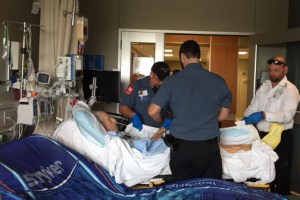 Five minutes later, the EMTs arrived to prepare Dad for the trip back to CCH. Because the cuff was deflated on his trach collar, Dad was able to chat with the EMTs without a speaking valve. He seemed to be in good spirits and didn’t exhibit any agitated behavior. The EMTs’ preparations were finished in less than 30 minutes. As they started pushing Dad’s gurney out of his room, Dawn rushed into the room with Dad’s speaking valve and installed it on his trach.
 Dr. Stewart then told me and Mom that he wanted to meet with us in a conference room to consult with us about some of Dad’s future possibilities. He started off this consultation by stating that they considered Dad’s recovery to be one of their best achievements and acknowledged our part in that success. He went on to say that he suspected that if Dad did go home, he could have more episodes of pneumonia. He continued by saying that Dad might never fully develop the ability to swallow, and if he did, he could very likely choke on his food and develop pneumonia again. He went on to say that although Dad might never be able to eat peas and carrots, we should let him eat what he wants, regardless of the consequences. He said that there was a good chance that Dad would go home with a trach tube. After that disheartening meeting with one of our favorite caregivers, Mom and I returned to Dad’s room.

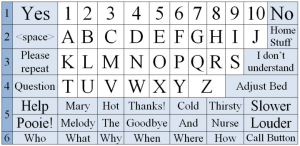
 August 9, 2015. We arrived at the hospital at 9:00 A.M. to find that Dad was still asleep and restrained, the nurse’s name was not on the board, and Dad’s feeding tube was empty. Two out of three of these situations were unacceptable. I went to the nurse’s station to find out who his nurse was and to let them know that his tube feed bottle was empty. A nurse entered the room with a fresh bottle of Nepro, changed out his tubing, and replaced the empty bottle. The nurse also told me that Dad’s nurse was Nicole, who finally showed up at 9:15 A.M. and introduced herself.
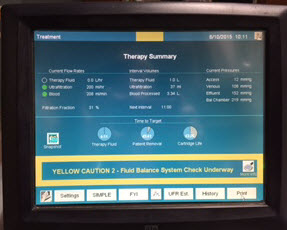 August 10. We arrived at 7:40 A.M. and noticed that Dad was already on dialysis. Before we arrived, they had drawn blood and ran an

 August 7, 2015. Mom and I arrived at the hospital at 7:45 A.M. Dad was still receiving CPAP breathing support. We were surprised to see that he was not having dialysis, but we had scarcely put down our purses when Lucy, the dialysis nurse, stopped by and said that she had been told to set up the (traditional) four-hour dialysis session. As she left the room,
  August 8. Mom and I arrived at Dad’s room at 6:30 A.M. The room was dark and Dad was still sleeping. Jennifer, his nurse, arrived at 7:30 A.M. and started her morning assessment of Dad. When she was finished, she told us that the night nurse told her that Dad was very agitated during the night. I wasn’t sure what that meant, but it didn’t sound good. On a more positive note, Dad’s WBC count was still trending downward.
 August 5, 2015. When Mom and I arrived this morning, Dr. Brett Ambroson, the resident, was finishing up his morning assessment of Dad’s current status. We were pleased to learn that the vomiting episodes from the previous day had stopped. Dr. Ambroson also noted that Dad would now move his extremities when prompted by him or the other care providers. When I asked about Dad’s WBC count, the doctor said that it was down slightly from yesterday. I wasn’t thrilled with the very slight decrease, but at least the steady upward trend had been arrested. While speaking with Dr. Ambroson, Lucy and Cheryl, the dialysis nurse and her aide, prepared Dad for another eight-hour session.
 I returned to the hospital at 6:30 P.M., armed with a couple of small bottles of water. The physical therapist had told me that lifting the bottles while in bed would be good exercise for Dad. Unfortunately, he wouldn’t touch the bottles. I tried talking with him and shared some of his improved lab results with him, but nothing helped. I even tried to make a deal with him and told him that if he would exercise even a little, I would eat peas, which I detest. I still haven’t had any reason to eat peas.
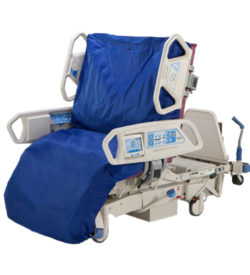 August 3, 2015. It had now been 90 days since Dad first entered the hospital for his seven-to-ten day stay. When Mom and I arrived at 7:45 A.M., Dad’s room was a hubbub of activity. Dr. Phan, the nephrology resident, was assessing him and Emily, his nurse, was exercising his arms and legs. But the first thing that we noticed was Dad’s bed. Yesterday, Dr. Jimenez had told Dad’s nurse that he wanted to see Dad’s bed raised to a more upright position. I had envisioned that the angle of his bed would change from 30 to 75 degrees. What we saw instead was a bed that had morphed into a chair. It played music, automatically adjusted to specific angles, and could change into a chair. Was there anything that this bed couldn’t do?
 While Mom and I were at home for dinner, I printed out some recent photos of Dad with the family. I wanted the hospital personnel to see him as more than the sick man that they attended in that hospital bed. He hadn’t entered the hospital as some sickly old man, and I wanted them to have a sense of who he was just a few months earlier. After dinner, Mom and I returned to the hospital around 6:50 P.M. and learned that Dustin was Dad’s nurse. I wasn’t impressed with this nurse, and I wasn’t thrilled to see him again.
 I had never heard about procalcitonin (PCT) until today, when Dr. Jimenez mentioned that Dad’s current level was 48—down from 64. As soon as the doctor left the room, I whipped out my iPad and searched the internet for information about PCT. From what I read, a PCT level greater than 10 indicated a “high likelihood of severe sepsis or septic shock.” You didn’t have to be a PhD to know that a PCT level of 48 was pretty bad.
 When Dr. Jimenez and his entourage entered the room, he said that Dad was “one tough guy.” He said something about an albumin transfusion (protein) to help with absorption, but I was too excited to remember everything that he said. Mom and I knew that Dad was still in the woods, but we felt that he had finally found the path out. Before the doctor left, he told Melissa, the nurse, that he wanted the bed raised to more of a sitting position. This day also marked the first day since my father’s return that we didn’t hear something about his grave prognosis.
 Shortly after 10:00 A.M., we met
  When Dad was transferred from the CCH to Memorial, his flowers could not come with him. Cut flowers and plants are not permitted in the ICU. I had been thinking about it for a couple of days, and I was now determined to brighten up Dad’s room. After lunch, I cleaned the vase that had held his sunflower arrangement, took it back to
  July 28, 2015. Six days since Dad returned to
  The big surprise of the week occurred right after Dr. White left Dad’s room. During the procession of residents and the attending physician, a woman kept appearing in the doorway, and would then leave. When the room was finally empty of providers, she entered Dad’s room and introduced herself as Aimee from the Patient Relations department. She told us that a hospital employee had contacted her office about Dad, and suggested that she meet with us about the events that led to his return to Memorial. I pulled out my iPad of notes and shared our concerns about some of our interactions with one of the CCH doctors. Aimee told us that they would investigate our complaint and get back to us in 30 days. I assured her that although we had complaints about one person, for the most part, we were pleased with the level of care that Dad had received from his providers. When she left, Mom and I were stunned and kept trying to guess who contacted Aimee’s office.
 Tale of Two Parents