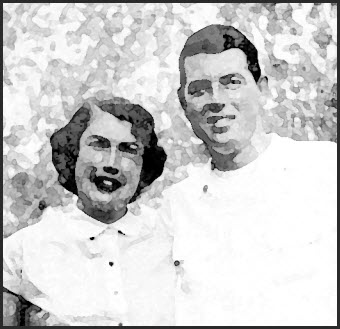

November 24, 2015. Dad and Michell woke up at 4:15 A.M. Dad still had some problems overnight, but I hoped to have him on the road to recovery quickly. I had Michell administer the trach care again this morning. I had to assist her a couple of times, but she was a little less nervous than she had been during her first attempt last night. During the administration of Dad’s morning meds, I added a couple of crushed Imodium tablets. Dad and Michell were able to get ready without much difficulty.
 Kristin, Dr. Pfanner‘s nurse, called to tell me that the doctor had decided on an antibiotic for Dad that would take a couple of weeks to clear up the CDiff. The nurse also provided me with some guidance about laundering and cleaning anything that Dad had come in contact with. She also recommended that we purchase some isolation robes to protect ourselves and encouraged us to wear gloves. I told her that we would abide by her guidelines, but it sure seemed like the horse was already out of the barn. Dad had probably been sick with CDiff for several days. Because prolonged antibiotic use probably contributed to Dad’s CDiff, before hanging up, the nurse encouraged me to contact Dad’s pulmonologist to see if they would change his antibiotic. This was a difficult request. We weren’t going to meet Dad’s pulmonologist for a few weeks. I also thought that it was the infectious diseases doctor at the hospital who had prescribed the doxycycline, and I didn’t know when or if we would see her again.
I thought that the dialysis nurses should know about the diagnosis. I texted Sue, our friend and nurse practitioner at the dialysis center, to let her know that Dad had tested positive for CDiff.
When Dad and Michell returned home at 12:15 P.M., Dad was in a rush to get to the bathroom. As I was pushing him past the piano, I caught his hand between the wheelchair and the piano and gouged him good. His skin was very fragile and susceptible to tears, so now he was also bleeding. Because I had already helped enough, I left the chaos that I had created and drove to the pharmacy to pick up the antibiotic prescription. I returned around 12:30 P.M. and gave Dad his first dose of Flagyl. When I had a couple of minutes to talk with Michell, she told me that Dad had had 1,100 ml of fluid removed during dialysis. With his weight so low, this news wasn’t good, but at least the quantity wasn’t excessive.
It was Thanksgiving week, and I was working half days, starting at 3:45 A.M., so my day was over by the time that Dad returned from dialysis. Michell, Mom, and I ate lunch, and then I resumed the baking that I had started yesterday.
At 4:00 P.M., Mom tried to wake Dad, but he just grunted at her. He finally responded when she told him that he had his head on his sore hand—the one that I had injured. He then tried to get up by himself to go to the bathroom, which he’s incapable of doing. Michell tried to help him, but he told her to get out of his way. She finally got him into the wheelchair, and he kept telling her (and now me) to get out of his way. Michell kept trying to help him, but he kept shoving her away. She then got him the walker, but he pushed it into me and told me to get out of his way. During the arguing and raised voices, he called me by my mother’s name a couple of times, which I found a little disconcerting. He kept insisting that he could walk by himself. I finally stepped back and told him to walk. It took him about one second to realize that he couldn’t walk, and then he let us help him, although he still didn’t seem like himself.
In addition to the drastic personality change, he woke up looking different and years older than he had just four hours earlier. I checked the printout of precautions and side effects that came with the meds, and a couple of the severe side effects included confusion and irritability. I called Dr. Pfanner’s office and talked to the nurse about his drastic change and our concerns, and she said that she would consult the doctor and call back. When she called a few minutes later, she said that we wouldn’t like the answer, but the doctor wanted us to take him to the ER.
And then it got crazy.
When I called 911, I told them about Dad’s symptoms, and mistakenly used the word aggressive to describe his behavior. The 911 operator then started asking questions about weapons and alcohol and drug abuse, but I assured him that we didn’t have those concerns. Before hanging up, the 911 operator asked whether I felt safe hanging up the phone. I assured him that I did and made a mental note to never use the word aggressive during a call to 911.
Just a few minutes later, I heard the sirens, and a black SUV belonging to the sheriff’s department turned into the driveway. The deputy told me that the sheriff’s department is called whenever 911 receives a psych call. I assured him that I had not placed a psych call and that my father did not pose a physical threat to us. While we were talking, the deputy spoke into his shoulder mic and told two other deputies to “stand down.” Moments later the first fireman from Little River-Academy arrived. A couple of minutes later, the ambulance arrived, followed by another Little River-Academy fire truck. The EMTs, deputy, and I chatted on the front porch about Dad’s willingness (or not) to go with them. They asked about Dad’s wife and whether either of us had medical power of attorney, which we both possessed. The entourage of deputies and EMTs followed me into the bedroom, and I was able to talk Dad into going to the hospital. Michell rode in the ambulance with him and Mom and I followed them in my car. We sat in the driveway for what seemed like 10 minutes before the ambulance finally pulled out of the driveway. We finally arrived at the hospital at 6:00 P.M.
EMTs take the patient into the hospital through a designated door, separate from any visitors, including those who ride in the ambulance. I parked the car and Mom and I met Michell in the waiting room. While Michell left us to find a restroom, Dad, Mom, and I were ushered into an exam room. When the nurse arrived, I told her about the events of the day. When the resident, Dr. Stephanie Katrin Clark, arrived, said that Dad’s mentation problems could be from the CDiff and not the meds. She then ordered a chest x-ray to see if the lack of lung capacity was causing his confusion. She also ordered an EKG. Finally, the nurse arrived to take Dad’s blood. It was then that we learned that the reason why Dad’s ambulance stayed in the driveway so long was that the EMT was starting an IV. Having an IV in place simplified the nurse’s task, and she quickly acquired the necessary samples and turned them in to the lab shortly before 7:50 P.M. Before the nurse left the room, she started Dad on a saline drip.
At 7:49 P.M., I texted Sue to inform her that Dad had had 1,100 ml removed this morning and that he was now in the ER getting 500 ml of saline. I didn’t know if she could provide us with any information that might help our situation.
A little over an hour later, Dr. Clark returned to the exam room and said that she wanted to admit Dad. She said that his blood pressure was soft and he seemed dehydrated. I told her that we had to be home tomorrow for his 60-day home-care assessment. She said that she would give him another 250 ml of saline to improve his blood pressure. The next thing I knew, a tech arrived and said that she was to take Dad to radiology for a CT scan. I told her that it was our understanding that Dad could leave after he had received the 750 ml of saline and that I didn’t want him to have a CT scan. I also told her that he was out of Medicare days (and S&W Senior Care days), so admitting him was out of the question. After the tech had left the room, I explained to Dad and Mom that Dr. Smith had told me that Dad’s CT scan in August had not been normal, but he had then added that the CT scan of someone his age wasn’t normal anyway. I didn’t trust this doctor to say that the results of a CT scan weren’t normal, which would be another reason to admit him.
Shortly after the radiology tech left the room, we heard a knock on the door and a woman entered, identifying herself as the social worker and a problem solver. I again explained why we had to go home. My argument didn’t seem to sway her, so I told her that Dad was uninsured and that unless she could pay his hospital bill, I wasn’t interested in anything that she had to say. She left the room and returned a couple of minutes later with Dr. Clark and with the charge nurse. The doctor then informed me that Dad had suffered a heart attack. Today would mark the second time since July 22 that I had heard this, and I suspected that she was no more correct than the previous doctor had been. When I pressed her for details, she said that his numbers were elevated so that he might have suffered a heart attack. She also said that his kidney function was very high and that according to his medical history, he was very sick. I explained that his kidneys were in terrible shape and that he was ERSD and on dialysis. One of our problems was that the Scott & White Home Care department was not on the same records program as the hospitals, so the latest information accessible to the medical staff at Memorial was from September 29, some 57 days ago.
The social worker and charge nurse explained to us that to take Dad home, we would have to sign an AMA, which would ensure that he could not be recertified. They had effectively trapped us into a no-win situation. We didn’t trust them or the hospital, and even if we did, Dad was uninsured, and we had to get out of there. I told them that I wanted to make some phone calls. I called the Home Health after-hours phone number and told them about our situation. I was transferred to Leo, the night nurse who had originally admitted Dad into home care. My phone died, and when I used Mom’s phone, Leo and I kept getting disconnected. When the nurse returned to the exam room, we told her that we would sign the AMA so that we could take Dad home.
At 10:38 P.M., I texted Sue again and told her that Dad had been dehydrated and that we might need to rethink the amount of fluid we’re pulling off of him, especially when he has diarrhea. At the rate that he was receiving fluids at the hospital, it wouldn’t be long before they replaced everything that had been removed during dialysis.
Eventually, the nurse came back, and my mother told her that we were ready to leave. After we signed the AMA, the nurse removed the IV lines and called for an ambulance to transport Dad home. About 30 minutes later, the EMTs arrived with a gurney. Mom and I recognized both of the EMTs. One of them had been by the house several times and the other, a woman, had brought him home from dialysis earlier today. When the EMTs took Dad to the ambulance, Mom and I passed through the waiting room, where we found Michell, who had been waiting patiently for almost five hours. Michell quickly left the waiting room and joined Dad for the return ride home in the ambulance. Fortunately, we had been able to text with Michell, so she had some idea of what was happening.
The four of us finally arrived home around 11:15 P.M. I started cleaning up in the kitchen and toasted the biscotti that I had baked earlier. We were hungry and too wired to sleep, so Mom also prepared a plate of cheese and crackers. Michell was with Dad in the bedroom. The poor guy was suffering from CDiff and had been trapped in the ER for more than five hours.
At 11:45 P.M, we heard a loud pounding at the door. I peeked around the corner to see if I could tell who was at the door and was momentarily relieved when I saw the uniform of a sheriff’s deputy. When I opened the door, I met Deputy Ryan Blankemeier. He said that his department had received a call that we had taken Dad home from the hospital too soon and he was here to ensure that my father was OK. Deputy Blankemeier looked pretty confused when I told him that it was the nurse at the hospital who called for the ambulance to transport Dad home.
I told the deputy that Dad was on the commode and that he would have to wait until Dad was decent. From where we were standing in the hall, the deputy could hear Dad and Michell talking. After a while, the deputy said that he felt like he could leave, but I insisted that he stay. Eventually, Dad was decent, and I escorted the deputy to the bathroom to see him. I told Dad that the deputy wanted to ensure that he had gotten home OK. He said that “she” got home OK. I told Dad that it was him that the deputy cared about, and Dad said that he was fine, but it was “touch and go there for a while.” Dad laughed, and the deputy smiled. I eventually escorted the deputy to the front door shortly after midnight.
It was well after midnight before Dad was in bed and approaching 2:00 A.M. before I got to bed.
I hadn’t realized how upset Michell had been about the day. I had mentioned in an earlier post that she was astonished when I openly disagreed with a doctor. To sign an AMA and bring Dad home, followed by the visit from the sheriff’s department, was just a bit too much for her. After Dad had gone to sleep, she called a friend and cried about the day and then cried herself to sleep. At this point, she wasn’t sure if she would return next week and would have to pray for guidance. I hoped that she said a prayer or two for all of us.

 When Michell and Dad were picked up by the EMS wheelchair van service, Stan and I drove to the dialysis center. I had been very upset that they had removed 2,500 ml from Dad on Thursday, and I intended to express my concern to the charge nurse. For each 1,000 ml removed, a dialysis patient loses 1 kg. After I had explained Dad’s situation, she said that they would just clean his blood today and not remove any fluid from him.
 After I saw Dad weighed, Stan and I left Dad and Michell at the dialysis center so that we could run several errands before Dad returned home. Everything worked in our favor, and we were home by 10:30 A.M. As it turned out, Stan and I didn’t have to rush. Dad and Michell had to wait for the van and didn’t return home until after noon.
 Shortly before 2:00 P.M., Dad took a long nap on the couch while we were in the living room because he didn’t want to be away from us. I think that he thought that sleeping on the couch would ensure that he didn’t miss happy hour, but he slept through it. Dozing on the couch might not seem like a big deal, but it was another first for him in his post-hospital life. We had to rely on the oxygen tank and trach bib because we couldn’t bring the oxygen concentrator and nebulizer to the living room, but he was able to receive Nepro during his nap. He slept for about four hours, and we woke him when we finished dinner.
 At 10:30 P.M., the baby monitor station in our room started alarming. After quickly putting on my glasses, I could read the message on the display that indicated that our station was unlinked from the base station. As I tried to turn on the light, I discovered that the
  By 8:00 A.M., Dad was back in the wheelchair and was reading the Sunday newspaper. When Mom and I left for church, he and Stan were playing cribbage. After a couple of games of cribbage, Dad wanted to lie down and rest. According to Michell, he fell asleep as soon as his head hit the pillow. Usually, he liked for us to wake him before Stan left for Houston, but today he asked that we let him sleep.
 November 23. Dad was very slow in waking up this morning. When I heard him and Michell talking, I took a break from work to administer his morning meds and trach care. Tracy, one of our RNs, called around 9:00 A.M.to see if we could be her first stop this morning. I was very low on the Mepilex dressings that American HomePatient didn’t provide and asked Tracy if she could bring me a few to tide me over until I could order more from Amazon. She said that she would stop by the office and pick up a couple for me. I was very fond of Tracy. She was a wonderful nurse and the mother of a special needs child. She was one of my favorite nurses and a very caring person. She arrived at my parents’ home at 10:00 A.M. with my requested dressing in hand. After her brief examination of Dad, she said that his bed sore was practically healed. With the way that Dad had been feeling, I didn’t want to take him back to the wound care doctor, which would most likely take the entire afternoon. She said that I could safely cancel his appointment with wound care today. Also, she didn’t think that I would need any more of the expensive Mepilex dressings. I happily accepted the good news and canceled the appointment with the doctor and the EMS wheelchair van service.
 While Tracy was visiting, Dad spent the entire time either sitting or lying on the bed, so she didn’t see how weak he had become. Shortly before Tracy arrived, Michell had had to hold up Dad to keep him from falling when he was trying to get dressed. I hoped that we would hear something soon from Dr. Pfanner’s office.
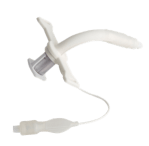 Because he was feeling better, it seemed like a good time for me to take a break and change his trach. I set up my TV trays to do that. I still hated this weekly task, and I had a knot in my stomach throughout the procedure, but I was accomplishing it in less time.
 About 30 minutes after Kristen left, Sally and Ray, dear friends of my parents (and me) stopped by for a visit. In about a month from now, they would move from Temple to New Braunfels. I saw Sally only a few times a year, but she is a delightful person and fabulous quilter and crafter of cards. Her husband, Ray, is also an interesting person who had been involved in the space program, another one of my interests. I could practically recite the dialog from the Apollo 13 movie, and Ray had been involved with this launch at NASA. I would miss them both after they moved from Temple. Dad came out for a few minutes to visit with them. The visit lacked our usual spontaneous conversation. They hadn’t seen Dad in almost a year, and I suspect that his appearance was a little shocking and was the proverbial elephant in the room. It didn’t help that Dad wasn’t feeling well.
 Shortly after Sally and Ray left, I administered another Imodium pill into Dad’s feeding tube. Although he was feeling a bit better, he still was not better.
 During his dialysis session, Dad had the nurse call the EMS dispatch office 15 minutes before his session was scheduled to end so that he wouldn’t have to wait any longer than necessary for his ride home. When Michell told me that they had removed 2500 ml from him, I was flabbergasted. When he left there, his dry weight was 138.28 lbs. He was probably dehydrated when he got there, and then they removed over two liters of fluid from him. I couldn’t help but question the judgment of the nurse who made the decision to remove almost twice the usual amount of fluid.
 When Dad and Michell arrived home at 11:15 A.M., Dad was wiped out and was not feeling well. Within a few minutes after getting back on the bed, he was nauseous, and his trach collar was loose again. I tightened the collar, but he still didn’t feel well. I was becoming very concerned about him and called the Home Care nurse. Stephanie was working today and arrived shortly before 1:00 P.M. in response to our call. After checking Dad, she said that heard congestion in his lungs that she had not heard before. Also, his oxygen saturation never exceeded 93% while she was there. My concern for Dad escalated when Stephanie advised me to call 911.
 Although Dad’s condition wasn’t any better, I was somewhat relieved by the EMTs’ assessment, and that we were able to avoid the emergency room. Dad was scheduled to see the gastroenterologist tomorrow, so I just needed to get him through the night. I called Sue, and she refilled Dad’s prescription of ondansetron (Zofran). Mom drove to the pharmacy as soon as I got off the phone with Sue. By the time that she returned home with the prescription, Dad was in a deep sleep. I eventually administered the Zofran in his feeding tube shortly before 5:00 P.M.
 Stan left work early and drove from Houston to my parents’ home. He arrived shortly after 5:00 P.M. and just in time for happy hour. Shortly after 6:00 P.M., Dad went to his room and read the paper while we had dinner. After dinner, we played Oh Hell and hit the hay pretty early.
 As Mom and I were driving to church, I told her that I had read the log book that the aides kept about Dad, so I knew about Dad’s fall yesterday. I was pretty irritated that she had decided to withhold this information from me. I was very invested in his care and recovery, and it disturbed me that my parents would choose to keep this information from me. She agreed that they would not withhold this type of information from me again and said that she would talk with Dad after lunch. However, we both hoped that there would be no next time.
 While we were at church, Dad told Gale that he was tired and that he wanted to lie down. He also complained about some tightness and soreness in his back. Gale thought that he also seemed a little depressed about yesterday’s fall in the bedroom. The home-patient hospital beds had only two side rails, which did nothing to keep Dad in bed. At one point, I had used pipe cleaners to attach a couple dozen little bells to four chairs that we pushed up against the sides of Dad’s bed. He still might have been able to escape from the bed, but we hoped that the bells would wake at least one of us during an attempted escape. The chairs and bells had worked for about a week but were less effective as Dad got stronger. One side of the bed was partially obstructed because of the oxygen concentrator and nebulizer. While Dad napped, Gale moved the wheelchair to the other side of the bed and locked it in place, which made that bad boy practically impossible to move.
 Fortunately, they didn’t have to wait too long after dialysis for a ride, and Dad and Gale were home by 12:15 P.M. He was pretty wiped out and wanted to take a nap. By 12:40 P.M., he was back on the bed, hooked up to the tube feed and moist air. I administered his trach care and a portion of his midday meds. I became distracted by some shiny object and forgot to administer his antibiotic. Less than five minutes after I left his room, he was sleeping. While he slept, I called Sue, our friend and nurse practitioner at the dialysis center, to see what else I could do for Dad. She said that I could safely give him two pills, the recommended dosage of Imodium.
 While Gale and I were in Dad’s room running through his nighttime routine, Gale found a little scorpion on the floor near her bed. Gale was one of the most fearless women I knew, but she screamed like a little girl when she saw the critter. We had barely disposed of it when she encountered another one crawling on the bathroom floor toward the bedroom carpet. My parents had found scorpions in the house in the past, but I don’t recall ever seeing one, and tonight we saw two.
 Later in the morning, I received a call from Barbara at the Scott & White gastroenterology center. She said that her office had received a referral from Dr. Issac. She wanted to schedule an appointment for Dad to have his G-tube changed and to discuss
  Shortly before I was ready to log off for the day, Dad wanted to make his way into the office, which was no easy task. Although the door was wide enough for the wheelchair, the placement of a large desk just inside the door made wheelchair access impossible. Gale and I had to carefully transfer him from the stable wheelchair to the less stable
  I had assumed that Michell would replace Gale tomorrow, but I hadn’t heard anything from Becky, the owner of One on One Personal Home Care. I dashed off a quick email to her to confirm, and then returned to my day job.
 Dad was still very tired and was ready for bed shortly after Mom was declared the Oh Hell winner of the night. By 7:30 P.M., he was in bed and ready for me to administer his meds and trach care. I sat with him while Gale prepared herself for bed, and then went upstairs to call Stan. To say the least, my updates to him about the daily events were varied from day to day. Because Dad went to bed early, I was also able to retire early and hoped to get an extra 30 minutes of sleep.
 Michell arrived at 11:00 A.M. and conferred with Gale for a few minutes. It was nice to have a few weeks in a row with the same two aides. The transitions were easier for them and they were getting to know one another. Shortly after Gale left, Dad wanted to lie down for a short nap.
 Dad and Michell were sound asleep when I woke them shortly after 4:00 A.M. We had an uneventful morning and Dad was picked up for dialysis shortly before 6:00 A.M. His dialysis session was finished before 11:00 A.M., and they were home before noon. After administering his midday meds and trach care, he was ready for a nap.
 After dinner, Dad felt well enough to play a couple of games of Oh Hell: Dad won the first game and Mom won the second. We had two sets of criteria that determined how long we played cards: how Dad felt and whether he had dialysis the next day and how I felt and whether I had to work the next day. For the most part, I wanted to start Dad’s nighttime routine by 8:30 P.M. so that I could go to sleep by 9:30 P.M. A perfect night was one in which we all got six hours of uninterrupted sleep.
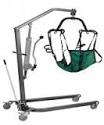

 Shortly after lunch, a UPS driver rang our doorbell. He had come to pick up the “box” that contained the infant-sized
  While I was attending an online meeting at work, Michell, the new aide, arrived. Gale spent the next hour orienting her to the routine and her responsibilities. Before Gale left, she confided in me that she thought that she smelled cigarette smoke on Michell’s hands. To address her suspicions, Gale stressed to Michell that we had oxygen in the house and that smoke particles were a hazard for Dad because of his trach.
 Dr. Issac started the meeting by asking if we needed anything. Without any hesitation, I told him that I needed him to be Dad’s PCP. Dad was running out of several medications that required the authorization of a physician. I said Dad also needed referrals to see specialists. I told him that although I was an MBRT, I would really like Dad to see a pulmonologist. The room became quiet, people looked at one other for a moment, and the doctor gave me a questioning look. I responded by saying, “make-believe respiratory therapist.” He laughed. In addition to explaining the need for a pulmonologist, I told them about our difficulty in getting a referral to a wound care specialist and how I had had to order the Y extensions from Amazon.com.
 I think that our family happy hour was a new experience for Michell. She didn’t drink, but she still joined us and we found that this time was perfect for getting better acquainted with the aides. Although Dad could not drink with us, he still ensured that we kept the bar refrigerator stocked with the beverages that the aides like to drink.
 The nurses were ready for Dad when he arrived, so his dialysis session started at 6:30 A.M. Two hours later, his
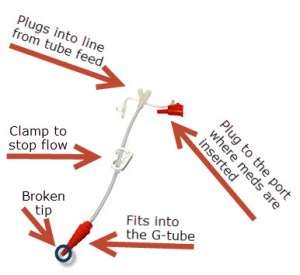
  When he woke a couple of hours later, he was in a much better mood. Because Dad could not take anything by mouth, all of his meds were crushed, mixed with water, drawn into a large syringe, and inserted into his G-tube, directly into his stomach. When I reached for the Y extension line that connected the G-tube with the tube feed line and provided the input valves to the G-tube, a loose end came up in my hand. I didn’t know how long that it had been disconnected from the G-tube, but Dad and the bed were a sticky mess. It was as if we had thrown a couple of milkshakes in bed with him.
 Shortly after Dad’s return home from the CCH a few weeks earlier, Gale and I were careful about the way in which we handled the Y extension because we didn’t know how long the tubing or connectors would last. Just a few days ago, we had asked the nurse if she could acquire more of them for us. Fortunately, she was able to find one and it was still in its packaging. I planned to bring it with me to the hospital later today and was determined that we would not come home until it was securely inserted in Dad’s G-tube.
 As I explained the problem, Dr. Klovenski enlisted the assistance of a medical student. This case was a little out of the ordinary and presented them with a problem-solving exercise that they never experienced in medical school. After gathering a variety of
  In addition to the lightheartedness of the visit, this trip to the hospital felt different for me too. From the moment that I arrived, everyone seemed to listen to what I had to say. I felt as if my IQ had suddenly increased. While Dad and I were waiting for the ambulance to take us home, one of the staff members asked me where I worked, and then it dawned on me. I had worn my navy scrubs: the color worn by RNs. Mom always told me to dress for success. I guess first impressions are important.
 While I had her on the phone, I told her that I also needed to order some Corpak Y Extensions to connect the tube feed tubing to the G-tube. She told me that she could not provide this item without an order from Dad’s primary care physician. I told her to forget it and that I would just buy them myself. She proceeded to lecture me about how I couldn’t just walk into a Walgreens and buy these supplies. During our call, I had my iPad sitting next to me, which I reached for during my lecture. She required a couple of minutes to complete her paperwork for the exchange order. Before our call had ended, I had placed an order with
 After lunch, Dad had Mom and Gale take him outside to check on the hoses in the backyard. My parents’ acre lot had quite a few young trees. Dad had set up permanent irrigation to some of the trees, but his system required that some hoses be moved among the trees. Diane had been his ready assistant a few days ago, and now it was Gale’s turn. Fortunately, Gale loved being outdoors.
 In addition to being concerned about all of the time that Dad was off of the humidified air, I was also concerned about the considerable amount of time he spent disconnected from his tube feed. The tube feed was available to him only in his room because his wheelchair had no IV pole to which to attach the Kangaroo pump that operated the feed. I suspected that he was receiving less than half of the protein and other nutrients that he needed. If I could attach the Kangaroo pump to the wheelchair, then he could receive nutrition all the time as he moved around the house, property, and elsewhere, except during dialysis. When I had called
  During the past few days, I had been discovering some of the flaws in the homecare system and Medicare. When the nurse encouraged us to take Dad to a wound care specialist, I called the nurse practitioner at the CCH for the referral and was told that Dad was no longer their patient and that we would have to get all of our referrals from his primary care physician (PCP). Dad had been hospitalized since May and hadn’t seen his PCP in almost two years. As a matter of fact, we had to cancel an appointment with her during his hospitalization. When I called the office of Dr. Sarla Patil, his PCP, and explained our predicament to her nurse, she said that the doctor could not provide any referrals or refill his prescriptions unless he came to her office. She went on to say that had Dr. Patil been the referring physician for homecare, then they could help, which was a nonhelpful and ridiculous comment. When I explained that he wasn’t ambulatory, she apologized and said that there was nothing that she could do. In desperation, I called the office of the doctor who had saved his life, Dr. Randall Smith. I spoke with his nurse, Christine, and explained Dad’s
  October 15. At 1:30 A.M., I was awakened by the sound of coughing coming through the baby monitor. I kept hoping that Dad would use the
  trach bib moistened with sterile water to provide some moisture to his lungs, he no longer was deprived of tube feed when he left the bedroom. Dad had to be more careful as he navigated the hallways to ensure that the pump didn’t hit the wall or knock photographs off of the wall.
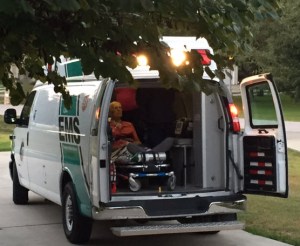 His dialysis session was happily uneventful, with no extra bleeding or trips to the hospital. To top it off, the ambulance was on time for the return trip, and Dad and Amanda arrived back home at 11:35 A.M., which was record time.
 Although Dad seemed to like her, I wasn’t enamored with Amanda, and having a new aide would cause multiple interruptions in my work day to train another person. When the doorbell interrupted my pity party, my first thought was that I wasn’t in the mood for company, but I was relieved to see that we had just received a package from Amazon.com. Dad’s padded commode seat cushion had just arrived. The cushion was four inches thick and appeared as if it would have satisfied that
  Tale of Two Parents