Four good days in a row was beginning to seem like an impossible goal

It’s June 5, 2015. Mom and I arrived at the hospital at 8:45 A.M. We’d had three good days and were hoping for the ever elusive fourth good day. Because it was Friday, we were greeted with a new set of doctors. Dr. Velazco returned as the pulmonologist and Dr. Issac was the nephrologist. We hadn’t been in the room long when I started feeling a little anxious about our four good days. In addition to Dad’s WBC count being up by 3000 points from the previous day, he sounded somewhat congested. He coughed throughout the day, but seemed unable to expel any of the secretions from his lungs.

The dreaded dialysis machine returned and removed approximately 2400ml of fluid during the eight-hour session. We had been told that the dialysis was a temporary procedure so that his kidneys could “rest,” but we wondered how much rest they needed. Holly tried to see Dad for swallow therapy, but he was asleep and could not be roused.

The respiratory therapist gave Dad a breathing treatment, which seemed to provide him with some small amount of relief. When Mom and I left at 4:00 P.M., Dad was still sleeping.

Stan’s late arrival into town caused us to run behind schedule, so we didn’t return to the hospital until 7:30 P.M., well after the shift change.  His night nurse, Carolina, entered his room—her first time seeing him that evening.

Dad appeared weak and it seemed to me that he was struggling to breathe. Carolina spent a considerable amount of time suctioning him and getting him cleaned up for the night. He seemed a lot better when we left, but this didn’t really feel like a good day.

My good-day counter remained at 3.
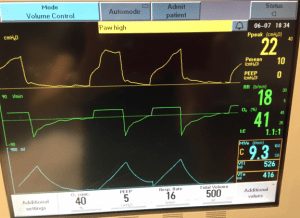
respiratorBecause it was Saturday, I slept in until 6:45 A.M. I usually slept with my phone on the nightstand, but I had inadvertently left it in the family room the previous night. I retrieved the phone and noticed that I had missed a call from Scott & White at 5:14 A.M. In a panic, I called the hospital and Kelli, the charge nurse answered. She told me that at 3:00 A.M., they had had to intubate my father. Evidently, he went into hypercapneic respiratory failure. Fortunately it was an emergency situation, so they didn’t need to obtain consent from someone separated from her phone. They also reinserted an arterial line in his right arm. In addition to all this good news, his WBC count had elevated to 15,000, which meant that yesterday’s elevation really was the beginning of the end of our good-day stretch.

When we met with Dr. Velazco that morning, he said that he would perform a bronchoscopy so that he could see what was happening in Dad’s lungs. They would also collect secretion samples. Knowing more about the infection in his lungs would help them target the infection with the correct antibiotics.

Mom and I left the hospital during the bronchoscopy. Because Dad was fully ventilated, the process was somewhat simpler, with the possibility of fewer complications. The rains that had started a couple of weeks earlier had finally stopped, and the daily temperatures were beginning to rise. When we stopped by the house, Stan was braving the heat to mow the lawn.

When we returned to the hospital after lunch, Dr. Velazco told us that he had removed a lot of “chunky” secretions from Dad’s lungs. Dr. Velazco was from Peru, was soft spoken and spoke with an accent that my parents couldn’t understand, but I really liked him. He took time to explain my father’s situation and often skipped the $20 technical terms for the easy-to-understand 5-cent words. The removal of this “chunky” matter improved Dad’s oxygen saturation levels, which zoomed from the worrisome 80s to 100%.

Somewhere around 2:00 P.M., I received a text message from a phone number that I didn’t recognize. The message said that there was a birthday hug waiting for me in the ICU waiting room. The mystery texter turned out to be my long-time friend, Susie. She had been in Dallas (a three-hour drive from Temple), and thought that she’d stop by to say hello.
friendsSusie’s appearance in the waiting room was just one example of the random acts of kindness that my mother and I received during my father’s ordeal. I still marvel at our good fortune to have been blessed with such wonderful selfless friends. The neighbors seemed to instinctively know when we needed a meal, some cookies, or a hug. My friend Rhoda gave up a week of her time in Wisconsin to help when Mom had her stoke, and in three days, my cousin Chris would be arriving from Phoenix to help out for a week.

Although I loved their support, I never stopped hoping that I wouldn’t need it much longer.

Today was Dad’s one-month anniversary in the hospital, and the good-day counter had been reset to 0.

 

Bad day, good day whiplash

June 1, 2015. There was something depressing about starting a new month in the hospital. I had to attend a business meeting that morning, so Mom and I didn’t arrive at the hospital until 9:15 A.M. Once again, Dad was hooked up to the dialysis machine. The alarms on the dialysis machine and on Dad’s blood pressure monitor chimed incessantly. The alarms on the dialysis machine sounded like Roger Rabbit sound effects, and they unnerved. Before he entered the hospital three weeks earlier, my father took medication to control his high blood pressure (hypertension). He now struggled with low blood pressure (hypotension), especially during dialysis (Removing fluid from the blood lowers blood pressure.). Before starting a dialysis session, the nephrologist or nurse determines the amount of fluid to remove. During the previous couple of sessions they had removed approximately 3 liters of fluid, roughly 3 kilograms of weight. During the dialysis session this day, the dialysis nurse continually reduced the target amount in an attempt to stabilize Dad’s blood pressure. Dr. White finally decided to stop fluid removal and simply clean the blood. After four hours of struggling to control Dad’s hypotension, the doctor suspended dialysis for the day.

o2Because Dad was so lethargic and nonresponsive, the doctor was concerned about his oxygen saturation. To check the oxygen levels in Dad’s blood, Dr. White ordered an arterial blood gas (ABG) test. Because I inherited Dad’s rolling and difficult-to-stick veins, I cringed whenever they had to draw blood from him. To find a vein for a blood draw, they sometimes had to use ultrasound. I had heard that ABG sticks were painful, and was relieved that he slept through this blood draw.

Dr. White stopped by again and said that he was concerned about Dad’s mentation and that he wanted to more closely monitor his blood gases. To do so, he wanted to insert an arterial catheter in his right forearm. This didn’t seem like something I wanted to watch and was relieved when I was told that a sterile environment was necessary for the procedure. I felt guilty about it, but was glad to leave the room with Mom. Fortunately, Dad’s blood pressure was so low that he slept through this procedure too. The arterial catheter also provided us with real-time (second-by-second) updates of his blood pressure. Although always knowing his blood pressure was helpful, it was also nerve wracking. I was starting to live by the monitors and their constant beeps and bells.

fighterPilotFollowing the insertion of the arterial catheter, the doctor attempted to improve Dad’s oxygen levels by starting him on BiPAP, which made him look like a drowsy fighter pilot. The doctor told me that if the BiPAP didn’t improve his oxygen saturation, they’d have to intubate him. Right about that time, Holly, the speech therapist, stopped by to see if Dad was ready for the Modified Barium Swallow Study (MBSS). There would be no swallow study today, and tomorrow wasn’t looking very promising, either.

Later that day, Pastor Janette from the church stopped by for a long visit. We’d just seen her a day earlier, but it was good to see her again. The pastors at my parents’ church seemed to instinctively know when we needed them. Jack, one of the parishioners, also stopped by for a visit. My parents had just recently joined this church and I was impressed by the care and attentiveness of its members, not to mention impressed by and grateful for their prayers.

Shortly before we left for dinner, Dr. White stopped by and told us that he would be intubating Dad. Moments later, as if he had heard, Dad woke up. He was responsive and responded to commands, so Dr. White rescinded the order. As much as we didn’t like the BiPAP mask, we preferred it over the intubation alternative.

Mom and I ran home for a quick dinner and then came back to the hospital. Dad was slightly responsive when we returned, but not much.

Contrary to Dr. White’s plans the previous day, Dad was not transferred out of ICU. Today was definitely a bad day. We reset my “good day” counter back to zero.

Tuesday, June 2. Not knowing what to expect, my mother and I nervously headed to the hospital. The day seemed to start out well. Not only did we score a good parking space, which was a major feat, Dad was sitting up in bed without his BiPAP mask. My excitement diminished somewhat when I learned that he was the one who removed it. Although he was a little pale, Dad looked and sounded much better than yesterday. I was alarmed when Kristin, his nurse, told me that during the night he had tried to pull out his central line and his arterial catheter. I took it upon myself to have a little talk with Dad about why pulling out lines was a bad idea. We were pleased to learn that the nephrologist had decided that Dad didn’t need to be dialyzed that day. His blood pressure was good and his white blood cell count was inching downward and was around 12,000, a vast improvement from two weeks earlier.

Holly, the speech therapist, stopped by and administered another bedside swallow test. Based on the results of this test, she allowed Dad to drink some thickened juice in the afternoon. She also scheduled his MBSS in Radiology for the following morning. The kidney team dropped by that morning and said that dialysis might start back up the next afternoon–after the MBSS.

Dr. Sai, Dad’s heart surgeon, stopped by just before Mom and I left for lunch and said that Dad was improving, but that “we needed to get a handle on his breathing.” He spoke of breathing treatment alternatives, like a tracheostomy (or something similar), but that wasn’t an option that we wanted to contemplate.

Dad was taken to Interventional Radiology (IR) around 2:15 P.M. to have tubes inserted in his chest that would drain the infected fluid that had accumulated between his lungs and chest cavity. He was supposed to have this procedure on Monday, but was suffering too much from hypotension. He returned to the room around 3:30 P.M. pretty sedated and he slept for quite a while. Pastor Tom, the senior pastor from the church, dropped by shortly after Dad had returned from IR. Dad slept during most of Tom’s visit, but woke up while Tom was there and was able to talk with the pastor briefly before he left.

When Mom and I returned after dinner, Dad and I had a surreal conversation about the BiPAP mask he needed to wear overnight. It became so ridiculous that Shawna, the night nurse couldn’t stifle her laughter. Too bad that we didn’t record our 10-minute exchange. Mom and I returned home around 8:30 P.M.

This was a good day, and after yesterday we needed one. I reset the “good day” counter to 1.

Have we been here forever yet?

It was May 29, 2015–Dad’s 5th day back in the ICU and his 18th day in the hospital. The other day they simply removed excess fluid; today, with the return of the dialysis machine they also cleaned the blood. What they didn’t tell us on either day was that his creatinine levels were about 4x above normal, which would have been disturbing to know.

Before Dad’s admission to the hospital, I never paid attention to creatinine levels in my Complete Blood Count (CBC) results for my own blood tests, but the creatinine and blood urea nitrogen (BUN) levels turn out to be pretty important markers for the kidneys. When the kidneys are working, they eliminate fluid and also clean the blood. When they aren’t working, fluid can accumulate around your heart and in your extremities, and creatinine accumulates in your blood. Sometimes the kidneys perform one function well but fail on the other. They need to perform both functions well to avoid dialysis. According to Dad’s chart, his system was also acidosis, a condition that can occur when your kidneys and lungs can’t keep your body’s pH in balance. Respiratory acidosis occurs when too much CO2 builds up in the body. Dad was so lucky; he was seen by both the nephrologists the pulmonologists. We were starting to see quite the parade of specialists.

Holly, another of the hospital’s speech pathologists, administered another bedside swallow test. Although he failed it again, Dad did show signs of improvement. For Holly to get an accurate assessment of his swallowing, Dad needed a modified barium swallow study (MBSS). Along with everything else that was scheduled for Monday, June 1, we hoped that he could have that test, too. He was getting tired of chips and sips.

After dinner, I went back to the hospital to visit with Dad and meet with his night nurse. Nighttime was scary for me and my mother, especially as my father started drifting toward a delirious state. I couldn’t relax until I knew who the night nurse was and had had a chance to talk with him or her. Dad’s needs were pretty simple: he needed to go to sleep with his suction tube in his right hand, the call button in his left hand, and his feet covered.

Meanwhile, I felt like I was starting to fall behind at work. Even with getting up at 3:30 A.M. and working between trips to the hospital and on weekends, I had a difficult time working 40 hours. Once again this week I had to take another 8 hours of paid time off. My manager wasn’t complaining about my unorthodox working hours, but I was starting to feel like I was hiking through peanut butter.

May 30 was Saturday. Stan was in Temple and he spent a significant portion of the weekend mowing my parents’ acre lot. He also handled all of the chores that we were too tired to tackle during the week. Then while Stan visited with Dad, Mom and I acquired a prepaid mobile phone for my father. He had decided that he wanted to be able to call us, although I had serious doubts that he would. After entering all of the important phone numbers (like mine, Mom’s, and Stan’s), I showed him how to use it.

It was during this time that the Infectious Diseases residents and doctors started visiting Dad’s room. They all said the same thing; because of his pneumonia and multiple infections, he’d be on antibiotics for an extended period—maybe 6 to 8 weeks.

After dinner, Stan and I returned to the hospital to run through the evening drill with Dad and the night nurse. When I removed Dad’s hearing aids, I noticed that one was missing. We looked through his bedding, to no avail. Fortunately, on May 31, when Mom and I arrived at the hospital, the nurse told us that the night nurse had found the missing hearing aid.

Dad had received quite a few cards, which Mom had brought to the hospital to show him. In addition to the cards that he received from their long-time friends, he had been the Member of the Week at their church, which significantly increased the number of cards that he received.

heart
Code for “heart valve replacement”

Every morning the nurse or the doctor asked Dad a series of questions: What’s your name, when were you born, do you know where you are, why you are here, and so on. He hated the daily drill, and as one day drifted into another, it became more difficult for him to remember the details. During the previous day Dad had had me create a cheat sheet of sorts on the dry erase board in his room. His day nurse, Sara, discovered the note and erased the board.

This week’s doctor was Dr. White. I had met him a couple weeks earlier when my mother was in the hospital. He was also her doctor in the Medical Intensive Care Unit (MICU) during her brief stay. Although I sometimes kidded him about his name, he was no relation to one of the hospital’s founders. Dr. White told me that they would move Dad to a different room later in the day. Since the tornadoes earlier in the month, he had been in an interior room. The doctors thought that he was becoming disoriented and that having a window room might help him. The doctor also told me that Dad would be moving back to the fourth floor the next day. The doctors suspected that Dad had empyema of the chest. To address it, Dr. White said that they would insert a couple of catheters in his chest to drain the pus and other infected fluids. Evidently, the accumulation of fluid was too much for the antibiotics to handle. He also mentioned that at the end of his hospital stay, Dad would be transferred to a long-term facility that could handle his various needs– provide strength building, and dialysis if necessary. I guess that they had decided he was improving; his WBC count was down to 22,000—only twice what is normal.

Dad’s dialysis ended at 4:30 P.M., and he and Mom watched a golf tournament on the television. This might have been the first television show that he had watched since his hospital stay started 20 days ago.

Keeping with our good day, bad day cadence, Mom and I thought that today had been a good day.

My definition of a bad day was evolving

On Saturday, May 23, 2015, I arrived back in Temple from Houston around 5:30 P.M. I’d been gone for less than 48 hours, but it seemed much longer and I felt like I had been in another world. Upon my return I learned that Dad had received two units of blood. His hemoglobin levels had been dropping and the doctors didn’t know why. They suspected that he might be bleeding from the colon and they began prepping him for a colonoscopy and endoscopy for the following day—Sunday.

These procedures are performed in the clinic, which is adjacent to the hospital. During normal working hours getting to the clinic is an easy, albeit long, walk through a series of hallways and elevators. On Sunday, most of the hallways are closed and locked. Fortunately, the transportation personnel let us accompany my father through the back hallways of the hospital to the clinic. Unfortunately, when the procedures were over, we had to find our own way out. I was reminded of the movie, “The Poseidon Adventure.” Pastor Don stopped by the hospital and was able to locate us. He was with us when we received the happy news that the results of Dad’s test were negative.Dad’s temperature had been hovering between 94 and 95 degrees for several days. When he was returned to his room from the clinic, they wrapped him in a Bair Hugger to help raise his temperature. The hospital rooms are kept pretty cold and Mom, Stan, and I were wishing we could each have one. When we left the hospital for the day, we were tired, but felt optimistic that Dad would be coming home in a few days. He had now been in the hospital for 18 days, a good 8 days longer than he had expected. According to the nurses, he was also a bit agitated about being in the hospital and wanted to “get out of this place.”

thermometerThose hopes were dashed at 10:00 P.M. when I was awakened by a phone call from his PA, Rob. Rob told me that they thought that Dad needed closer monitoring because they have been unable to raise his temperature. He neglected to mention that he needed closer monitoring because they were also concerned about sepsis, but maybe he thought I knew. The phone call also woke Stan, who heard my side of the conversation. When I ended the call, I told him that I couldn’t see the point in waking my mother. She was still recovering from a stroke and this news would only ruin her much-needed sleep.
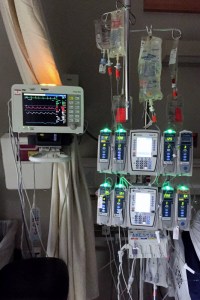
Monday, May 25, was Memorial Day, so Stan was still with me and my mother in Temple. Mom had had a good night’s sleep and I now had the unenviable task of telling her that Dad was back in ICU. We didn’t know it at the time, but a couple of days earlier, my father’s blood tests started showing rising levels of creatinine, indicating a slow decline in renal function. A nephrologist was called in for an initial consultation, and he encouraged Dad to drink more water. From this visit, we inferred that my father was in control of his fate (or his kidneys’ fate).

The weather was deteriorating and Stan wanted to leave Temple before the storms hit. When he left at 2:00 P.M., lightning constantly lit up the sky, and Mom and I spent about 20 minutes in their safe room during the tornado warnings. At the hospital, all of the patients with window rooms, which included Dad, were moved to interior rooms.

When Mom and I returned to the hospital after dinner, Dad was sitting in a chair, but seemed to be in a deep sleep. I tried for an hour to wake him and finally called in his nurse, “Nighttime Natalie.” When he was in CTICU, he had often been assigned one Natalie during the day and another Natalie during the night shift. In her sweet voice, Nighttime Natalie shook my father’s shoulder several times, saying, “Mr. Locke, honey; wake up.” She eventually called in the charge nurse—Ursula from Transylvania. Even Ursula’s booming voice could not rouse him. She finally called in all the male nurses and techs on the floor to lift him out of his chair and put him back to bed. One of the male nurses tried to wake him by pressing down and twisting on his chest scar. Fortunately, my father didn’t feel the pain.

The staff was very concerned that he had suffered a stroke, and they notified the on-call resident, who ordered a CT scan and an EEG. While waiting for the two technicians to arrive, Dad woke up and tried to talk to us, but he was unintelligible. Before we left the hospital for home we learned that the CT scan and EEG showed no sign of stroke or other brain damage.

When we left the hospital I told Mom that because every other day seemed to be bad, tomorrow had to be a better day.

The first homecoming

May 18, 2015, was the day that we had been thinking my dad would be discharged from the hospital. Instead, I spent a significant portion of that morning speaking with Dad’s caregivers about his deteriorating condition. In short, he had bacterial pneumonia and severe sepsis with acute organ dysfunction. His medical team was administering several antibiotics, but there was no way in which his cocktail of meds could take care of the amount of infected fluid (pus) in his chest. The doctors recommended that they reopen his chest and wash out the infection. Of course there were some risks, but the alternative was dire. What I didn’t know until May 2016 was that he was also at risk for acute kidney injury.

015311b4f046096e6baca1e8f21e99a56ab3538076Dad’s cardiologist stopped by and performed a Transesophageal Echocardiography (TEE). The TEE was necessary to ensure that Dad’s new bovine heart valve wasn’t harboring any infection. I hadn’t met her before and she surprised me when she said, “I didn’t want him to have this procedure. He should be home working in his garden.”  My parents never heard that she had had reservations about the more invasive procedure. Lesson learned: regardless of the surgeon’s reputation, have the physician who made the original surgical referral (in this case, the cardiologist) review the surgeon’s recommendation.

His washout surgery was scheduled for 6:00 P.M. that night, but the surgeon’s earlier procedures had run long, so he opted to wait until the next morning. Although it was a simple procedure, he didn’t want to perform surgery with only a skeleton staff on hand should something go wrong.

On May 19, Rhoda and I arrived early to the hospital. My father’s surgery started at 8:00 A.M., and I received a call shortly after 9:00 A.M. informing me that the surgery was finished. Around lunchtime, we received our first visit from Pastor Don, a pastor from my parents’ church. Before he saw my father, Don visited with my mother for a few minutes before her discharge.

During Mom’s discharge, I learned that she could not be alone or drive for at least 30 days, at which time she would undergo a neurological assessment. I was glad that she was home, although some of our conversations were pretty unsettling. She often could not remember what we asked her or what we or she had just said. To say the least, I was cautiously optimistic about her recovery.

On Wednesday, May 20, my mother and I returned to the hospital to see my father.  Rhoda had postponed a trip to Wisconsin to help me, but now she really needed to leave. She stopped by the hospital on her way home. Although my father’s breathing tube had been removed the previous day, speaking was still a little difficult. He managed to call her “a blessing,” when he said good-bye.

Within hours after Rhoda’s departure, Dad was transferred from CTICU back to the fourth floor. We were pleased that he was well enough to transfer, but he wasn’t there very long before it became very apparent that he was extremely disoriented. The fourth-floor charge nurse was more than a little annoyed that he had to assign an aide to my father’s room to ensure that he wouldn’t try to get out of bed or remove some vital tube.

I had had the foresight to take my work computer with me when I hurried to Temple five days earlier. I had been able to do my job in the intervening days even though I was away from my office. Now, however, I needed to return to my home and my office for a couple of days. I also needed to see my physical therapist—I had had surgery myself in March and was still undergoing physical therapy. Lucky for me, my dear husband agreed to come to Temple to relieve me for a couple days. He and I formulated a plan of coverage for Mom until my father was discharged.

On May 21, I worked from my parents’ home until about 8:00 A.M. My mother’s friend Marilyn stopped by to stay with Mom until Stan arrived. Stan and I met in Cameron, Texas, to exchange keys and information. I arrived at my workplace shortly after noon and felt a little guilty for leaving my mother and Stan to contend with my father’s delirium. My sense of guilt was short-lived, however. After being home for an hour or so, I noticed that my house was infested with fleas. Our cats never go outside, but we learned that this year was especially bad for fleas. We frequently employed a pet sitter and assumed that some fleas had hitched a ride with her. At this point Stan and I laughed about this latest situation, wondering what else could go wrong. After flea traps and expensive oral medication for the cats, we finally vanquished the fleas.

juggling_ballsDuring my five days in Temple I had been living in a sort of surreal and parallel universe. When I arrived on May 15, I had assumed that my father’s discharge was imminent. My big unknown was about what was in store for my mother. I had not anticipated that my mother would be discharged first. Now, in addition to figuring out how to care for my recently independent and active parents, I had to start thinking about my job and living away from my husband. It was a daunting juggling act—one I hoped would be over soon.