It was Thursday, June 11, 2015. Mom, Chris, and I arrived at the hospital in time to see Dad on dialysis and the infectious diseases (ID) doctor in my father’s room. She said that Dad’s white blood cell (WBC) count was back up to 12,000, and that he still had a lot of infection. She then looked at me and asked if there was any correlation between dialysis and his WBC count. It seemed like a strange question coming from a doctor and I was slightly puzzled that she’d ask me. Her visit was followed by Dr. Issac, the nephrologist, who said that Dad still wasn’t producing enough urine. He’d need to produce at least twice as much for them to consider stopping dialysis.
When Dr. Velazco arrived, he said that Dad’s spontaneous breathing was good and his vitals were good, except for his WBC count. Because recent X-rays showed that the pneumonia had not cleared up as much as they had hoped, the doctor scheduled a CT scan for the next day. The CT scan and tomorrow’s CBC would be very telling about his condition. Before the doctor left the room, Dad told him that his trach tube hurt, which was remedied with Tylenol. When I mentioned my concern for our inability to get past three or four good days, Dr. Velazco said that today was most likely a good day. I perked up a bit when he told me that Svenja, the trach nurse (who I nicknamed the Trach Goddess of Scott & White), would stop by the next day to fit Dad for a speaking valve. Although the medical staff thought that we had a great letter board, it was a tedious form of communication. Dad was moved to the chair at 4:30 P.M. and was still there when we came back after dinner. As bad as sitting is for a person, it’s a danged sight better than lying in bed. Maximum chair time was a daily goal for us and the doctors, although Dad was not always onboard.
 That day I also accompanied Mom to see the neurologist. For the past month, our lives had revolved around my father, and it was easy to forget that Mom had suffered a stroke—one that doctors had diagnosed as serious and life altering. In retrospect, I feel that I deprived her of the rehabilitative care that she deserved by not pursuing out-patient therapies. Although she’s much better now, it was startling to see how much the stroke had weakened her—similar to how one might have weakened from weeks in bed. My mother, who one month earlier had effortlessly walked the stairs, now opted for the ramps to access the hospital, and often had to stop to rest. Ideally, during the month that I had spent with her, she should have received speech and physical therapy. Instead, beginning the day after she was discharged, she was with me visiting Dad at the hospital. The good news was, not only could she now spell “world” backwards, she was told that she could drive again.
It was Friday, June 12, and doctor-change-out day at the hospital. From the get-go, it seemed like a really good day. One of our favorite nurses (Daytime Natalie) was Dad’s nurse and provided me with great morning vitals. Dad’s WBC count was down to 10,200 and Dr. Koshy, the ID, doctor said that he was doing well. This doctor was memorable because she always placed a glove over the cold stethoscope before she placed it on Dad’s chest. The good news kept coming when Dr. Sanchez said that Dad’s respirator was adjusted so that he was now breathing room air. He also said that he would have Dad’s arterial line (A-line) removed later in the day. Central lines and A-lines were highways to infection, so having them removed was a blessing. The only negative news of the day came from Dr. George, the nephrologist, who said that Dad still needed to produce more liquid gold.
 Mom and Chris stayed home after lunch and tended to my parents’ vegetable garden, which seemed to be exploding with tomatoes and cucumbers. During the early afternoon, Dad had his CT scan, which showed that his right chest cavity still held excess fluid. The doctor said that he might need another chest tube to clear it. Later that afternoon, Dad and I watched “Jeopardy,” which was one of the few normal activities that we had shared in a long time. Today we were fortunate to have two separate visits from pastors Tom and Don. Dad always seemed to brighten up after visiting with them. As if to underscore the good feelings of the day, Michelle, another of our favorite nurses, stopped in for just a moment to tell Dad how good he looked. When we returned to see him after dinner, Dad was back on CPAP. His oxygen levels had dropped some and he would receive full oxygen support during the night.
After such a good day on Friday, we felt optimistic that the trend would continue through the weekend. When we arrived at 8:15 A.M. on Saturday, June 13, Dad was still sleeping, was off CPAP, and was breathing on his own. His WBC count had ticked up slightly to 10,700, but Amanda, his nurse, wasn’t concerned. Dad’s hemoglobin level was also down almost a full point from the previous day, which meant that he needed another unit of blood. Amanda told me that Dad’s blood pressure had dropped overnight below a mean arterial pressure (MAP) of 65 and he required meds to raise it back to normal levels. I liked learning about MAP because I’d never been great at knowing when you had a good blood pressure reading. I knew some of the obvious readings, but Dad’s blood pressure was all over the place. The monitors alarmed only when the MAP dipped below 65. Understanding how to calculate the MAP would become important a few months later.
As Dad’s condition improved, the doctors started appearing later in the day. It’s an interesting situation—too sick to leave ICU, but not sick enough to be there. Mom and I had been a bit concerned about Dad’s congestion, his inability to stay awake, and the hemoglobin levels. When Dr. Sanchez arrived shortly before 1:00 P.M., he spent quite a bit of time suctioning Dad. He couldn’t explain the dropping hemoglobin levels and attributed it to Dad’s poor kidney function.
When Mom, Chris, and I returned after our very late lunch, we were pleased to see that Daytime Natalie had taken over for Amanda as Dad’s nurse. She informed us that Dr. Sanchez had requested an ABG test, and Dad’s blood gases were fine and were not responsible for his inability to stay awake. Dr. Sanchez was adamant about Dad getting out of bed and into the chair. With the help of a couple of other nurses, Natalie finally got Dad into the chair shortly after 5:00 P.M. From the moment he sat down, he was fussing to get back into bed. When we returned at 6:30 P.M., Natalie said that when they came back to move Dad back to bed, they could barely keep up with him; it was the most energy they’d seen from him all day. I guess we’re each energized by something, even if it’s the idea of going back to bed.
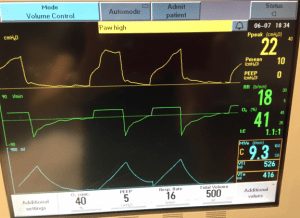 Because it was Saturday, I slept in until 6:45 A.M. I usually slept with my phone on the nightstand, but I had inadvertently left it in the family room the previous night. I retrieved the phone and noticed that I had missed a call from Scott & White at 5:14 A.M. In a panic, I called the hospital and Kelli, the charge nurse answered. She told me that at 3:00 A.M., they had had to intubate my father. Evidently, he went into hypercapneic
  Susie’s appearance in the waiting room was just one example of the random acts of kindness that my mother and I received during my father’s ordeal. I still marvel at our good fortune to have been blessed with such wonderful selfless friends. The neighbors seemed to instinctively know when we needed a meal, some cookies, or a hug. My friend Rhoda gave up a week of her time in Wisconsin to help when Mom had her stoke, and in three days, my cousin Chris would be arriving from Phoenix to help out for a week.
 Those hopes were dashed at 10:00 P.M. when I was awakened by a phone call from his PA, Rob. Rob told me that they thought that Dad needed closer monitoring because they have been unable to raise his temperature. He neglected to mention that he needed closer monitoring because they were also concerned about sepsis, but maybe he thought I knew. The phone call also woke Stan, who heard my side of the conversation. When I ended the call, I told him that I couldn’t see the point in waking my mother. She was still recovering from a stroke and this news would only ruin her much-needed sleep.
 Tale of Two Parents