He’s one tough guy

August 1, 2015. When Mom and I arrived at the hospital at 7:45 A.M., the respiratory therapist was administering oral care to Dad. Shortly after she left, the nephrology fellow stopped by to check Dad’s status to determine whether he would need dialysis. He noted that Dad’s feet were very swollen, which prompted Shannon, his nurse, to remove his leg massagers, which had been present since his readmittance.

sflowerI had never heard about procalcitonin (PCT) until today, when Dr. Jimenez mentioned that Dad’s current level was 48—down from 64. As soon as the doctor left the room, I whipped out my iPad and searched the internet for information about PCT. From what I read, a PCT level greater than 10 indicated a “high likelihood of severe sepsis or septic shock.” You didn’t have to be a PhD to know that a PCT level of 48 was pretty bad.

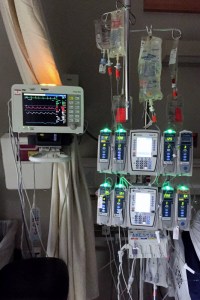
Dad’s blood pressure was all over the place, and Shannon had a tough time finding the sweet spot with Dad’s vasopressor dosages. A couple of times, his blood pressure skyrocketed, and then after the vasopressors were reduced, it would plummet. It seemed like the monitor would never quit alarming.

Stan left Houston earlier this morning, arriving at the hospital around 11:20 A.M. We spoke on the phone every night, but I always looked forward to seeing him arrive for his weekend visits.

Something about the sound of Dad’s breathing bothered me. To me, it sounded like he was breathing under water. We called for the nurse, who then called the respiratory therapist. It seemed that Dad’s trach tube had a leak. After a couple of visits, the respiratory therapist was able to patch it.

Dad seemed to be becoming slightly more responsive. During the past few days, Dad had been oblivious to anything that was done to him. Today, I stayed by his side during some of the daily procedures and held his hand, and he kept a vice grip on my hand during a couple of the visits from therapists. I couldn’t tell whether he was in pain or scared, but he was somewhat aware. He still wouldn’t follow verbal commands, but he was withdrawing to pain in his feet. I still cringed whenever they inflicted pain to test his responsiveness.

During one of his long naps, I reviewed the copious notes that I had been keeping about Dad’s hospital stay, and I composed a letter to Amiee McIlwain in Patient Relations about the nurses who had provided exemplary care for Dad. We had voiced several complaints during her visit with us and Mom and I wanted her to know that we weren’t just complainers. We knew good care givers when we saw them, and we were pleased to acknowledge them.

As I was preparing to leave for dinner, Dad’s blood pressure resumed its roller-coaster behavior. Shannon had little trouble controlling it, and I left at 4:30 P.M. when I felt that Dad was somewhat stable.

When Mom and I returned to the hospital after dinner, Dad was resting comfortably. He was still receiving a vasopressor, but the dosage was minimal. We met with Rebecca, Dad’s night nurse, and stayed until she ran through her initial assessment of him. She tried her best to perform a neurological assessment, but he was nonresponsive. After he had seemed somewhat responsive earlier in the day, seeing him this way was disheartening.

Mom and I went home shortly before 8:00 P.M. We were familiar with Rebecca and we felt that Dad would have a reasonably good night. My cell phone number was written on the dry-erase board in Dad’s room. Every night as I left the hospital, I hoped that they would have no reason to use it.

August 2. Mom and I arrived to the hospital earlier than normal for a Sunday, which was fortunate because Dr. Jimenez also stopped by early. Eavesdropping was my strategy for obtaining information. This morning, while standing on the threshold of Dad’s room, I overheard an interesting conversation in the hall between the good doctor and one of the residents. After the resident reviewed Dad’s lab work, particularly the PCT count, he offered a pretty poor prognosis for my father. The doctor told him that although Dad’s PCT was still very high, he had to look at the trend, and in the period of two days, my father’s PCT count had dropped from 64 to 38. Dr. Jimenez then said, “This guy is turning around.”

miraclesWhen Dr. Jimenez and his entourage entered the room, he said that Dad was “one tough guy.” He said something about an albumin transfusion (protein) to help with absorption, but I was too excited to remember everything that he said. Mom and I knew that Dad was still in the woods, but we felt that he had finally found the path out. Before the doctor left, he told Melissa, the nurse, that he wanted the bed raised to more of a sitting position. This day also marked the first day since my father’s return that we didn’t hear something about his grave prognosis.

Melissa tried lowering Dad’s already-low dosage of Levophed, but his blood pressure dropped sharply shortly after she left the room. After I called for her, she struggled to raise his blood pressure to a minimally-acceptable level. By the time that Stan arrived at 10:00 A.M., Dad was stable again, but his Levophed dosage was back to where it was when we had arrived.

While Mom and I were at home having lunch with Stan, Pastor Don stopped by the hospital to see Dad and say a prayer; we were now big on prayer. When Mom and I returned to the hospital at 1:30 P.M., Stan headed back to Houston. Shortly after we returned to the hospital, the respiratory therapist told us that they were going to try to move Dad from CPAP to BiPAP respiratory support. It seemed like there was suddenly a flurry of positive activity around Dad, and it felt good.

The downside of Dad’s improving mentation was his increased agitation. He repeatedly lifted his arms and pointed, and then looked concerned. We were pretty certain that he was hallucinating. Because he was unable to communicate, we couldn’t tell what he was seeing or thinking. We spoke with the nurse about his apparent hallucinations, and after consulting with the doctor, she increased his dosage of Fentanyl to help him sleep more. We didn’t like the idea of keeping him stoned, but we didn’t want him to decannulate himself or pull out his feeding tube.

When we returned at the hospital after dinner, we met Maggie, Dad’s night nurse. She was a high-energy woman, and I liked her immediately. She mentioned that she had helped Rebecca bathe Dad the previous night. Before we left, she stretched his arms and feet, something that I would try to remember to do for him in the days following.

Dad was still receiving a minimal dosage of Levophed, and his blood pressure and other vitals seemed pretty stable. He woke up a couple of times before we left and seemed to be seeing more hallucinations.

Maggie was assigned only one other patient, and we left at 8:00 P.M., feeling relatively positive that he would have a good night, unless he woke up to more hallucinations.
 

Some clinical improvements, but still unresponsive

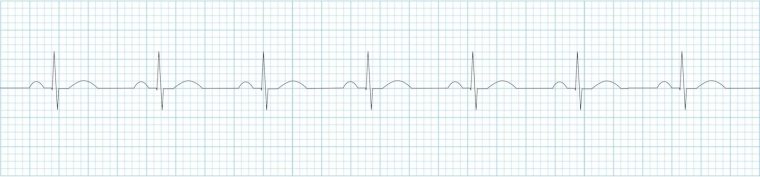
sinus-rhythm-stripJuly 26, 2015. Mom and I arrived at the hospital shortly after 8:00 A.M.; I looked at Dad, and then over to his IVs. Amazingly, Dad’s night nurse, Tyler, had been able to wean Dad down to one vasopressor. Dad’s day nurse, Kristina, also noted that he was down to one antibiotic. Unfortunately, his WBC count had ticked up to 21.2.  Dr. Pan, the nephrology resident, stopped by a few minutes after we arrived. He had reviewed Dad’s early morning lab results and recommended that they dialyze Dad again to remove more fluid, although they probably wouldn’t clean his blood.
Some of Dad’s other lab results looked a bit more promising. Although his poor liver was still in shock, his highly-elevated liver function had inched down slightly. The sparks of good news were tempered by Dad’s continued unresponsiveness.

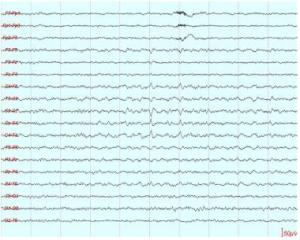
eeg_waveWhen Dr. White arrived, he acknowledged that while there had been some clinical improvement in my dad’s condition, Dad was still critically ill and his mental status was not improving. To ensure that Dad hadn’t suffered a stroke or a bleed, he planned to order a CT scan. Dr. White restated his concern about Dad’s toes and thought that he probably would lose at least one toe.

A few minutes after Dr. White and his residents left the room, Rob, a PA who had worked with Dad back in May, stopped by. He said that he had seen us in the waiting room the other day and thought that we looked familiar. After he realized who we were, he wanted to stop by and see how Dad was doing. We didn’t have great news, but so far, Dad had survived four days longer than the original prognosis.

Stan was in Temple for the weekend, and he arrived at the hospital at 10:15 A.M. to stay with Dad while Mom and I attended church. At the church, our friends were anxious to hear about Dad’s condition. One friend is a nurse practioner with the dialysis center and receives a daily schedule of dialysis patients in the Scott & White system. She was shocked when she saw Dad’s name on the Memorial list. My father wasn’t a patient of hers, so she couldn’t access the details about his transfer, but she knew that the transfer from the CCH to Memorial wasn’t good.

According to Stan, Dr. Issac, the nephrologist, stopped by right after we left for church and said that they would not dialyze Dad today. Dr. White wanted to further reduce Dad’s vasopressor therapy. The process of removing blood during dialysis lowers a patient’s blood pressure, which would have been counterproductive to the daily goal.

The tube feed, which had been stopped on July 22, was resumed today. The thought of the tube feed scared me, but Dad needed the nutrition, and this was the only way for him to get it. The rate was restarted at 20 ml/hour, which was considerably less than it had been when he aspirated on his tube feed four days earlier.

Stan said that Dad was transported to radiology at 11:40 A.M. for his CT scan. He was returned to his room shortly before Mom and I returned from church.

musical-notesWhile Mom, Stan, and I were at home for lunch, I decided I would try some music therapy with Dad.  KNCT, a local public radio station in central Texas, plays big band music on Sundays. Armed with a small radio and headphones, I hoped that having Dad listen to his favorite genre of music might spark some response from him. We returned to the hospital at 2:30 P.M., and I placed the headphones on Dad’s ears and turned on the radio. Maybe I’d seen too many movies, but I was disappointed when we didn’t detect any response from him. We also tried yelling at him, tickling him, and shaking his arms, but we still got no response.

Charris, his assigned resident, stopped by to talk with us about Dad’s apparent stupor. She showed us the CT scan results and the radiologist’s assessment. Everything seemed to be normal from a brain trauma point of view. She agreed that he was just about in a coma. She suggested that they request a consultation with a neurologist.

Around 5:00 P.M., a nurse entered the room and introduced herself as Melissa, Dad’s new nurse. Because the MICU had too many nurses for the number of patients, they had to send one home, so Melissa would be with Dad for the next two hours. Mom and I left around 5:15 P.M. to visit the next-door neighbors and share some of the bounty from my parents’ garden.

When Mom and I returned to the hospital at 7:00 P.M., Tyler was his nurse again and the other Tyler was the respiratory therapist. I probably shouldn’t have, but when Tyler said that he was doing something barbaric to see if Dad would withdraw from pain, I asked Tyler to stop hurting him.

Nurse Tyler’s goal was to further reduce Dad’s vasopressors overnight.  Tyler performed a pretty thorough assessment of Dad tonight while we were there, and then showed me how to use the music on Dad’s super expensive bed. I set up nature sounds, which later confused a nurse’s aide who stopped by to take Dad’s blood sugar. She thought that there were crickets in the room, which really isn’t too unusual for central Texas.

Mom gave Dad a goodnight kiss, and it looked like he kissed her too. We left the hospital for home around 8:30 P.M.

Before I went to bed, I emailed my cousin, David, who is a cardiovascular diseases fellow at Brigham and Women’s Hospital in Boston. I updated him about Dad’s condition and then asked about his thoughts pertaining to my father’s mentation. My question was way outside of his specialty, but I was hoping that he might be able to help me understand my father’s catatonic state.

Just. Want. To. Go. Home.

redCap2
Red caps rock!

July 12, 2015. Stan arrived at my parents’ home at 9:00 A.M. from Houston, and Mom and I left for the CCH shortly after his arrival. Before Mom and I left the CCH for church, the respiratory therapist stopped by and replaced Dad’s speaking valve with a red cap. Oh my gosh! It was almost like having no trach tube. He breathed normally and he sounded more like his usual self. Dad’s ability to remove his own secretions with the Yaunker would determine when they could decannulate him.  If Dad could not handle his secretions, the respiratory therapists would have to remove the red cap and suction him. While we were there, Dr. Smith stopped by and asked if Dad had been in the chair. I just hated knowing that our week with this doctor was about to end.

Stan visited with Dad at the CCH while Mom and I attended church, and then he stayed for another couple of hours while Dad sat in the chair. I was encouraged when Stan told me that Dad did most of the transfer from his bed to the chair, and once he was in the chair, his coughing stopped.

Later in that day, Cassie, the nurse, mentioned that Dr. Smith was considering switching Dad from intravenous to oral antibiotics. Among other things, the oral antibiotics were less harsh on the kidneys. Because Dad could not swallow pills, the oral antibiotics would be crushed and administered through his feeding tube.

keyFor the past few weeks, Mom and I had been unable to unlock the front door with the house key. Stan had sprayed graphite into the lock and that remedy had worked for a couple of weeks, but we were now back to square one. We didn’t have the time or inclination to fix it, so we just accessed the house from other doors. The front door lock was just an example of life’s little inconveniences that didn’t seem all that important at the time.

July 13. It was Monday, which meant that a new doctor started the week-long rotation, and Dad was scheduled for another 4-5 hours of dialysis. On the positive side, Dad was gaining less weight between dialysis sessions, which meant that they would remove less fluid from his blood. Today they removed only 1,497 ml, far less than the 4,000 ml or more removed only a week or so earlier. The nephrology personnel were cautiously optimistic that his kidneys might be perking up. What they actually said was that they “would watch him closely for a possible sign of recovery.”  Dad’s labs that day were a little contradictory. Although his creatinine levels had improved slightly, his WBC count had inched up. It was still well within the normal range, but this was the first uptick that we’d seen in the WBC count in a couple of weeks. Dr. Ciceri, the new doctor, mentioned that Dad seemed to be in good spirits and that he was very conversant. Perhaps I worried too much.

My parents live down the street from Bob Probe, an orthopedic surgeon with Baylor Scott & White, who was now chief of staff for Scott & White Clinic. This morning, while Dad was in dialysis, Mom and I visited with Dr. Probe and expressed some of our concerns about recent events. In particular, we wanted to tell him about my mother’s experiences at the hospital—specifically, her admittance to Scott & White Hospital as Trauma Patient Ohio. We also told him about my difficulty calling 911. Although he had no authority over the 911 system, he had many contacts who he said he would contact. We also shared some of the challenges that we had had with Dad’s care. In our experience with the hospital, we had learned that it was the patients’ responsibility to understand what was happening. We had seen firsthand that the doctors didn’t ensure that the patient could hear or understand what was being said. You’d have to pity the poor person who was admitted without a support system or advocate. As someone who is concerned about new-user experiences, I told him that to navigate the system, new patients and their families needed more information about resources, and perhaps the case managers could come around more often. From what Mom and I could surmise, the hospital personnel who filled this void were the chaplains, and some did it better than others. If the chaplains were the designated go-to resources, it would have been nice to know that on May 6. Dr. Probe said that he appreciated the perspective and the feedback. He took a lot of notes during our meeting, and Mom and I left the meeting under the impression that we would hear back from the good doctor. Spoiler alert: It’s been almost 14 months and we still haven’t heard from him, but hope springs eternal. He might have bigger fish to fry. Since our meeting, Dr. Probe was promoted to Chief Medical Officer of the Baylor Scott & White system.

Following our visit with Dr. Probe, Mom and I went home for lunch.  On my way back to Houston, I stopped by the hospital to say good-bye to Dad. He was dozing when I arrived, but woke easily and was pretty talkative. He looked pretty alert, and seemed to be feeling better than he had on most dialysis days. Mom arrived shortly before I left at 2:00 P.M. Soon after I left, Dad said that he was tired and had Mom leave for the day. When he was tired, he could fall asleep in midsentence. Later that evening, Mom tended to the garden and also gave it a good soaking. After all the rain just two months earlier, we were now suffering from a drought. Where rain was concerned, it was either feast or famine in central Texas.

July 14. Dad was alert and in good spirits when Dr. Ciceri visited him during morning rounds. Dad’s vitals were good, and it seemed like it was a perfect day to conduct the MBSS. The swallow study must be administered in the radiology department at Scott & White Memorial. Dad was ferried to the hospital in an ambulance and the test was administered by Holly, his speech therapist during his stay at Memorial. Unfortunately, the test that we had yearned for yielded some disappointing results. In short, he was diagnosed as a high risk for aspiration. They tested him with thin liquids, nectar and honey-thickened liquids, puree, and pudding. Even when swallowing with a chin tuck, he was not successfully swallowing anything but the pudding. Fortunately, Adan planned to continue working with him. The prospect of Dad not being able to eat again was unthinkable.

Dad was pretty tired by the time he returned from Memorial to his room at the CCH. Shortly after he arrived, Jennifer, the physical therapist, arrived for his session. He told her that he felt as though he had already been moving around all morning. Physical therapists tend to ignore such protests from patients, and she proceeded with therapy. Although Dad had some difficulty standing from a chair and the side of the bed, he was able to complete all the repetitions of his exercises and walked a few steps. He did much better when he “walked” in the wheelchair. When she was finished with their session, Jennifer left him in the chair, where he stayed for an hour. Mom was encouraged by all the therapy that he was receiving.

Mom stayed until 5:45 P.M. and was still there when our church friends, Kris and Sue, stopped by after work. They had stopped by once before, but didn’t know the password. I don’t remember ever being told about a password, and unless you visited after 8:00 P.M., the doors opened automatically. Sometimes this place was just weird.

Today seemed like a pretty good day for Dad. I would have felt better about it I hadn’t been so worried about his white blood cell count.

homeJuly 15. During dialysis, Dad told the nephrologist that he wanted to go home. The doctor told him that to be declared dialysis dependent (with End Stage Renal Disease), he had to be hospitalized and on dialysis for a total of 12 weeks. Although Mom and I had heard this news a few days ago, it was new news for Dad and prompted him to start asking questions about billing. The doctor contacted Marty Edens, the social worker, who dropped by to answer his questions. Marty couldn’t answer his specific billing questions, but she was familiar with Medicare and some of Dad’s situation. Dad told Marty that he “can’t imagine being here for six more weeks.” He repeatedly told her that he “made a wrong decision two months ago that put him where he was now.” I was glad that I missed this heartbreaking conversation and the follow-up discussion that Marty had with my parents later that day. My mother then requested a plan for his discharge. Marty told them that she could not give them a time frame regarding recovery, other than that if he continued to need dialysis, he would remain at the CCH until at least August 26, or until the doctors said he didn’t need dialysis, or they declared him to be dialysis dependent.

My exasperated parents then asked her when Adan would be able to come by. They both found some comfort and sense of progress in therapy sessions, especially speech therapy sessions with Adan. Adan stop by, had Dad eat some ice chips, and said that he would stop by tomorrow with some thickened soup for Dad to try.

Jennifer then arrived for their physical therapy session, but Dad was too tired after dialysis to exercise. Before she left, Jennifer said that Dad was now ready for sessions with occupational therapy.  They had withheld occupational therapy until he was a little stronger and no longer dependent on oxygen. The occupational therapist judged his prognosis to be fair, based on what he had read in Dad’s chart. His prognosis for just about everything was fair. I was getting tired of this “F” word.

Although Dad’s lab work and his vitals were holding tight, Dr. Ciceri thought that Dad might be somewhat confused, which can be a side-effect of prolonged hospitalization. On a more positive note, during Dad’s dialysis session, only 1,194 ml of fluid was removed, which was considerably less than earlier amounts and left him less fatigued. With Dad’s extra energy, he continually told nurses, doctors, and other providers that he “just wanted to go home.” Up until 71 days ago, my parents had been the poster adults for healthy seniors. They were active, engaged, and in control of their lives. Their current situation left them frustrated and just barely able to tolerate their current situation.


Have we been here forever yet?

It was May 29, 2015–Dad’s 5th day back in the ICU and his 18th day in the hospital. The other day they simply removed excess fluid; today, with the return of the dialysis machine they also cleaned the blood. What they didn’t tell us on either day was that his creatinine levels were about 4x above normal, which would have been disturbing to know.

Before Dad’s admission to the hospital, I never paid attention to creatinine levels in my Complete Blood Count (CBC) results for my own blood tests, but the creatinine and blood urea nitrogen (BUN) levels turn out to be pretty important markers for the kidneys. When the kidneys are working, they eliminate fluid and also clean the blood. When they aren’t working, fluid can accumulate around your heart and in your extremities, and creatinine accumulates in your blood. Sometimes the kidneys perform one function well but fail on the other. They need to perform both functions well to avoid dialysis. According to Dad’s chart, his system was also acidosis, a condition that can occur when your kidneys and lungs can’t keep your body’s pH in balance. Respiratory acidosis occurs when too much CO2 builds up in the body. Dad was so lucky; he was seen by both the nephrologists the pulmonologists. We were starting to see quite the parade of specialists.

Holly, another of the hospital’s speech pathologists, administered another bedside swallow test. Although he failed it again, Dad did show signs of improvement. For Holly to get an accurate assessment of his swallowing, Dad needed a modified barium swallow study (MBSS). Along with everything else that was scheduled for Monday, June 1, we hoped that he could have that test, too. He was getting tired of chips and sips.

After dinner, I went back to the hospital to visit with Dad and meet with his night nurse. Nighttime was scary for me and my mother, especially as my father started drifting toward a delirious state. I couldn’t relax until I knew who the night nurse was and had had a chance to talk with him or her. Dad’s needs were pretty simple: he needed to go to sleep with his suction tube in his right hand, the call button in his left hand, and his feet covered.

Meanwhile, I felt like I was starting to fall behind at work. Even with getting up at 3:30 A.M. and working between trips to the hospital and on weekends, I had a difficult time working 40 hours. Once again this week I had to take another 8 hours of paid time off. My manager wasn’t complaining about my unorthodox working hours, but I was starting to feel like I was hiking through peanut butter.

May 30 was Saturday. Stan was in Temple and he spent a significant portion of the weekend mowing my parents’ acre lot. He also handled all of the chores that we were too tired to tackle during the week. Then while Stan visited with Dad, Mom and I acquired a prepaid mobile phone for my father. He had decided that he wanted to be able to call us, although I had serious doubts that he would. After entering all of the important phone numbers (like mine, Mom’s, and Stan’s), I showed him how to use it.

It was during this time that the Infectious Diseases residents and doctors started visiting Dad’s room. They all said the same thing; because of his pneumonia and multiple infections, he’d be on antibiotics for an extended period—maybe 6 to 8 weeks.

After dinner, Stan and I returned to the hospital to run through the evening drill with Dad and the night nurse. When I removed Dad’s hearing aids, I noticed that one was missing. We looked through his bedding, to no avail. Fortunately, on May 31, when Mom and I arrived at the hospital, the nurse told us that the night nurse had found the missing hearing aid.

Dad had received quite a few cards, which Mom had brought to the hospital to show him. In addition to the cards that he received from their long-time friends, he had been the Member of the Week at their church, which significantly increased the number of cards that he received.

heart
Code for “heart valve replacement”

Every morning the nurse or the doctor asked Dad a series of questions: What’s your name, when were you born, do you know where you are, why you are here, and so on. He hated the daily drill, and as one day drifted into another, it became more difficult for him to remember the details. During the previous day Dad had had me create a cheat sheet of sorts on the dry erase board in his room. His day nurse, Sara, discovered the note and erased the board.

This week’s doctor was Dr. White. I had met him a couple weeks earlier when my mother was in the hospital. He was also her doctor in the Medical Intensive Care Unit (MICU) during her brief stay. Although I sometimes kidded him about his name, he was no relation to one of the hospital’s founders. Dr. White told me that they would move Dad to a different room later in the day. Since the tornadoes earlier in the month, he had been in an interior room. The doctors thought that he was becoming disoriented and that having a window room might help him. The doctor also told me that Dad would be moving back to the fourth floor the next day. The doctors suspected that Dad had empyema of the chest. To address it, Dr. White said that they would insert a couple of catheters in his chest to drain the pus and other infected fluids. Evidently, the accumulation of fluid was too much for the antibiotics to handle. He also mentioned that at the end of his hospital stay, Dad would be transferred to a long-term facility that could handle his various needs– provide strength building, and dialysis if necessary. I guess that they had decided he was improving; his WBC count was down to 22,000—only twice what is normal.

Dad’s dialysis ended at 4:30 P.M., and he and Mom watched a golf tournament on the television. This might have been the first television show that he had watched since his hospital stay started 20 days ago.

Keeping with our good day, bad day cadence, Mom and I thought that today had been a good day.

The first homecoming

May 18, 2015, was the day that we had been thinking my dad would be discharged from the hospital. Instead, I spent a significant portion of that morning speaking with Dad’s caregivers about his deteriorating condition. In short, he had bacterial pneumonia and severe sepsis with acute organ dysfunction. His medical team was administering several antibiotics, but there was no way in which his cocktail of meds could take care of the amount of infected fluid (pus) in his chest. The doctors recommended that they reopen his chest and wash out the infection. Of course there were some risks, but the alternative was dire. What I didn’t know until May 2016 was that he was also at risk for acute kidney injury.

015311b4f046096e6baca1e8f21e99a56ab3538076Dad’s cardiologist stopped by and performed a Transesophageal Echocardiography (TEE). The TEE was necessary to ensure that Dad’s new bovine heart valve wasn’t harboring any infection. I hadn’t met her before and she surprised me when she said, “I didn’t want him to have this procedure. He should be home working in his garden.”  My parents never heard that she had had reservations about the more invasive procedure. Lesson learned: regardless of the surgeon’s reputation, have the physician who made the original surgical referral (in this case, the cardiologist) review the surgeon’s recommendation.

His washout surgery was scheduled for 6:00 P.M. that night, but the surgeon’s earlier procedures had run long, so he opted to wait until the next morning. Although it was a simple procedure, he didn’t want to perform surgery with only a skeleton staff on hand should something go wrong.

On May 19, Rhoda and I arrived early to the hospital. My father’s surgery started at 8:00 A.M., and I received a call shortly after 9:00 A.M. informing me that the surgery was finished. Around lunchtime, we received our first visit from Pastor Don, a pastor from my parents’ church. Before he saw my father, Don visited with my mother for a few minutes before her discharge.

During Mom’s discharge, I learned that she could not be alone or drive for at least 30 days, at which time she would undergo a neurological assessment. I was glad that she was home, although some of our conversations were pretty unsettling. She often could not remember what we asked her or what we or she had just said. To say the least, I was cautiously optimistic about her recovery.

On Wednesday, May 20, my mother and I returned to the hospital to see my father.  Rhoda had postponed a trip to Wisconsin to help me, but now she really needed to leave. She stopped by the hospital on her way home. Although my father’s breathing tube had been removed the previous day, speaking was still a little difficult. He managed to call her “a blessing,” when he said good-bye.

Within hours after Rhoda’s departure, Dad was transferred from CTICU back to the fourth floor. We were pleased that he was well enough to transfer, but he wasn’t there very long before it became very apparent that he was extremely disoriented. The fourth-floor charge nurse was more than a little annoyed that he had to assign an aide to my father’s room to ensure that he wouldn’t try to get out of bed or remove some vital tube.

I had had the foresight to take my work computer with me when I hurried to Temple five days earlier. I had been able to do my job in the intervening days even though I was away from my office. Now, however, I needed to return to my home and my office for a couple of days. I also needed to see my physical therapist—I had had surgery myself in March and was still undergoing physical therapy. Lucky for me, my dear husband agreed to come to Temple to relieve me for a couple days. He and I formulated a plan of coverage for Mom until my father was discharged.

On May 21, I worked from my parents’ home until about 8:00 A.M. My mother’s friend Marilyn stopped by to stay with Mom until Stan arrived. Stan and I met in Cameron, Texas, to exchange keys and information. I arrived at my workplace shortly after noon and felt a little guilty for leaving my mother and Stan to contend with my father’s delirium. My sense of guilt was short-lived, however. After being home for an hour or so, I noticed that my house was infested with fleas. Our cats never go outside, but we learned that this year was especially bad for fleas. We frequently employed a pet sitter and assumed that some fleas had hitched a ride with her. At this point Stan and I laughed about this latest situation, wondering what else could go wrong. After flea traps and expensive oral medication for the cats, we finally vanquished the fleas.

juggling_ballsDuring my five days in Temple I had been living in a sort of surreal and parallel universe. When I arrived on May 15, I had assumed that my father’s discharge was imminent. My big unknown was about what was in store for my mother. I had not anticipated that my mother would be discharged first. Now, in addition to figuring out how to care for my recently independent and active parents, I had to start thinking about my job and living away from my husband. It was a daunting juggling act—one I hoped would be over soon.