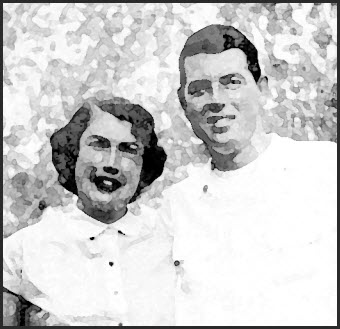
After hearing from my parents’ neighbor that he had called 9-1-1, I paced the floor for 30 minutes. The hospital was just a short distance from my parent’s house, so I should have already heard something. Maybe the ambulance didn’t show up. I called their house, but there was no answer. I called our friend again and he asked me for an update. I told him that I was calling him for an update. He said that she should be at the hospital.
At 7:51 P.M. I called Scott & White Emergency Department (ED) and asked for the status of Mary Locke. I was informed that they had no patient by that name. I hung up and phoned our friend again. He said that he would call a neighbor and get back to me. Evidently a couple of ambulances and a Little River-Academy fire truck had pulled up to my parents’ house, which had attracted the attention of some neighbors. The next-door neighbors saw my mother escorted out of the house, placed on a gurney, and put in the ambulance.
 With this new information, I called Scott & White ED again and asked about the status of my mother. Again they told me that they had no such patient. I informed her that neighbors witnessed a Scott & White ambulance drive off with my mother on board. Because my parents’ house was less than five miles from the hospital, I assumed that it was her destination. It was then that she asked me about her symptoms, and as I started to explain, she said, “We have a Jane…” I interrupted her and asked if she was saying that my mother was a Jane Doe. She said that my mother had not been able to identify herself and she was admitted as Trauma Patient Ohio.
I left the house for Temple just a couple of minutes later, but I was fuming. Somewhere between the 9-1-1 call and the hospital, identifying information about my mother was lost. What’s worse is that even though she was having a stroke, she carried her purse with her when she left the house. In it was her wallet with her Medicare card, Texas driver’s license, and Scott & White Senior Care card. The ambulance drivers and the ED staff didn’t check her purse for any identification. Had they done so, they would have been able to access her medical history and medications.I questioned a hospital administrator a few months later about this oversight and he surmised that privacy might have been the reason for not checking her purse. When I asked if they checked for IDs of unconscious victims, he shrugged.
I left home at 8:45 P.M. After about 30 minutes I decided that I should call the hospital and give them my contact information, which the clerk gratefully accepted. As I approached Chappell Hill, I received a call from the hospital. My mother was being admitted, and Drew, her nurse gave me an update on her condition and also told me where I could find her when I reached the hospital. I also received a call from the ED doctor who had treated her, and the prognosis was depressing. It seemed that my mother had suffered a stroke in the part of the brain that controls speech. You’d have to know my mother to know how devastating this news was to me. She’s one of the most articulate people I’ve ever known. Among other things, she’s been a politician, a political activist, and a lobbyist. I couldn’t believe that God would deprive her the ability to communicate. However, my mother can write. When I asked about writing, I was told that all forms of communication are controlled by the affected area. With this depressing news, I continued driving. I still had 100 miles to go.
I finally arrived at Scott & White at 11:45 P.M. After checking in with the guard, I made my way to Medical ICU in the south tower. I found my mother and the nurse in room 249. Drew asked that I not wake her. She had been very agitated and she was heavily sedated and finally sleeping. He said that I could sleep on the couch in her room if I wanted. I planned to take him up on his offer, but I thought that I should check in on my father first, who was in the north tower.
It was now midnight and I was praying that my father was asleep. How do you tell someone who just had open-heart surgery that his wife just had a stroke? As luck would have it, the light was on in his room and he was sitting up in bed. I don’t remember what we said. All I remember is that when I told him that I was going to sleep in the hospital, he told me that I needed to go to his house to ensure that the house was secure.
Technically, it was now Saturday, May 16, both of my parents were in the hospital, and I was 160 miles from my husband. It was one of the few times in my life that I wished I wasn’t an only child.
 Tale of Two Parents